Why Ethen Keeps Research Separate From Product Claims
Ethen keeps research and product claims apart because they rest on different kinds of evidence, and readers make different decisions based on them. A product claim says what an Ethen product does today, and should be backed by product evidence. A research claim says what Ethen Research Lab is studying, proposing or has measured, and carries an explicit evidence status — often "proposal" or "protocol; not yet run". When the two blur, research gets read as a shipped feature, and product statements borrow credibility from papers that never tested them. So we publish in three lanes — the Ethen Blog, Ethen Research Lab and company writing — and we follow a few simple rules whenever one lane draws on another.
Ethen keeps research and product claims apart because they rest on different kinds of evidence, and readers make different decisions based on them. A product claim says what an Ethen product does today, and should be backed by product evidence. A research claim says what Ethen Research Lab is studying, proposing or has measured, and carries an explicit evidence status — often "proposal" or "protocol; not yet run". When the two blur, research gets read as a shipped feature, and product statements borrow credibility from papers that never tested them. So we publish in three lanes — the Ethen Blog, Ethen Research Lab and company writing — and we follow a few simple rules whenever one lane draws on another.
Key takeaways
- The Blog explains what Ethen builds. Ethen Research Lab records what Ethen is learning. Company writing explains what Ethen is and why it exists.
- Different lanes, different evidence. Product articles rely on implemented behavior and state their test limits; research publications declare an evidence class; company writing is philosophy tied to public facts.
- Labels travel. When a product article cites research, it links the canonical paper and repeats its evidence status.
- "Proposed" never becomes "does". A research proposal is not cited as evidence that a product works.
- Readers can use the lanes. Asking "which lane is this claim in?" is a fast way to judge any AI vendor's statement, including ours.
What is the difference between a research claim and a product claim?
A product claim describes what a product does: a behavior someone can observe, test, or rely on. "Ethen's AI Gateway removes ineligible models before ranking any of them" is a product claim. Its evidence is the implemented mechanism, described in How Ethen Gateway Chooses an Eligible Model together with what its tests did and did not cover.
A research claim describes knowledge: an argument, a proposed mechanism, a planned experiment, or a measured result. "A learned router should be promoted only if it beats carefully written rules" is a research claim. It comes from the Ethen Research Lab survey Why Learned AI Model Routing Must Beat Good Rules, which is an external literature survey with no Ethen measurements.
The two claims are related — both are about routing — but they answer different questions. One tells you what the Gateway does. The other tells you what standard a future routing change should meet. Treating the survey as evidence about the Gateway, or the Gateway as evidence for the survey's position, would be a mistake in both directions.
Why does mixing them cause problems?
Mixing research and product claims causes three distinct failures, and each one harms a different reader.
Research read as capability. A paper that proposes a mechanism can easily be summarized as "the company has built this". A buyer who believes that summary will expect behavior the product does not have. This is the most common failure in AI communication, because research papers are written to be persuasive about ideas, and persuasive ideas sound like features when quoted out of context.
Products borrowing research credibility. The opposite failure is quieter. A product page that cites a rigorous-looking paper can imply that the paper validated the product. Unless the paper actually measured the product — on a stated build, with a published method — the citation lends authority the evidence does not support.
Research bent by product pressure. When research exists to support marketing, its questions drift toward ones with flattering answers, its baselines get weaker, and negative results stop being published. Keeping research in its own lane, with its own editorial standard, protects its ability to reach inconvenient conclusions.
Risk-management guidance for AI treats accountability and transparency as characteristics of trustworthy systems, alongside validity and reliability (NIST AI RMF 1.0). Being transparent about which of our statements are evidence about our products, and which are research, is part of meeting that standard rather than an editorial nicety.
What are the three lanes?
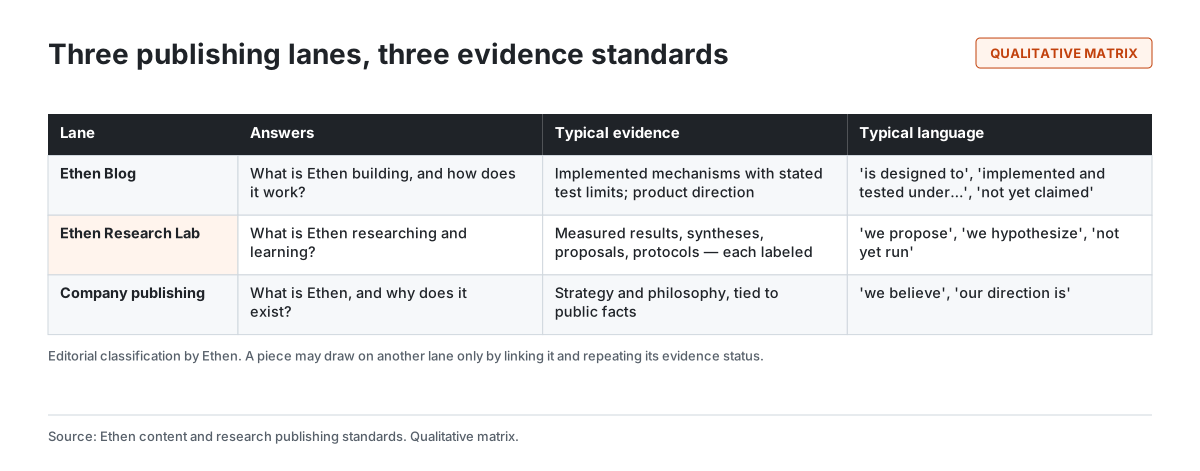
We publish in three lanes, each with one job.
The Ethen Blog explains what Ethen is building, how it works and why it was designed that way. Its engineering posts describe implemented mechanisms — how a job survives a crash, how a voice session starts, how a model is selected — and they state the scope of the evidence plainly. A sentence such as "the inspected code shows X; it does not show that X has been released" is typical. Product posts describe direction as direction.
Ethen Research Lab records what Ethen is researching and learning. Every publication declares its type (position paper, proposal, protocol, benchmark design, system card and so on) and its evidence class. The first library of 40 papers contains no new measured Ethen results, and says so. Why we publish research this way is explained in Why Ethen Research Lab Publishes Its Work in Public.
Company writing explains what Ethen is and why it exists: product philosophy, strategy and direction. It is opinion and intent, and it should be tied to public facts rather than to unpublished plans.
What rules keep the lanes apart?
Five rules do most of the work.
1. Research is never cited as proof that a product works
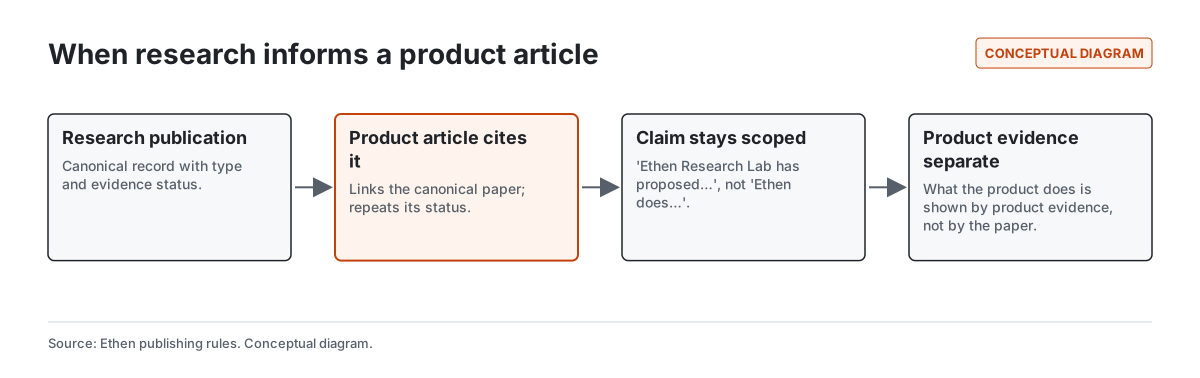
If an Ethen product article mentions a research paper, it is to explain an idea, a definition, or the reasoning behind a design — not to prove the product's behavior. Product behavior is shown by product evidence.
2. Citations repeat the evidence status
When a Blog article draws on research, it links the canonical Research Lab publication and repeats its status in plain words: "a research proposal that has not been tested", "a benchmark design that has not been run", "a research synthesis with no measured Ethen results". The label is part of the claim, not a footnote to it.
3. Language matches the evidence
We use different verbs for different evidence. For a proposal: "Ethen Research Lab has proposed…". For a protocol: "Ethen Research Lab has specified an experiment to test…". For system evidence: "In a system-card evaluation of a pinned build…". For a product mechanism: "In Ethen's implementation, … — tested under the conditions the post describes". We avoid "Ethen solves", "Ethen guarantees" and "proven" unless the evidence supports exactly that, which is rare.
4. "May inform" is not "now does"
Research can shape products. When we say a result "may inform future Ethen routing work", we mean exactly that. We do not write "Ethen now solves this problem" unless the behavior has been implemented and verified in the product.
5. Products appear in research only as context
In research publications, products appear as experimental contexts, not as advertisements. A paper may say that a code environment is a natural setting for a study; it will not say the study shows the product is good.
What does this look like on the same topic?
The clearest test of the rules is a topic covered in both lanes. Three examples from our own publishing show how the lanes coexist.
Unknown outcomes. When an AI agent's action times out, the outcome may be unknown: the action might have happened even though no confirmation arrived. The Blog post When an Agent Action's Outcome Is Unknown describes how Ethen's mission system records the outcome as unknown and keeps it open until evidence resolves it, and it states that live provider integrations were outside the tested scope. The research note Unknown Effects in Autonomous AI Systems argues the general case — reconcile before retrying, tie retry keys to intent — from distributed-systems practice. It is a research synthesis with no Ethen measurements. Each piece is accurate within its lane, and neither borrows the other's evidence.
Completion. The Blog describes how Ethen's mission system requires independent evidence before a mission can complete. The research proposal Commitment Graphs defines "false completion" and proposes an experiment to test whether tracking obligations explicitly reduces it. The product mechanism is not evidence that the research hypothesis is true, and the hypothesis is not evidence that the product prevents false completion everywhere.
Routing. The Gateway's eligibility-first selection is a product mechanism. Faros as an "execution-configuration policy" is a research position. Learned routing is a research question whose protocol has not been run. A reader who sees "Faros" in both a product context and a research context should check which lane they are in before drawing a conclusion.
How can readers use the lanes?
Readers can turn the lanes into a habit: before acting on any claim, ask which lane it belongs to and what evidence that lane requires.
- For a product claim, ask what behavior is claimed, under what conditions it was tested, and what the source says it does not show. Good product writing answers all three.
- For a research claim, find the evidence status first. A proposal or protocol tells you what someone intends to test, not what they found.
- For a company claim, treat it as direction and philosophy, and look for the public facts it rests on.
This works for any AI vendor, including Ethen. If a sentence mixes lanes — "our research shows our product is reliable" — ask for the specific evidence behind each half. Model documentation practices such as model cards exist for the same reason: to keep intended use, evaluation conditions and limitations attached to the system they describe (Mitchell et al., 2018).
How do the lanes handle change over time?
Each lane changes in a different way, and keeping them separate makes those changes easier to follow.
Product claims expire. A product mechanism described in an engineering post is true of the code it describes, on the date it describes it. Products change, so product articles carry a freshness class and a review window. Historical posts — such as a dated architecture map or a release write-up — are not silently rewritten; they receive update notes so that readers can see what was true then and what changed since.
Research labels change only when evidence arrives. A protocol does not become a result because time passes or because a related product ships. Its evidence class changes when the study is run and the result is published, including when the result is negative. If a later study contradicts an earlier paper, the earlier paper stays in the archive with a note, rather than disappearing.
Company direction is revisable. Strategy articles describe what we believe and where we are heading. When direction changes, we say so in a new piece rather than editing old ones to look prescient.
The common thread is that a reader should always be able to tell what was claimed, when, and on what evidence. Lanes make that possible because each lane has its own rules for what counts as an update and what counts as a correction.
Why this matters for search and AI assistants
More and more readers meet our content through search snippets and AI-generated answers rather than full pages. Summarization tends to drop qualifiers: "a research proposal suggests that X could reduce Y" becomes "X reduces Y". Our defense is to put the evidence status into the sentence itself, not only into a badge or footer, so that it survives extraction. That is why our product articles say "Ethen Research Lab has proposed" in full, and why our research pages state their evidence class in the first paragraph. If an AI assistant quotes us accurately, the label should come with the quote.
Tradeoffs
Keeping lanes separate has real costs. Product copy becomes less exciting when it refuses to borrow research's ambition. Research reads as more tentative than a polished whitepaper. Readers sometimes find the labels repetitive. And some topics appear twice — once as a mechanism, once as research — which requires discipline to keep the two in sync without merging them.
We accept those costs because the alternative is worse for the people who rely on what we publish. A buyer who discovers that a "feature" was a research proposal stops trusting the product page. A researcher who discovers that a "study" was marketing stops trusting the lab. Separation is how both stay credible.
Frequently asked questions
Is Ethen Research Lab research used in Ethen products? Research can inform product direction, vocabulary and test design. When it does, product articles say so and link the paper with its evidence status. Research publications themselves do not claim product behavior.
Why does an Ethen product article link to a paper that says it has not been tested? To explain an idea or a definition, not to prove the product. The article repeats the paper's status so the link cannot be read as evidence.
Where do company strategy articles fit? They explain why Ethen exists and what we are building toward. They are statements of direction and belief, grounded in public facts, and they should not introduce unpublished plans or metrics.
Does this mean Ethen products have no evidence? No. Product evidence lives in product and engineering writing, release records and product pages, each with its stated scope. The point is to keep that evidence and research evidence from standing in for each other.
Related reading
- Why Ethen Research Lab Publishes Its Work in Public
- How to Explore Ethen Research Lab
- Agent Verification and Evaluation — where product mechanisms and research appear side by side, labeled.
- Ethen Research Lab archive
References
- National Institute of Standards and Technology (2023). Artificial Intelligence Risk Management Framework (AI RMF 1.0), NIST AI 100-1. https://doi.org/10.6028/NIST.AI.100-1
- Mitchell, M. et al. (2018). Model Cards for Model Reporting. arXiv:1810.03993. https://arxiv.org/abs/1810.03993
- Ethen Blog (2026). How Ethen Gateway Chooses an Eligible Model. https://upcube.ai/blog/how-ethen-gateway-chooses-an-eligible-model
- Ethen Blog (2026). When an Agent Action's Outcome Is Unknown. https://upcube.ai/blog/when-an-agent-actions-outcome-is-unknown
- Ethen Research Lab (2026). Why Learned AI Model Routing Must Beat Good Rules. External literature survey. https://upcube.ai/resources/research/learned-routing-vs-rules
- Ethen Research Lab (2026). Unknown Effects in Autonomous AI Systems: Why Timeouts Are Not Permission to Retry. Research note; research synthesis. https://upcube.ai/resources/research/unknown-effects