What Makes an AI Model Useful Beyond Benchmarks
The gap between AI benchmarks and real-world performance comes from what benchmarks leave out. A typical benchmark score measures accuracy on a fixed, public set of tasks, under one method, often from a single attempt, without cost or speed. Real work depends on much more: whether the model fits your inputs, outputs and tools; whether it succeeds every time rather than once; whether it is fast enough to work with; whether it actually uses the long context it accepts; what each good result costs; whether its behavior stays stable; whether it stops honestly when it cannot do something; how it handles instructions hidden in content; and whether its terms and deployment options fit your data. Benchmarks are a useful starting point. Usefulness is decided by these other dimensions, most of which you can test cheaply on your own work.
The gap between AI benchmarks and real-world performance comes from what benchmarks leave out. A typical benchmark score measures accuracy on a fixed, public set of tasks, under one method, often from a single attempt, without cost or speed. Real work depends on much more: whether the model fits your inputs, outputs and tools; whether it succeeds every time rather than once; whether it is fast enough to work with; whether it actually uses the long context it accepts; what each good result costs; whether its behavior stays stable; whether it stops honestly when it cannot do something; how it handles instructions hidden in content; and whether its terms and deployment options fit your data. Benchmarks are a useful starting point. Usefulness is decided by these other dimensions, most of which you can test cheaply on your own work.
Key takeaways
- Benchmarks answer a narrow question. Accuracy on fixed public tasks, under one method, on one date.
- Reliability is not accuracy. A model that is right once in three tries is not ready for unattended work.
- Accepting long input is not using it. Effective context is often shorter than the advertised window.
- Cost per good result beats price per token. Retries and corrections are part of the price.
- Honest stopping is a capability. A model that guesses when it should stop is less useful than one that says it can't.
Why do benchmark leaders sometimes disappoint?
Benchmark leaders sometimes disappoint because a benchmark is a specific test, and real work is a different test. Four limits explain most of the gap.
Scope. A benchmark measures the skill it was designed for. A reasoning benchmark says little about extraction from scanned documents; a coding benchmark says little about customer email. Ethen's own guide How to Read an AI Model Comparison starts there: find the question a comparison can actually answer before reading any number.
Contamination. Public test sets can leak into training data, inflating scores without real capability gains. A carefully matched replacement for a widely used math benchmark revealed accuracy drops for several model families, with evidence of overfitting (Zhang et al., 2024).
Validity. Benchmarks themselves can be flawed. An audit of agentic benchmarks found task-setup and grading problems — insufficient tests, and in one case empty responses counted as successes — that could misstate measured performance by up to 100% in relative terms (Zhu et al., 2025).
What is left out. Most benchmark tables report accuracy and nothing else. Research on agent evaluation has argued that focusing on accuracy without cost has encouraged needlessly complex and expensive systems and led to mistaken conclusions about where gains come from (Kapoor et al., 2024).
None of this makes benchmarks useless. It makes them context, not verdicts.
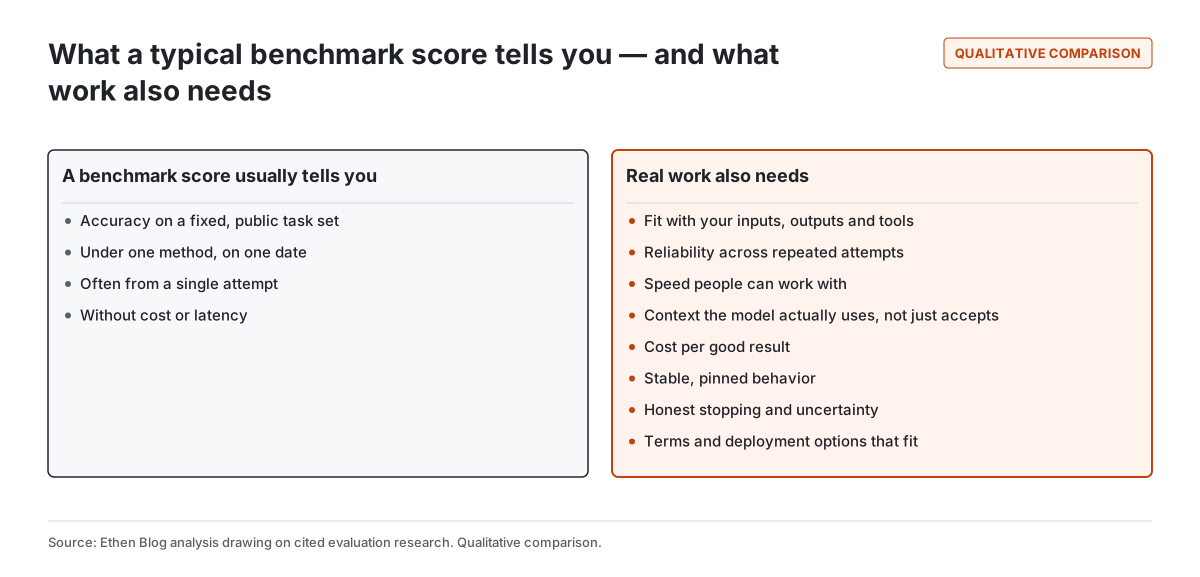
What decides whether a model is useful?
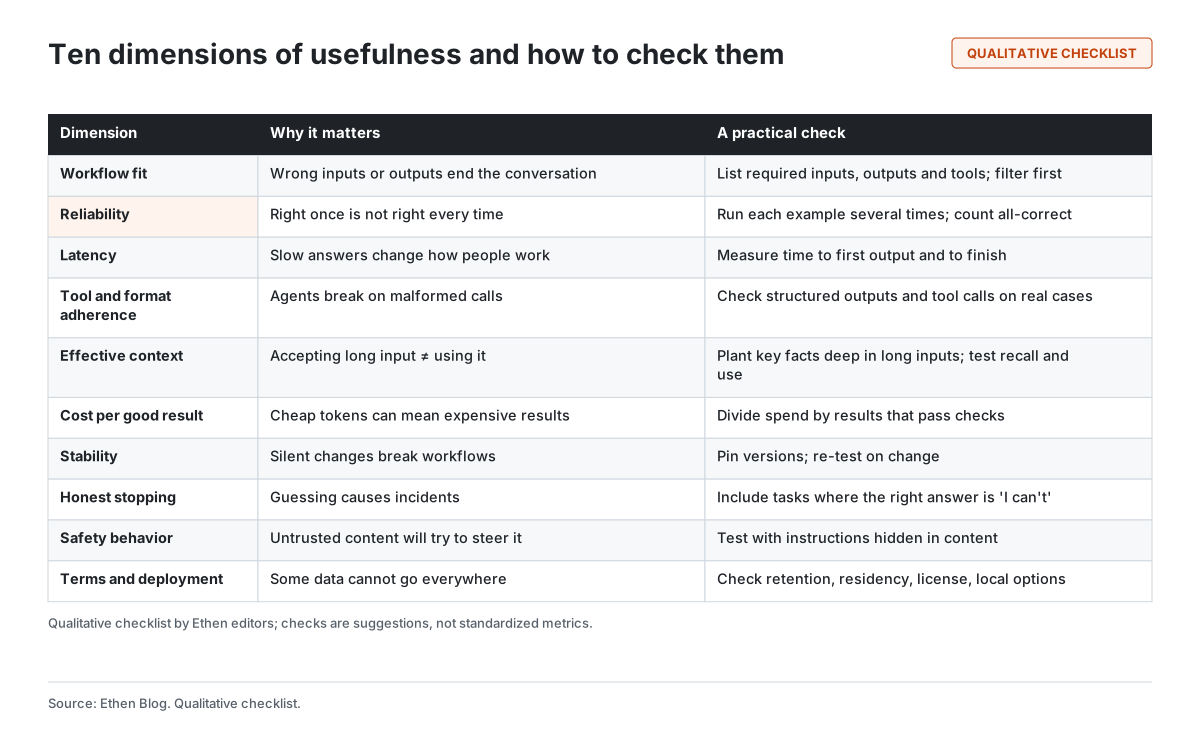
Ten dimensions decide whether a model is useful for a particular job. Each has a practical check.
1. Workflow fit
A model is useless for a job it cannot accept or produce: the wrong input types, no structured output, no tool support, too small a context limit, or no option to run where your data must stay. Fit is a filter, not a score. Ethen's AI Gateway applies it before anything else, removing models that cannot serve a request before ranking the rest; see How Ethen Gateway Chooses an Eligible Model.
2. Reliability across attempts
Generative models are not deterministic. A model can produce an excellent answer on one attempt and a wrong one on the next. For work that runs without a person checking each output, what matters is the probability of being right every time, not on average. Agent evaluation research introduced a measure for exactly this — the probability of succeeding on all of several independent attempts — precisely because averages hide inconsistency (Yao et al., 2024). Check: run each test example several times and count the ones that were right on every run.
3. Latency
Speed changes how people work. Time to first output decides whether a conversation feels responsive; total time decides whether a task fits into a workflow. A model that is slightly more accurate and three times slower may be the wrong choice for interactive work and the right one for overnight jobs. Check: measure both, under realistic load.
4. Tool use and format adherence
Agents and integrations depend on models calling tools correctly and returning outputs in required formats. A model that occasionally emits malformed tool calls or drifts from a schema can break an otherwise reliable pipeline. Check: run real tool-using tasks and count malformed or missing calls, not just final answers.
5. Effective context
A model's advertised context window is how much it can accept, not how much it uses well. Models tend to use information at the beginning and end of long inputs more reliably than information in the middle (Liu et al., 2023). On a benchmark designed to go beyond simple retrieval, most models showed large drops as length grew, and many fell short of their advertised lengths (Hsieh et al., 2024). When the relevant passage and the question share little wording, performance degrades sharply with length (Modarressi et al., 2025). Check: place key facts deep inside long realistic inputs and test whether the model both recalls and uses them. Ethen Research Lab has specified a protocol for measuring how much context agents actually need, How Should We Measure How Much Context an AI Agent Actually Needs?; it has not been run.
6. Cost per good result
The price per token is the easiest number to compare and often the least useful. A cheaper model that needs more retries, longer outputs or more human correction can cost more per result you can actually use. Check: divide what a test run cost by the number of results that passed your checks. Ethen Research Lab proposes this measure for agent work as Cost Per Verified Outcome; it is a research note, and Ethen's own figure has not been measured.
7. Stability and versioning
A model that changes behavior without notice is harder to rely on than a slightly weaker one that stays put. Hosted model behavior has been documented to shift between versions released months apart (Chen et al., 2023). Check: can you pin a version, and are you told before it changes? We discuss upgrades in Why Ethen Sometimes Won't Use the Newest Model.
8. Honest stopping and uncertainty
A useful model knows when it cannot do something — a missing document, an ambiguous request, a figure it cannot verify — and says so instead of producing a plausible guess. This is rarely measured and very valuable. Check: include tasks in your test set where the right answer is "I can't do that with what I have", and see which models say so.
9. Safety behavior with untrusted content
Models increasingly read content they did not write: web pages, emails, documents, tool outputs. Some of that content contains instructions meant to redirect the model. Check: include test inputs with embedded instructions ("ignore previous instructions and…") relevant to your workflow, and see whether the model treats them as content or as commands.
10. Terms and deployment
A model's data-handling terms, retention, processing regions, license and deployment options decide where it can be used at all. An excellent model you are not permitted to send your data to is not an option for that data. Check: read the terms before running the benchmarks.
What are benchmarks actually good for?
Benchmarks are good for several things, and it is worth being fair to them. They provide a shared, reproducible way to compare models on a defined skill, which is how the field notices progress at all. They are useful for screening: a model that does badly on a relevant benchmark is unlikely to do well on similar real work. They expose trends over time, such as how quickly models are improving on particular kinds of task. And well-designed benchmarks — with executable checks, held-out data and published methods — are among the most trustworthy evidence available about model capability.
The mistake is not using benchmarks; it is treating a single score as an answer to a question it was never designed to ask. The useful habit is to read a benchmark result as "on this kind of task, measured this way, on this date, this model did this well" — and then to test the dimensions it did not cover on your own work.
Which dimensions matter most for which work?
Different work weights the ten dimensions differently, and knowing which ones dominate saves time.
- Interactive conversation depends most on latency, workflow fit and honest uncertainty. Small accuracy differences matter less than responsiveness and knowing when the model is unsure.
- Unattended automation depends most on reliability across attempts, format adherence and honest stopping, because nobody is watching each output.
- Agentic, tool-using work depends most on tool-call reliability, behavior with untrusted content, and recovery — what the model does when a tool fails or returns something unexpected.
- Long-document work depends most on effective context: whether facts deep in the document are actually found and used.
- Regulated or sensitive work depends first on terms and deployment options, which can rule a model in or out before any quality test.
- High-volume work depends heavily on cost per good result, because small differences multiply.
Picking the two or three dimensions that dominate your work, and testing those carefully, gets most of the value of a full evaluation.
How does Ethen use benchmarks?
Ethen uses benchmarks as sourced context, not as verdicts. In Ethen Model Intelligence, a benchmark value appears only with its source, retrieval date, methodology and adequate confidence; otherwise the cell shows Unknown with the reason. See Showing Unknowns in Ethen Model Intelligence. Decisions about where a model belongs in Ethen rest on the broader dimensions above, tested on representative tasks — a process we describe in What We Look for Before Adding a New Model to Ethen.
Ethen Research Lab has also designed a benchmark that tries to measure what typical benchmarks leave out. Ethen VerifiedWork proposes grading the state of the world after an agent acts rather than its final message, reporting cost per verified outcome and reliability across repeated attempts alongside success, putting every task under explicit authority constraints, publishing graders' error rates, and stating for each track what its scores cannot prove. It is a benchmark design that has not been run.
A worked example
Illustrative example — hypothetical.
Two models are candidates for summarizing long supplier contracts. Model A tops a popular reasoning leaderboard. Model B ranks lower. A team builds a small test: 30 real contracts, each with five facts the summary must include, three of them deliberately located deep in long appendices, plus five contracts with a missing page.
Run three times each, Model A produces the best-written summaries but includes all five facts on every run for only 18 of 30 contracts; it often misses the appendix facts, and on four of the five incomplete contracts it confidently summarizes clauses that are not there. Model B's prose is plainer, but it includes all five facts on every run for 26 of 30 contracts, flags the missing page on all five incomplete contracts, and costs less per summary that passes the checks. Model B is the more useful model for this job. The leaderboard was not wrong; it was answering a different question.
Limitations
The ten dimensions are not a scoring system, and they weigh differently for different work. Some — honest stopping, safety behavior — are hard to test thoroughly with small samples, and a clean result on twenty examples does not prove a property holds in general. Your own test set can be unrepresentative. And many of these checks need repeating when models change. The goal is not perfect measurement; it is replacing a single borrowed number with a few relevant checks of your own.
Frequently asked questions
Are LLM benchmarks reliable? They are reliable for the narrow question they test, when they are well designed and uncontaminated. They are unreliable as a general measure of usefulness for your work.
What should I measure besides benchmark scores? Fit, reliability across attempts, latency, tool and format adherence, effective context use, cost per good result, stability, honest stopping, behavior with untrusted content, and terms.
Why does a model with a huge context window miss information? Accepting long input is different from using it. Many models use information in the middle of long inputs less reliably than information at the start or end.
Does Ethen publish its own model rankings? Ethen Model Intelligence shows sourced benchmark evidence and its gaps rather than an original Ethen index.
Related reading
- Making AI Model Choice Less Confusing
- Why Ethen Is Investing in Model Intelligence
- Model Intelligence and Routing
- Ethen Model Intelligence
References
- Zhang, H. et al. (2024). A Careful Examination of Large Language Model Performance on Grade School Arithmetic. arXiv:2405.00332. https://arxiv.org/abs/2405.00332
- Zhu, Y. et al. (2025). Establishing Best Practices for Building Rigorous Agentic Benchmarks. arXiv:2507.02825. https://arxiv.org/abs/2507.02825
- Kapoor, S. et al. (2024). AI Agents That Matter. arXiv:2407.01502. https://arxiv.org/abs/2407.01502
- Yao, S. et al. (2024). τ-bench: A Benchmark for Tool-Agent-User Interaction in Real-World Domains. arXiv:2406.12045. https://arxiv.org/abs/2406.12045
- Liu, N. F. et al. (2023). Lost in the Middle: How Language Models Use Long Contexts. arXiv:2307.03172. https://arxiv.org/abs/2307.03172
- Hsieh, C.-P. et al. (2024). RULER: What's the Real Context Size of Your Long-Context Language Models? arXiv:2404.06654. https://arxiv.org/abs/2404.06654
- Modarressi, A. et al. (2025). NoLiMa: Long-Context Evaluation Beyond Literal Matching. arXiv:2502.05167. https://arxiv.org/abs/2502.05167
- Chen, L., Zaharia, M., Zou, J. (2023). How is ChatGPT's behavior changing over time? arXiv:2307.09009. https://arxiv.org/abs/2307.09009
- Ethen Research Lab (2026). Ethen VerifiedWork: A Benchmark Framework for AI Systems That Take Action. Benchmark design; not yet run. https://upcube.ai/resources/research/verifiedwork-benchmark
- Ethen Research Lab (2026). Cost Per Verified Outcome. Research note; research synthesis. https://upcube.ai/resources/research/cost-per-verified-outcome