Making AI Model Choice Less Confusing: A Practical Way to Choose
The way to choose an AI model without guessing is to stop asking "which model is best?" and start asking "which model fits this job, under my constraints, at a cost I accept?". In practice that means seven steps: describe the job; filter out models that cannot do it or cannot meet your constraints; shortlist using evidence that matches your kind of task; test the shortlist on a handful of your own examples; compare the cost of good results rather than the price per token; pick a default and a fallback; and re-check when something changes. Ethen is built to support each step — from automatic model choice in Chat to sourced comparisons in Ethen Model Intelligence and eligibility checks in the AI Gateway — but the method works with any tools.
The way to choose an AI model without guessing is to stop asking "which model is best?" and start asking "which model fits this job, under my constraints, at a cost I accept?". In practice that means seven steps: describe the job; filter out models that cannot do it or cannot meet your constraints; shortlist using evidence that matches your kind of task; test the shortlist on a handful of your own examples; compare the cost of good results rather than the price per token; pick a default and a fallback; and re-check when something changes. Ethen is built to support each step — from automatic model choice in Chat to sourced comparisons in Ethen Model Intelligence and eligibility checks in the AI Gateway — but the method works with any tools.
Key takeaways
- There is no single best model. There is a best fit for a specific job, under specific constraints, at a cost.
- Filter before you rank. Most confusion disappears once you remove models that cannot do the job or break your constraints.
- Your own examples beat someone else's benchmark. A small test on real inputs is usually more informative than a large unrelated leaderboard.
- Measure the cost of good results. A cheaper model that needs more retries or corrections can make finished work more expensive.
- Automatic choice is useful when it explains itself. Let the system choose when you do not need to, but expect to see which model answered and why.
Why is choosing an AI model so confusing?
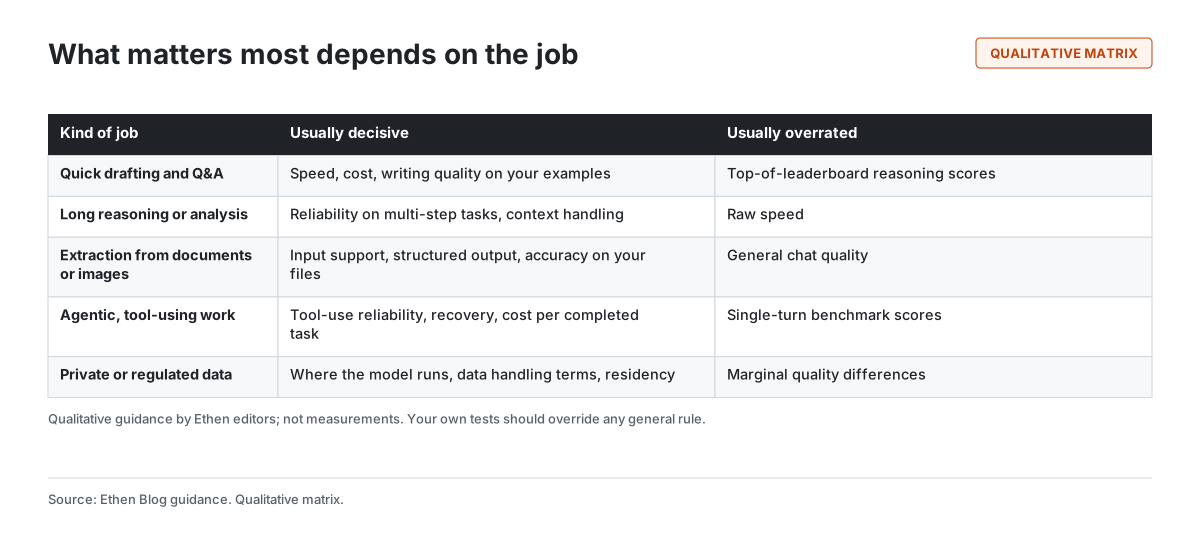
Choosing a model is confusing because the number of options grows faster than the information needed to compare them. New models and new versions arrive constantly; prices change; benchmark tables mix results produced in different ways; and names rarely tell you what a model is good at. On top of that, most comparisons answer a narrower question than their headline suggests. A ranking built on a reasoning benchmark says little about document extraction, and a score without a date may describe a model version that no longer exists.
The result is a choice that feels like it requires expertise most people do not have, and a temptation to pick whatever is at the top of the most recent list. The method below replaces that with a short sequence of questions anyone can answer.
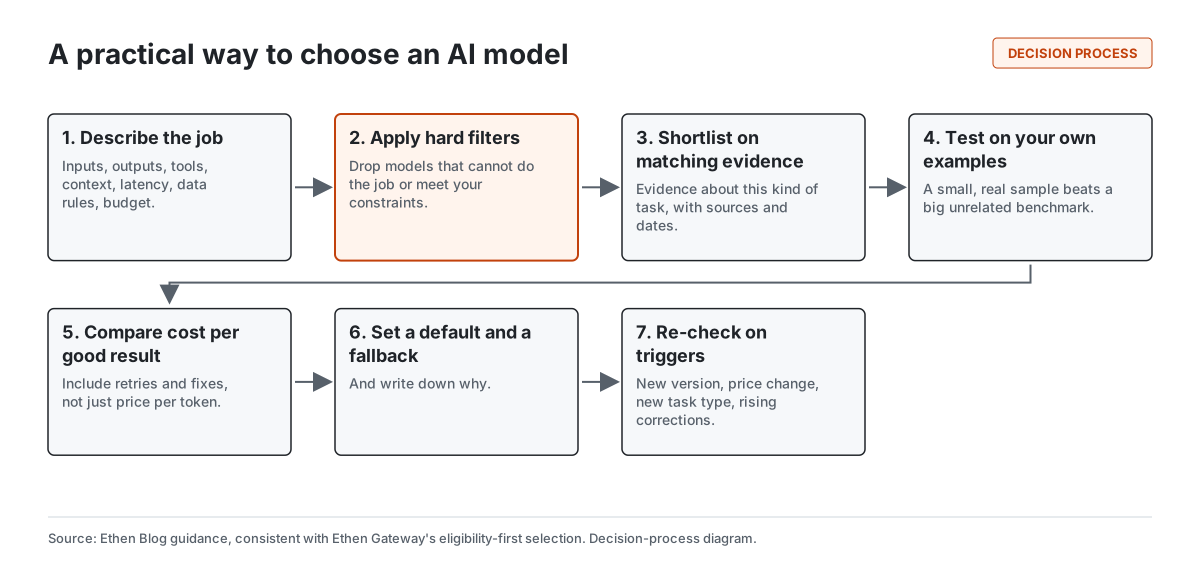
Step 1: Describe the job before you look at any model
Write down what the work actually requires. Be concrete:
- Inputs: text only, or images, scanned documents, audio, video, code?
- Outputs: free text, structured data, code, an image, speech?
- Tools: does the model need to call tools, browse, run code or act on other systems?
- Context: how much material must it consider at once — a paragraph, a contract, a codebase?
- Speed: does a person wait for the answer in real time, or can it run in the background?
- Data rules: may this data leave your environment? Are there residency or contractual restrictions?
- Budget: roughly what can one good result cost?
This list does more work than any benchmark. It turns "best model" into a question with an answer, and it tells you which evidence will be relevant later.
Step 2: Apply hard filters first
Hard filters remove models that cannot do the job or cannot meet your constraints, before you compare quality at all. If the task needs image input, models without it are out. If the data may not leave a region, models whose providers cannot meet that requirement are out. If structured output is required, models that do not support it are out.
This is how Ethen's AI Gateway chooses a model, too. It removes every candidate that lacks a required capability, is unhealthy or would exceed the budget, and only then ranks what remains; if nothing remains, it refuses rather than quietly substituting something else. The mechanism is described in How Ethen Gateway Chooses an Eligible Model. Ethen Research Lab's survey Why Learned AI Model Routing Must Beat Good Rules makes a related point from the research side: well-designed rules are a strong baseline, and more sophisticated selection has to beat them to be worth its complexity. The survey reports no Ethen measurements.
Filtering usually shrinks a list of dozens of models to a handful. That alone removes most of the paralysis.
Step 3: Shortlist using evidence that matches your task
Now compare the remaining models — but only on evidence relevant to your job. If your task is extracting fields from invoices, a strong score on a math-reasoning benchmark is not evidence. Look for results on similar tasks, check the source, date and method behind each number, and treat missing values as missing rather than as average.
Ethen Model Intelligence is designed to make this step honest: it shows benchmark values only when they have a source, a retrieval date, a methodology and adequate confidence, and shows Unknown otherwise. Our guide How to Read an AI Model Comparison explains how to read any comparison table with the right skepticism.
Step 4: Test on your own examples
A test on twenty to fifty of your own real inputs will usually tell you more than any public benchmark, because it measures the thing you care about. Pick examples that represent the work, including a few hard or unusual cases. Define what a good result looks like before you run anything — the extracted total matches the invoice, the summary includes the three required points, the code passes the tests. Then run each shortlisted model on the same examples and check the results against that definition.
Two practical tips. Run each example more than once if outputs vary, because a model that is right once in three tries is not reliable. And keep the test set; it becomes the fastest way to re-check your choice later.
How do I build a small test set that actually helps?
A good test set is small, real and opinionated about what "good" means. Five guidelines make the difference between a test that informs a decision and one that just confirms a preference.
Sample from real work. Pull examples from the last few weeks of the actual task — real emails, real documents, real tickets — rather than writing clean examples by hand. Hand-written examples tend to be easier than reality.
Include the awkward cases on purpose. Add a few inputs you know are hard: a blurry scan, a contract with an unusual clause, a request with two possible interpretations. Models that look identical on easy inputs often separate on hard ones, and hard inputs are where mistakes cost the most.
Write the pass criteria before running anything. Decide in advance what counts as a good result for each example: required fields present and correct, required points covered, no invented facts. Deciding afterward lets the most persuasive output win rather than the most correct one.
Check results against the source, not against your impression. For extraction and summarization, compare outputs with the original document. Fluent output is easy to over-rate.
Keep it, and keep it private. Save the examples and the criteria so you can re-run them whenever something changes. Keep them out of anything you publish, so they stay a fair test of models that may have been trained on public data.
Twenty to fifty examples is usually enough to separate a clearly better option from a clearly worse one. It is not enough to detect small differences, and it is not a substitute for watching results once a model is in use. Its purpose is to make the first choice an informed one.
Step 5: Compare the cost of good results, not the price per token
The price per token is the easiest number to compare and often the least useful. A cheaper model that produces more wrong answers, needs more retries or requires more human correction can make each good result more expensive. Research on agent evaluation has argued for reporting cost and accuracy together rather than separately (Kapoor et al., 2024), and work on the economics of language models proposes measuring the expected cost of obtaining a correct solution (Erol et al., 2025).
Ethen Research Lab extends that idea to agent work as cost per verified outcome: all the costs of producing results, including failures and checking, divided by the number of results independently verified as successful. It is a research note, and Ethen's own figure has not been measured. You do not need special tooling to apply the idea: divide what you spent in your test by the number of results that met your definition of good, and compare that across models. See Cost Per Verified Outcome.
Step 6: Choose a default and a fallback — and write down why
Pick the model that gives the best balance of good results, cost and speed for your job, and pick a fallback in case it becomes unavailable or changes. Record the reason in a sentence: "Model A: best accuracy on our invoice test at acceptable cost; fallback Model B, slightly less accurate, different provider." That sentence is what lets someone revisit the choice in three months without starting from scratch.
If you use the Gateway, keys are bound to a project, so the model choices, budgets and usage for that project stay together; see How Ethen Gateway Binds API Requests to Projects.
Step 7: Re-check when something changes
A model choice is a decision with an expiry date. Re-check it when a new version of your model is released, when prices change, when you start using the model for a new kind of task, or when people start correcting its output more often. Re-run your saved test set; it takes minutes.
Do not assume a newer version is better for your work. Model updates can improve average performance while getting worse on specific cases that a particular workflow depends on — a finding documented in research on backward compatibility in machine learning. We discuss this in Why Ethen Sometimes Won't Use the Newest Model.
When should you let Ethen choose for you?
You should let Ethen choose when the job is general and you do not need to control the model — everyday questions, drafting, summarizing. In Ethen Chat, the model selector includes an automatic option backed by Faros, Ethen's intelligence layer, which resolves to a default model for the conversation. Automatic choice saves you from evaluating models for work where the differences rarely matter.
Choose explicitly when the job is specialized, when your data has rules about where it may go, when you have tested and found a clear winner, or when you need consistent behavior over time. In those cases the method above gives you a reason for your choice that automatic selection cannot.
Our direction is for automatic choices to explain themselves — which model answered, and why it was chosen — so that letting Ethen choose never means not knowing.
A short example
Illustrative example — hypothetical, not a measured result.
A small legal-operations team wants help drafting first-pass summaries of supplier contracts. Describe the job: long PDF inputs, a summary with five required sections, no data may leave the EU, results reviewed by a person, moderate budget. Filter: remove models that cannot accept long documents and models whose providers cannot meet the EU requirement; four candidates remain. Shortlist: look for evidence on long-document summarization with sources; one candidate has no relevant evidence and two have results only on short-text benchmarks. Test: run all four on thirty past contracts, checking whether each summary contains the five required sections and no factual errors against the source. Cost: one model is the cheapest per token but misses required sections often enough that reviewers rewrite a third of its summaries; another costs more per token but needs far fewer rewrites, making it cheaper per usable summary. Decide: the second becomes the default, with the third as a fallback from a different provider. Re-check: the team reruns the thirty-contract test whenever either model changes.
Common mistakes
- Choosing by leaderboard rank alone. The leaderboard may measure a different skill than you need.
- Ignoring constraints until late. A great model you are not allowed to use is not an option.
- Testing on toy examples. If your real inputs are messy scans, test on messy scans.
- Comparing price per token only. Count retries and corrections.
- Upgrading automatically. A new version is a reason to re-test, not proof of improvement.
Frequently asked questions
Which AI model is best? There is no single best model. The best choice depends on the job, your constraints and your budget. Filter on constraints, then test on your own examples.
Should I use a frontier model or an open model? It depends on the job and your constraints. Frontier models are often strongest on hard general tasks; open models can be preferable when you need to run locally, control data handling, or keep costs predictable. Test both kinds on your own examples if both pass your filters.
Is automatic model selection trustworthy? It is useful for general work where model differences rarely matter, and most trustworthy when the system tells you which model answered and why.
How often should I re-check my model choice? Whenever a model version or price changes, when you start using it for a new task, or when corrections increase. Keep a small test set so re-checking takes minutes.
Related reading
- Why Ethen Is Investing in Model Intelligence
- What Makes an AI Model Useful Beyond Benchmarks
- Model Intelligence and Routing — Ethen's hub for model choice.
- Ethen Model Library and Ethen AI Gateway.
References
- Kapoor, S. et al. (2024). AI Agents That Matter. arXiv:2407.01502. https://arxiv.org/abs/2407.01502
- Erol, M. H. et al. (2025). Cost-of-Pass: An Economic Framework for Evaluating Language Models. arXiv:2504.13359. https://arxiv.org/abs/2504.13359
- Srivastava, M. et al. (2020). An Empirical Analysis of Backward Compatibility in Machine Learning Systems. arXiv:2008.04572. https://arxiv.org/abs/2008.04572
- Ethen Blog (2026). How Ethen Gateway Chooses an Eligible Model. https://upcube.ai/blog/how-ethen-gateway-chooses-an-eligible-model
- Ethen Blog (2026). How Ethen Gateway Binds API Requests to Projects. https://upcube.ai/blog/how-ethen-gateway-binds-api-requests-to-projects
- Ethen Blog (2026). How to Read an AI Model Comparison. https://upcube.ai/blog/how-to-read-an-ai-model-comparison
- Ethen Research Lab (2026). Why Learned AI Model Routing Must Beat Good Rules. External literature survey. https://upcube.ai/resources/research/learned-routing-vs-rules
- Ethen Research Lab (2026). Cost Per Verified Outcome: A Better Economic Unit for Agentic AI. Research note; research synthesis. https://upcube.ai/resources/research/cost-per-verified-outcome