Asking AI vs Delegating Work to AI: What Changes
Delegating work to AI is different from asking AI in one fundamental way: when you ask, you do the work with the answer; when you delegate, the AI does the work — but you are still accountable for the result. That shift changes almost everything else. A question becomes a brief with a goal, limits and a definition of done. Checking happens at checkpoints and at the end, not once when you read a reply. The AI needs authority to act, and that authority needs boundaries. And what comes back is an outcome with evidence, including an honest account of anything unfinished or uncertain. This guide explains each change, offers a five-part delegation brief you can use with any agent, and describes when not to delegate at all.
Delegating work to AI is different from asking AI in one fundamental way: when you ask, you do the work with the answer; when you delegate, the AI does the work — but you are still accountable for the result. That shift changes almost everything else. A question becomes a brief with a goal, limits and a definition of done. Checking happens at checkpoints and at the end, not once when you read a reply. The AI needs authority to act, and that authority needs boundaries. And what comes back is an outcome with evidence, including an honest account of anything unfinished or uncertain. This guide explains each change, offers a five-part delegation brief you can use with any agent, and describes when not to delegate at all.
Key takeaways
- Asking keeps execution with you; delegating moves it to the AI. Accountability stays with you either way.
- Delegation is a range of levels. Draft, prepare, act with approval and act-and-report are different choices, made per step.
- A delegation brief needs five parts. Goal, limits, definition of done, checkpoints and the report you expect.
- Trust should be earned per task type. Rely on an agent as far as its record on similar work justifies.
- Some work should not be delegated. High-stakes judgment, irreversible commitments and anything you could not check.
What is the difference between asking AI and delegating to AI?
When you ask an AI something, it responds and you decide what to do next. "How should I compare these three suppliers?" gets you a method. You still find the suppliers, collect the prices, build the comparison and decide.
When you delegate, you hand over a goal and the AI carries out the steps. "Compare these three suppliers on price, lead time and minimum order, with sources, and recommend one" gets you a finished comparison — if the agent can do it, and if you told it enough to know what finished looks like.
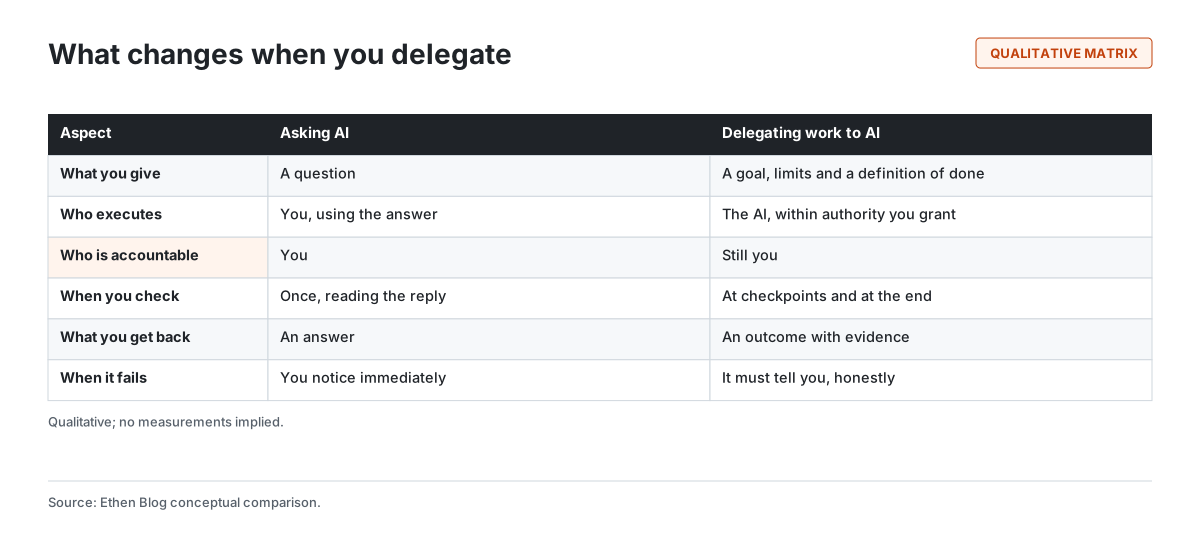
The obvious difference is who does the work. The less obvious difference is what you are now responsible for. When you ask, you are responsible for every step because you take every step. When you delegate, you are responsible for the brief, the authority you grant, the checkpoints you set and the judgment you apply to the result. Figure 1 lays out the full set of changes.
Delegation is a spectrum, not a switch
It is tempting to think of delegation as all or nothing: either you do it, or the agent does. In practice there are several useful levels in between, as Figure 2 shows.
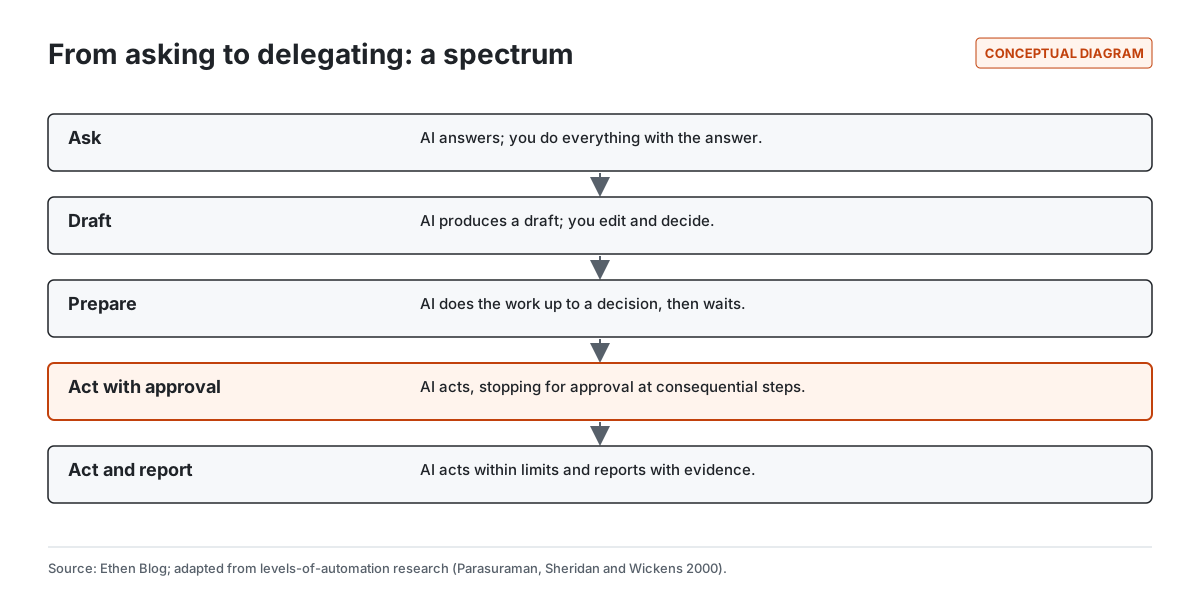
Ask. The AI answers; you act on the answer.
Draft. The AI produces a draft — an email, a document, a plan — and you edit and decide whether to use it.
Prepare. The AI does the work up to the point of a decision and stops: the comparison is built, the form is filled in, the message is written, but nothing is sent or submitted.
Act with approval. The AI carries out the work and acts, but stops for your approval before consequential steps such as sending, paying or publishing.
Act and report. The AI acts within limits you set and reports what it did, with evidence.
This idea is not new. Human-factors researchers described levels of automation decades ago and argued that the right level depends on the function being automated and the cost of mistakes. The useful insight for AI agents is that one task can use different levels for different steps. Researching suppliers can be act-and-report. Contacting them should be act-with-approval. Signing a contract with one should not be delegated.
The five-part delegation brief
Most delegation failures start with a brief that would confuse a capable human colleague. A good brief has five parts, shown in Figure 3.
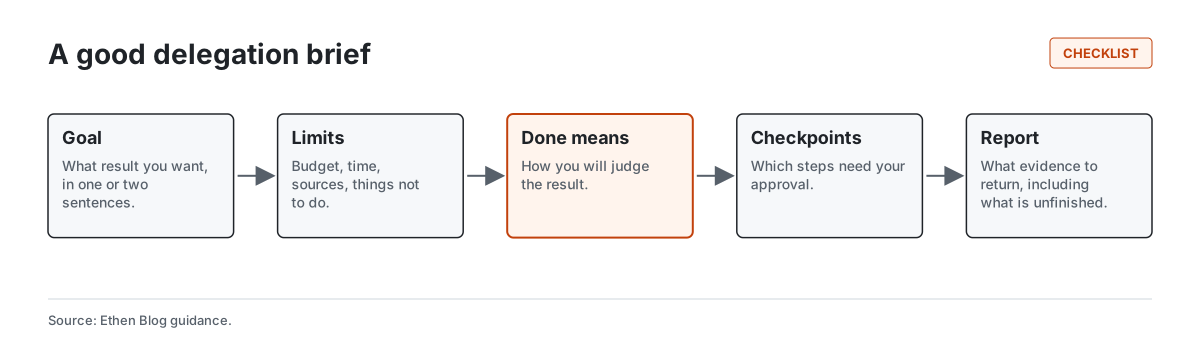
1. Goal. One or two sentences on the result you want, and why. "Find a supplier for this component so we can place a first order next month" is better than "research suppliers", because the purpose tells the agent what matters.
2. Limits. Budget, time, sources to use or avoid, people not to contact, actions not to take. Limits are where most of the safety of delegation lives. An agent that knows it may spend nothing, contact no one and use only public sources can be given a lot of freedom inside those limits.
3. Done means. How you will judge the result. "Three suppliers, each with price, lead time and minimum order, each fact linked to a source, and a recommendation with reasons." This is the most frequently missing part, and without it the agent decides for itself when it has finished.
4. Checkpoints. Which steps need your approval before they happen. Typical checkpoints are anything that contacts another person, spends money, publishes, changes a shared system or cannot easily be undone.
5. Report. What you want back: the result, the evidence behind it, what it cost, what was approved, and — critically — what is unfinished or uncertain. An agent that reports only successes is hiding information you need.
The same five parts work whether you are briefing an AI agent, a contractor or a new colleague. That is not a coincidence. Delegation is a management skill, and AI agents make it relevant to many more people.
What the AI needs from you to act
Delegation also requires giving the AI the ability to act: access to tools, files, accounts or systems. This is where delegating work to AI differs most sharply from asking.
Grant the least authority that does the job. If the task only needs read access to a folder, do not give it your whole drive. If it needs to draft emails, it does not need to send them. Narrow authority limits the damage when something goes wrong — whether through a mistake or through manipulated content the agent reads along the way.
Make approvals specific. "Yes, carry on" approves everything that follows. "Yes, send this message to this person" approves one action. The second is safer and only slightly slower. Ethen's approach to binding approvals to specific actions is described in Why Ethen Keeps Human Approval in the Loop.
Know how to stop it. Before delegating, make sure you can pause or cancel the work and see what has already happened.
Ethen Research Lab's Mandates research note explores how a brief like the one above could be compiled into bounded authority that an agent cannot exceed, and its VerifiedWork Control benchmark design sets out how delegation, approval and revocation could be tested. Both are research — a note and a benchmark design without results — not shipped features.
What should come back
The output of delegation is not an answer but an outcome, and an outcome is only useful if you can check it quickly. A good report from a delegated job includes the result, the sources and actions behind it, the approvals granted, the cost, and a plain list of anything unfinished, assumed or unverified.
That last item matters more than it looks. Agents, like people, tend to report what went well. An agent that silently skips a step, or reports a task as complete when a confirmation never arrived, creates the most dangerous kind of failure: one you do not know about. We discuss this in What "Done" Should Mean for an AI Agent, and in What Happens When an AI Task Fails Halfway Through?. For a practical checklist, see What Makes an AI Agent Job Verifiable.
A worked example: the same task, asked and delegated
The following example is illustrative. A small company needs a new accounting tool.
Asked. "What should we look for in accounting software for a ten-person company?" The AI returns a sensible list of criteria. The founder then spends an afternoon finding products, reading pricing pages and building a comparison.
Delegated. The founder writes a brief. Goal: choose accounting software we can adopt next quarter. Limits: public information only; do not sign up for trials or contact vendors. Done means: four products compared on price for ten users, the integrations we need, and data export, with each fact linked to its source and a recommendation with reasons. Checkpoints: none needed, since nothing leaves the building. Report: the comparison, its sources, and anything that could not be confirmed.
The agent returns the comparison. Two facts are marked unconfirmed because the vendors' pricing pages did not state them clearly. The founder reviews the comparison in fifteen minutes, checks the two flagged items, and books demos with the two strongest candidates — personally, because that step involves other people.
Two things made the delegated version work. The brief made the finish line explicit, so the agent knew what complete looked like. And the report was honest about uncertainty, so the founder knew exactly where to spend their limited checking time.
How much should you trust a delegated result?
You should trust an agent about as much as its track record on similar work justifies — no more and no less. Human-factors research calls this calibrated trust. A widely cited review of trust in automation argued that problems arise both from over-trust, where people rely on automation beyond its capability, and from under-trust, where they reject automation that would help. The goal is reliance that matches actual reliability.
In practice, calibration means three things.
Start with checkable work. Delegate tasks where you can verify the result quickly, such as research with sources. As the agent proves reliable on a type of task, check less of each result.
Calibrate per task type, not per agent. An agent that is excellent at summarizing documents may be unreliable at booking travel. Trust earned on one does not transfer automatically to the other.
Watch for silent failure. The most important signal is not how often the agent succeeds but whether it tells you honestly when it does not.
The ironies of delegation
There is a well-known paradox in automation research, described in a short and much-cited 1983 paper on the "ironies of automation". The more a system automates, the more important — and the harder — the human's remaining role becomes. People who no longer do a task lose practice at it, yet are expected to step in exactly when the automation fails, which is when the situation is hardest.
Delegating work to AI inherits this irony. If you delegate all your research, you may lose the instinct for when a source is weak. If you approve hundreds of routine actions, you may stop reading them carefully. Two habits help: keep doing some of the work yourself, so your judgment stays sharp, and design approvals so that only genuinely consequential steps reach you, so you can give those proper attention.
When not to delegate
Some work should stay with you, at least for now.
Judgment calls with high stakes. Hiring decisions, legal positions, medical choices and anything where the reasoning matters as much as the result.
Irreversible commitments. Signing agreements, making large payments, deleting important data. We discuss why in How Ethen Thinks About AI Actions That Can't Be Undone.
Work you could not check. If you have no way to tell whether the result is right, delegation turns into hoping.
Relationships. Messages where tone and trust matter more than content are usually better drafted by the AI and sent by you.
How Ethen approaches delegation
Ethen is designed so that asking and delegating each have the right home. Ethen Chat is for asking, drafting and thinking. Ethen Founder is designed for delegated jobs: goals carried to checked outcomes, with approvals, spend and evidence attached, as we explain in Why Ethen Founder Is About Outcomes, Not More Chat. The interface for delegated work needs to differ from chat, too, which we discuss in Why Long-Running AI Work Needs a Different UX Than Chat.
Tradeoffs and limitations
Good briefs take effort. Writing goal, limits, done-criteria and checkpoints takes longer than typing a question. For small tasks, asking is often better.
Checkpoints slow things down. Approvals add waiting time. The answer is to choose them carefully, not to remove them.
Calibration takes time. Trust grows only as an agent proves itself on a type of task, so early delegation involves more checking.
This is general guidance. It applies to any agent; it is not a description of a specific Ethen feature.
FAQ
What's the difference between asking AI and delegating to an AI agent? Asking gets you an answer you act on. Delegating hands the AI a goal to carry out. Execution moves to the AI; accountability stays with you.
How do I delegate a task to an AI agent? Write a brief with a goal, limits, a definition of done, checkpoints for consequential steps and the report you expect back. Grant only the access the task needs.
What should I not delegate to AI? High-stakes judgment, irreversible commitments, relationship-critical communication and any work you could not check.
How much should I trust an AI agent? As much as its record on similar tasks justifies. Start with checkable work and expand as reliability is demonstrated.
Is an AI agent the same as an AI assistant? Not quite. An assistant typically responds to requests; an agent takes a goal and carries out steps using tools. Many products offer both.
Related reading
- Why Ethen Founder Is About Outcomes, Not More Chat
- What Makes an AI Agent Job Verifiable
- Why Ethen Keeps Human Approval in the Loop
- What "Done" Should Mean for an AI Agent
- Why Long-Running AI Work Needs a Different UX Than Chat
References
- Lee, J. D., & See, K. A. (2004). Trust in automation: Designing for appropriate reliance. Human Factors, 46(1), 50–80. https://doi.org/10.1518/hfes.46.1.50_30392
- Bainbridge, L. (1983). Ironies of automation. Automatica, 19(6), 775–779. https://doi.org/10.1016/0005-1098(83)90046-890046-8)
- Parasuraman, R., Sheridan, T. B., & Wickens, C. D. (2000). A model for types and levels of human interaction with automation. IEEE Transactions on Systems, Man, and Cybernetics — Part A, 30(3), 286–297. https://doi.org/10.1109/3468.844354
- Ethen Research Lab (2026). Mandates: Compiling Human Intent Into Bounded Agent Authority. Research note. https://upcube.ai/resources/research/agent-mandates
- Ethen Research Lab (2026). VerifiedWork Control: Evaluating Delegation, Approval, Revocation, and Agent Authority. Benchmark design; results gated. https://upcube.ai/resources/research/verifiedwork-control