How We’re Thinking About AI for Founders and Small Teams
AI for small teams has to work under constraints large companies rarely face: no IT department to set it up, no spare time to check every result, budgets that cannot absorb surprise bills, customer data that still needs protecting, and headcount that changes every few months. Those constraints shape how we design Ethen for founders and small teams. The aim is AI that finishes bounded pieces of work with results that are quick to review, shares context across a few people without administrative overhead, keeps spending visible and limited, protects data by default, and grows from one founder to a team without forcing a move to a different system. This article explains those principles, where AI helps small teams most today, and where we think care is still needed.
AI for small teams has to work under constraints large companies rarely face: no IT department to set it up, no spare time to check every result, budgets that cannot absorb surprise bills, customer data that still needs protecting, and headcount that changes every few months. Those constraints shape how we design Ethen for founders and small teams. The aim is AI that finishes bounded pieces of work with results that are quick to review, shares context across a few people without administrative overhead, keeps spending visible and limited, protects data by default, and grows from one founder to a team without forcing a move to a different system. This article explains those principles, where AI helps small teams most today, and where we think care is still needed.
Key takeaways
- Time to review is the binding constraint. Small teams need results they can check in minutes.
- Setup must be light. Good defaults matter more than configuration options.
- Costs must be predictable. Visible spend and limits set up front are features, not extras.
- Start where results are checkable. Research, drafts and summaries first; customer-facing actions with checkpoints.
- Growth should add controls, not migrations. The system a founder starts with should still work at twenty people.
Why small teams are different
Small teams are not just smaller versions of large companies. They operate under a different set of constraints, and those constraints change what makes an AI product useful.
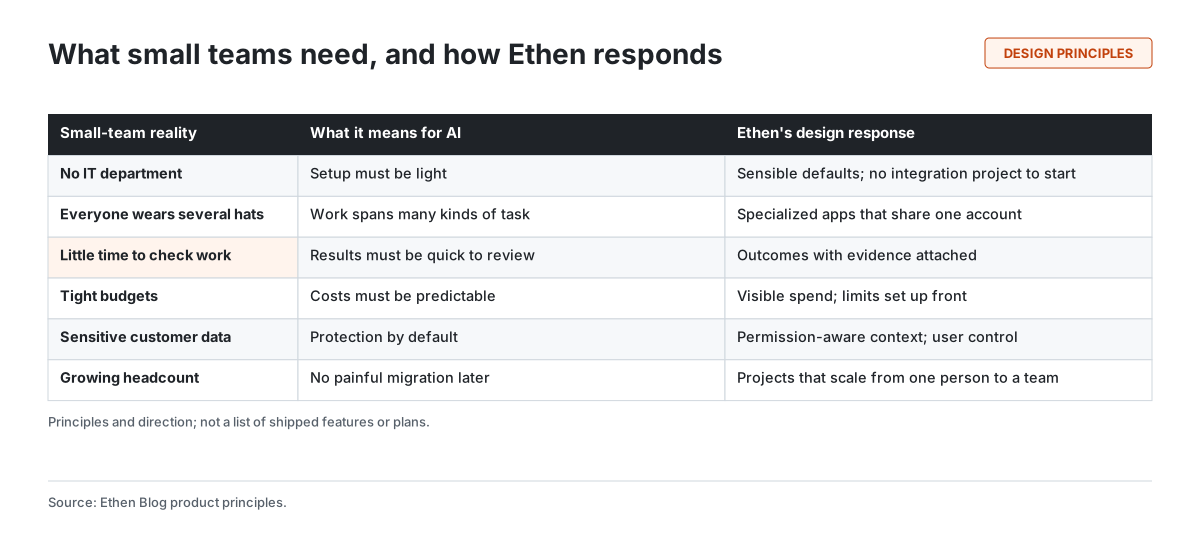
Nobody owns the tools. In a large company, someone evaluates, configures and supports software. In a five-person team, that person is usually the founder, in the gaps between everything else. An AI product that needs an integration project before it is useful will not be used.
Everyone wears several hats. The same person may write marketing copy in the morning, review a contract at lunch and debug a spreadsheet in the evening. One narrowly focused tool does not cover that range; a dozen separate tools create their own overhead.
There is little time to check work. This is the most important constraint. AI that produces plausible but unchecked results moves the work rather than removing it. If every output has to be verified from scratch, the time saved disappears.
Budgets are tight and lumpy. A surprise bill matters more to a small team than to a large one, and usage can spike unpredictably.
Data still needs protecting. Small teams hold customer lists, financial records and their own intellectual property. A survey of small businesses published by the Federal Reserve Bank of San Francisco in 2026 found that concern about keeping intellectual property safe, and not knowing how to get started, were among the barriers holding owners back.
Figure 1 maps these realities to what they mean for AI and how Ethen is responding.
What the evidence says about AI and small teams
The evidence on AI productivity is encouraging, with important qualifications. One of the most careful studies of generative AI at work followed more than five thousand customer-support agents as an AI assistant was introduced in stages. It found productivity gains of about 15% on average, with the largest improvements for less experienced workers — and small or negative quality effects for the most experienced.
That pattern is relevant to small teams. A founder doing work outside their expertise — writing a first privacy policy, preparing a first financial model, running a first hiring process — is in exactly the position where AI assistance helps most. But the same finding is a warning: the people best placed to judge the quality of AI output are often the experts the team does not have. That makes verifiable results more important for small teams, not less.
Adoption among small businesses is growing but uneven. The San Francisco Fed's 2026 survey found that close to 40% of the small businesses surveyed were already using AI or planning to soon, often for content, email, marketing, research and grant applications. Many used AI built into software they already had, or free general-purpose assistants.
Where AI helps small teams most today
The best first uses of AI for small teams share two traits: the result is easy to check, and a mistake does not reach anyone outside the team. Figure 2 sorts common uses into three groups.
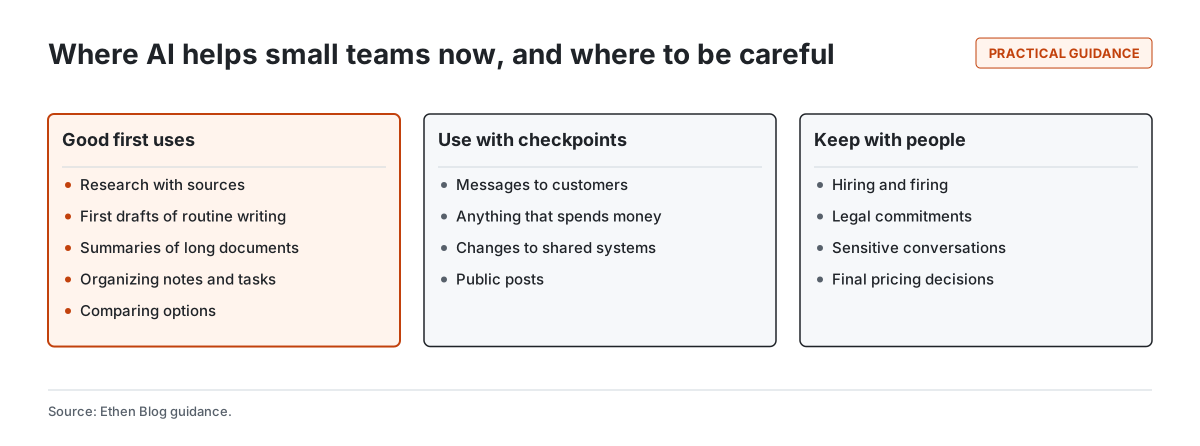
Good first uses. Research with sources, first drafts of routine writing, summaries of long documents, organizing notes and tasks, and comparing options. These save real time, and you can check the result against the sources or your own knowledge.
Uses with checkpoints. Messages to customers, anything that spends money, changes to shared systems and public posts. AI can prepare all of these, but a person should approve the specific action before it happens.
Decisions to keep with people. Hiring and firing, legal commitments, sensitive conversations and final pricing decisions. AI can inform these, but the decision and the accountability belong with the team.
We explain the general difference between asking AI and handing it work in Asking AI vs Delegating Work to AI.
Five principles shaping Ethen for small teams
1. Finish bounded work, and make it quick to review
Small teams need AI that finishes things, not AI that starts conversations. That is the thinking behind Ethen Founder, which is designed around jobs — a goal carried to a checked outcome with evidence attached — rather than chat. We explain the reasoning in Why Ethen Founder Is About Outcomes, Not More Chat.
The emphasis on review is deliberate. An outcome that arrives with its sources, the steps taken and a clear list of anything unconfirmed can be reviewed in minutes. An outcome that arrives as a confident paragraph cannot.
2. One account, several specialized tools
A small team's work spans writing, research, design, code, media and operations. Ethen is organized as a family of specialized apps that share one account, rather than one app that does everything adequately or a dozen unrelated tools. We explain why in Why Ethen Is a Family of Specialized AI Apps. For small teams, the practical benefit is that the right tool for each kind of work is available without a separate sign-up, bill and learning curve for each.
3. Predictable, visible costs
Cost surprises hurt small teams. The design principle is that spending should be visible as it happens and limited up front: a job states what it may spend, and the record shows what it did spend. Ethen Research Lab argues in Cost per Verified Outcome, a research note, that the useful economic unit for AI work is the cost of a result that was actually checked, not the cost of tokens or requests. That framing suits small teams: what matters is what it cost to get a usable result.
4. Safe defaults and user control
Small teams rarely have time to configure security settings. So defaults matter. Context should respect permissions — a document shared with one person should not surface for another — and people should be able to see and control what Ethen remembers, as we explain in Why User-Controlled AI Memory Matters. Actions that reach outside the team should wait for a specific approval by default.
5. Grow without starting over
The tools a founder adopts alone should still work when the team has twenty people. Figure 3 shows the path we are designing for.
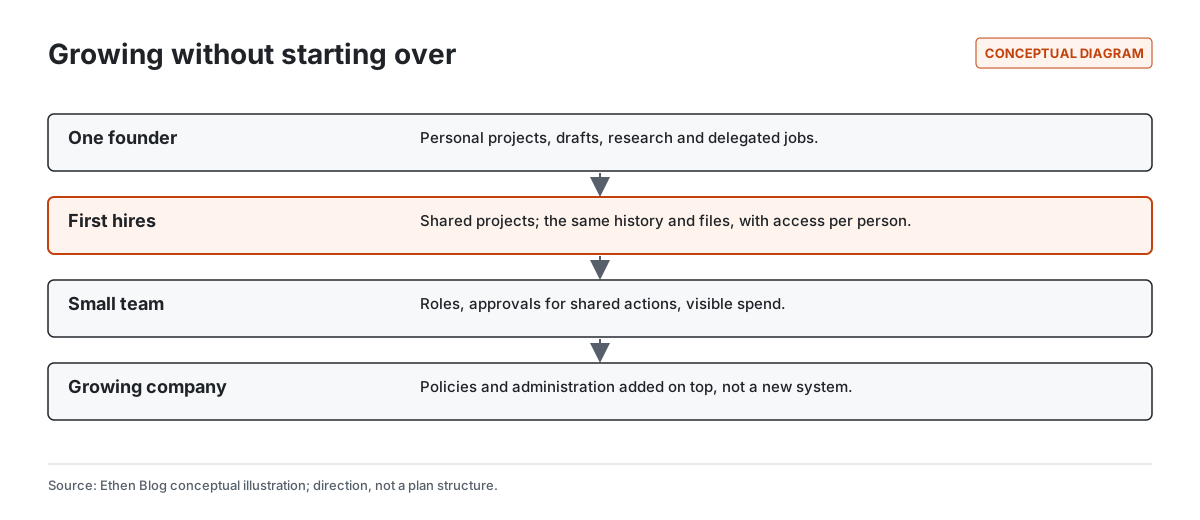
A founder starts with personal projects. The first hires join shared projects, with the same files and history and access set per person. As the team grows, roles and approvals for shared actions are added. Later, administration and policies are layered on top. Each stage adds controls rather than requiring a migration to a different product. This is direction, not a description of plan tiers.
What we are measuring ourselves against
For small teams, the questions that matter are practical, and they are the ones we intend to judge Ethen against: how long it takes to get from sign-up to a first useful result; whether results can be reviewed faster than doing the work; whether costs stay within what the team expected; and whether teams keep coming back for repeat work rather than trying it once. We are not publishing results for these here. They describe what good looks like, not what has been achieved.
A first month with AI: an illustrative plan
The following plan is illustrative. It shows one sensible way for a small team to adopt AI, starting where results are easiest to check.
Week 1: research and summaries. Use AI for research questions with sources and for summarizing long documents the team would otherwise skim. Check every source for the first few results. Note where the AI is reliable and where it is not.
Week 2: first drafts. Move routine writing — internal updates, job descriptions, first drafts of help articles — to AI drafts that a person edits. Keep track of how much editing each kind of draft needs; that is your best measure of usefulness.
Week 3: one delegated job. Pick one bounded, recurring task with a clear finish line, such as a weekly competitor summary, and delegate it fully with a written brief. Review the result each time and refine the brief.
Week 4: one action with a checkpoint. Choose one customer-facing or spending action — sending a follow-up email, for instance — and let AI prepare it, with a person approving each one. Decide afterwards whether the approval step is earning its time.
At the end of the month the team has evidence, not impressions: which tasks AI handles well, how much checking each needs, and what it cost.
Questions to ask any AI product as a small team
Whatever tools you consider, five questions cut through most marketing.
- How long until the first useful result? If the answer involves an integration project, it is probably not for a five-person team yet.
- How do I check the results? Look for sources, steps and an honest list of anything unconfirmed.
- What will it cost, and can I cap it? Ask how spending is shown and limited, not just the headline price.
- What happens to our data? Ask whether it is used to train models, who can see it and how to delete it.
- What happens when we grow? Ask whether sharing, roles and approvals can be added without moving to a different product.
Common mistakes small teams make with AI
A few patterns come up repeatedly when small teams adopt AI.
Treating plausible as correct. AI output reads well whether or not it is right. Without sources and checks, errors slip through — especially in areas where nobody on the team is an expert.
Pasting sensitive data into tools without checking terms. Customer lists and financial records deserve the same care with AI tools as with any other software.
Too many tools. Each tool adds a login, a bill and a place where information gets stuck. A smaller number of tools that share context usually beats a long list of single-purpose ones.
Automating before understanding. Automating a process the team has not yet done by hand a few times tends to automate the wrong thing.
Skipping approvals to save time. The first time an AI sends the wrong message to a customer costs more than all the approvals it would have needed.
For a structured way to choose tools, see Choosing a Multi-Model AI Workspace, and for what we mean by a workspace, What Is an AI Workspace?.
Tradeoffs and limitations
Simplicity limits flexibility. Good defaults help most teams and frustrate a few with unusual needs. We would rather start simple and add options than the reverse.
Approvals add friction. Checkpoints slow down customer-facing work. For a small team, one avoided mistake usually justifies the delay.
Verification cannot replace expertise. Sources and checks reduce errors but do not make a non-expert into an expert. For legal, financial and medical questions, professional advice still matters.
This is direction. The principles here describe how we are designing Ethen for small teams. They are not a list of plans, prices or shipped features.
FAQ
What AI tools should a small team use? Fewer tools that share context are usually better than many single-purpose ones. Choose tools that make results easy to check, keep costs visible and protect data by default.
How can founders use AI without an IT department? Start with uses that need no integration and produce checkable results — research, drafts, summaries — and add customer-facing or spending actions only with approval steps.
What are the risks of AI for small businesses? Accepting plausible but wrong output, exposing sensitive data, unpredictable costs, and automated actions that reach customers without review.
Is AI more useful for small teams than large ones? Research suggests AI helps most where people work outside their expertise, which describes much of small-team work. The same research suggests results still need careful checking.
How is Ethen designing for small teams? Around five principles: finished, reviewable work; one account with specialized apps; predictable costs; safe defaults; and growth without migration.
Related reading
- Why Ethen Founder Is About Outcomes, Not More Chat
- Asking AI vs Delegating Work to AI
- Choosing a Multi-Model AI Workspace
- What Is an AI Workspace?
- Why Ethen Is a Family of Specialized AI Apps
References
- Holmes, N., Sanchez-Moyano, R., & Simms, S. (2026, March 23). Early Findings on Small Business Use of AI. Federal Reserve Bank of San Francisco. https://www.frbsf.org/research-and-insights/publications/community-development-articles/2026/03/ai-and-small-businesses/
- Brynjolfsson, E., Li, D., & Raymond, L. (2025). Generative AI at Work. The Quarterly Journal of Economics, 140(2), 889–942. https://doi.org/10.1093/qje/qjae044
- Ethen Research Lab (2026). Cost Per Verified Outcome: A Better Economic Unit for Agentic AI. Research note. https://upcube.ai/resources/research/cost-per-verified-outcome
- Ethen Blog. Choosing a Multi-Model AI Workspace. https://upcube.ai/blog/choosing-a-multi-model-ai-workspace