Why Ethen Is a Family of Specialized AI Apps, Not One App
Ethen is organized as a family of focused apps rather than one universal chat window because different kinds of AI work need different things to persist, different controls, and different evidence. A quick question needs a thread. A research investigation needs sources and branches that survive across sessions. A code change needs a repository, tests and review. A goal-driven job needs a plan, approvals and a record of what actually happened. Ethen gives each kind of work one canonical home — Chat, Code, Studio, Research, Designer, Founder, the Platform products and Desktop — and keeps the account, model access, permissions and evidence shared underneath, so it still works as one Ethen.
Ethen is organized as a family of focused apps rather than one universal chat window because different kinds of AI work need different things to persist, different controls, and different evidence. A quick question needs a thread. A research investigation needs sources and branches that survive across sessions. A code change needs a repository, tests and review. A goal-driven job needs a plan, approvals and a record of what actually happened. Ethen gives each kind of work one canonical home — Chat, Code, Studio, Research, Designer, Founder, the Platform products and Desktop — and keeps the account, model access, permissions and evidence shared underneath, so it still works as one Ethen.
Key takeaways
- One capability, one canonical owner. Ethen's product rule is that a capability may appear on several surfaces, but it has one owning product and one shared backend, so there are never two conflicting versions of the same thing.
- The boundaries follow the work, not the feature list. Each app exists because its kind of work has state and controls a general thread cannot hold well.
- Chat starts work; specialized apps continue it. Hand-offs between apps are a design goal, not a failure of Chat.
- What is shared matters as much as what is separate. Identity, model access, approvals and the evidence trail are meant to travel with the work.
- This is a direction with real tradeoffs. More surfaces cost navigation and coordination, and not every app is equally mature or available.
What does "a family of specialized AI apps" mean?
A family of specialized AI apps is a set of products that each own one kind of work end to end, built on a common layer that handles identity, models, permissions and records. It is different from two familiar alternatives. One is the single universal app, where every capability is a mode inside one interface. The other is a collection of unrelated tools that happen to share a brand, each with its own login, its own model settings and no way to pass work between them.
Ethen's published product map describes five areas, each with a one-line job. The public site, Model Library and Model Intelligence are for discovering models and products. Ethen Chat is for interacting with intelligence: fast, general conversation. The specialized apps — Studio, Research, Designer and Founder — are for focused professional work. Platform is for operating intelligence: the Code workspace, Computer, Automation, Sentinel, AI Gateway and GPU Compute. Desktop is for running intelligence on your own machine, with local Chat, local Code and Local Models. The full map, including the migrations it still requires, is recorded in How Upcube Is Organizing Ethen Across Specialized Apps.
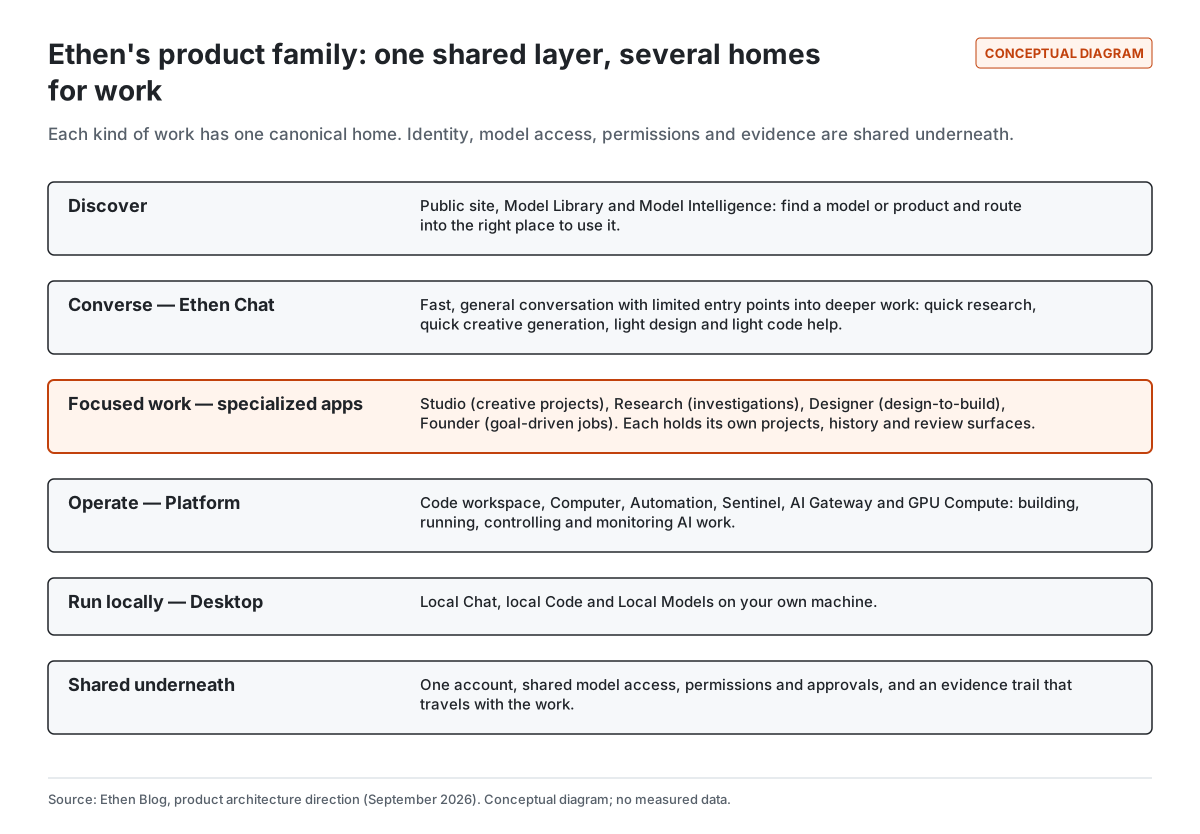
That map is design direction. It says where each capability belongs; it does not, on its own, prove that every app has shipped or that every migration is complete. We keep that distinction visible on purpose, and this article keeps it too.
Why not build one app that does everything?
One app that does everything fails in a predictable way: it makes the simplest work slower and the most demanding work fragile. A general chat interface is excellent at starting things. It is a poor container for work that has to be resumed, reviewed, or trusted later.
Four practical differences drive the split.
What has to persist. A conversation is a sequence of messages. A research project is a set of sources, claims, branches and notes that should still be organized next week. A creative project is a set of assets, versions and edits. A software change lives in a repository with history. When all of these are flattened into a thread, the important structure becomes scroll position.
What has to be controlled. Asking a question carries little risk. Merging code, spending budget, sending a message or changing a record carries real consequences. Work with consequences needs approval points, scoped permissions and spending limits that are visible before something happens, not buried in a chat history. A surface built for that kind of work can put those controls where people actually look.
What has to be proven. For conversational help, the answer is the product and you judge it on the spot. For delegated work, the agent's final message is the least reliable evidence of what it did. Work that acts needs a record that someone other than the agent can check. That record looks different for a code change (tests, review), a research report (sources that support each claim) and a creative job (which inputs and models produced which asset).
How much attention it deserves. People do not want a cockpit when they ask a quick question, and they do not want a chat box when they are reviewing a forty-file change. Interfaces carry implicit promises about what a system can do. Human-computer interaction research has long recommended that AI products make clear what the system can do and how well it can do it, so that people form accurate expectations (Amershi et al., 2019). A focused app sets those expectations through its shape before anyone reads a line of help text.
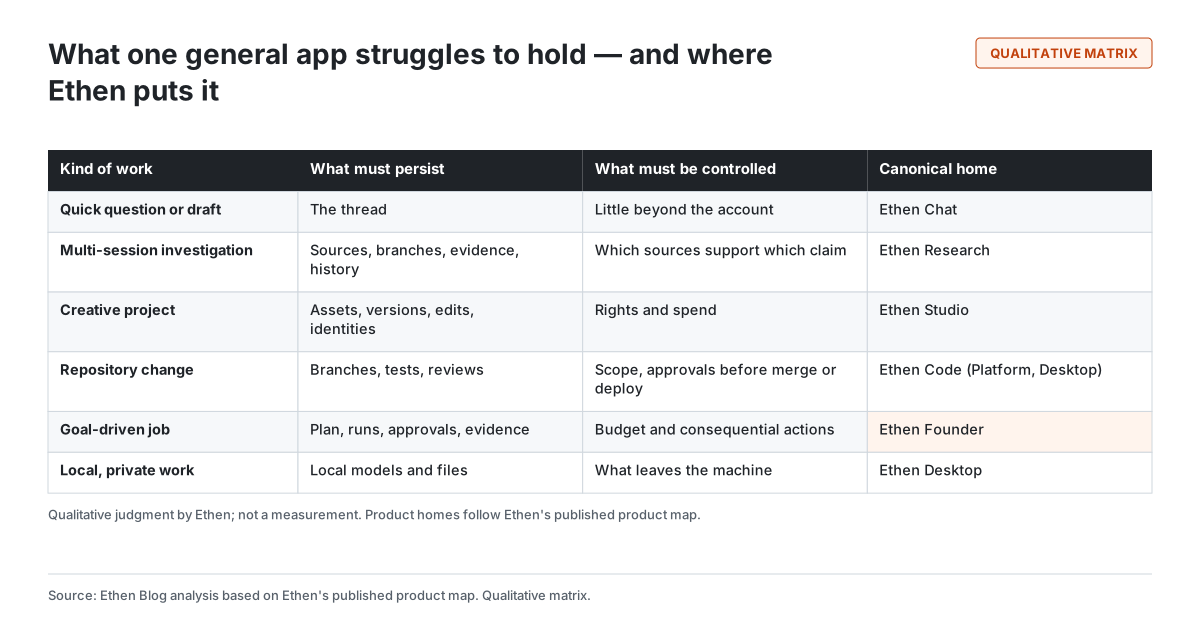
The alternative — adding each of these needs to one interface as another mode — tends to produce a product where every mode is a compromise. The thread becomes a project manager, a file browser, an approval queue and a code editor at once, and is good at none of them.
What is each Ethen app for?
Each Ethen app owns one kind of work, and the clearest way to describe it is by the unit of work it holds.
Ethen Chat holds a conversation. It is deliberately limited: core chat, a model selector, files, artifacts, tools and memory, plus lightweight entry points into research, creative generation, design and code. Those entry points are on purpose and each has a named way out into the full app. We describe the boundary in detail in Keeping Ethen Chat Focused.
Ethen Research holds an investigation: projects, searches, sources, evidence, branches, notes, citations and reports. Chat can produce a sourced answer in one sitting; Research is designed to hold work that spans sessions and must stay auditable.
Ethen Studio holds creative projects: image, video, audio and voice work, editing, history and assets, with the full model catalog. Chat offers a curated handful of options; Studio is where the complete catalog and the project lives.
Ethen Designer holds a design-to-build workflow: pages, components, design systems, code, preview and versions.
Ethen Code is the one capability we deliberately expose in three places: light conversational help in Chat, a full cloud engineering workspace in Platform, and a local coding environment in Desktop. One Code system, three levels of depth, described in Three Places to Use Ethen Code.
Ethen Founder holds a job: a goal that moves through planning, research, execution, approvals and verification toward a delivered result.
Platform holds the operational side of AI work: running agents, supervised computer use, automations, security policy, gateway access to models and GPU deployment. It is a control plane, and its design explicitly refuses to absorb the specialized apps; it links to them instead.
Desktop holds local work: local chat, local code and local models on your own hardware.
What keeps it feeling like one Ethen?
A family of apps only works if the seams are invisible where they should be and visible where they matter. Ethen's answer is a shared layer under every app, governed by one rule: one capability can appear on multiple surfaces, but it should have one canonical product owner and one shared backend and state.
That rule has concrete consequences.
- One account. You should not sign in again, re-create your organization or re-enter preferences when you move from Chat to Studio.
- Shared model access. The models you can use, and the option to let Ethen choose a model for you, follow the same policies everywhere. Model facts come from one place, which is why the Model Library and Model Intelligence sit on the public site rather than inside any one app.
- Shared permissions and approvals. The rules about who can approve a consequential action, and what an approval covers, should not change depending on which app you are in.
- An evidence trail that travels with the work. When work moves from a conversation into a project or a job, the record of what was done should move with it.
- Hand-offs instead of copies. When Chat reaches its limit, it links into the canonical app rather than growing a second, weaker version of that app.
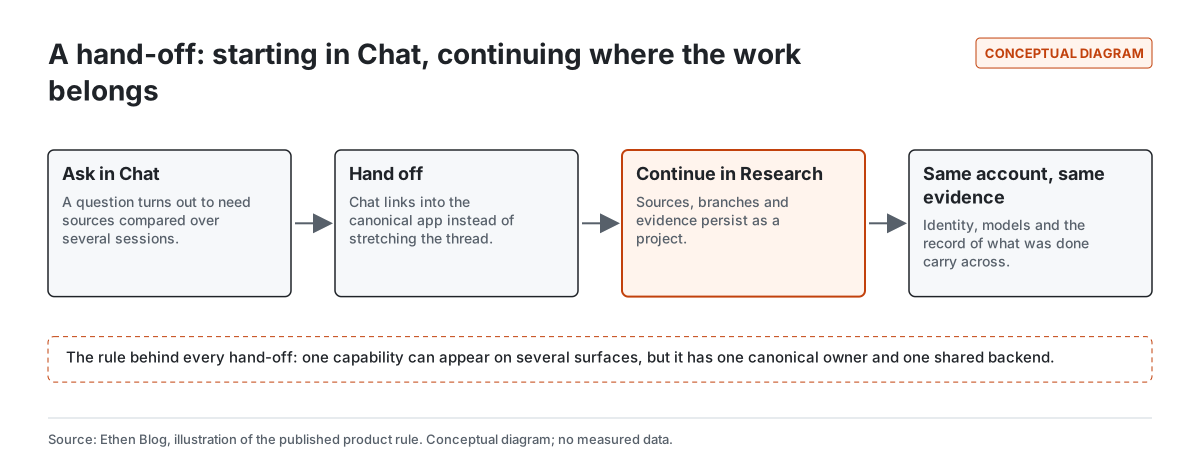
The rule is easy to state and demanding to keep. Every time a popular feature lives in one app, there is pressure to copy it into another. The rule says: link to it, or expose a limited entry point that hands off, but do not fork it. That is how a family of apps avoids becoming a pile of near-duplicates.
How does this look in practice?
In practice, most work starts in one place and finishes in another, and the design aims to make that transition feel like continuing rather than starting over. A few examples show the pattern.
A question that becomes an investigation. You ask Chat to summarize the evidence on a technical decision. The first answer is useful, but you now want to compare sources, keep track of which claim came from where, and come back after a meeting. That is Research-shaped work. Chat's job is to recognize it and hand it off, so the sources become a project rather than a long scrollback.
A quick image that becomes a campaign. One generated image fits in Chat. A set of assets that must stay consistent, with edits, versions and a record of which model produced what, belongs in Studio.
A snippet that becomes a change. Explaining a function or fixing a small bug is conversational. Once the work needs branches, tests and review, it belongs in the Code workspace or on Desktop if the repository lives on your machine.
A request that is really a goal. "Find three vendors, compare them and draft the outreach — but check with me before sending anything" is not a question. It is a job with a plan, approval points and a result someone will rely on. That belongs in a surface designed for jobs.
In each case the boundary is a decision about the work, not about the user. The same person moves between apps in the same afternoon, and the shared layer is what keeps that from feeling like four different products.
How does this connect to Ethen's research?
The product structure and Ethen Research Lab's research agenda rest on the same idea: AI work that acts should leave a record that can be checked. Ethen Research Lab's position paper Verified Adaptive Intelligence argues that a system should learn from its own work only when that work can be verified, lawfully reused and shown to hold up on new tasks. It is a research synthesis and agenda; it reports no measured Ethen results.
The connection to product design is practical. Verification looks different for code, for research and for operational workflows, which is one reason the Lab's proposed benchmark framework, Ethen VerifiedWork, plans separate environment families for code, enterprise workflows and research evidence. VerifiedWork is a benchmark design that has not been run. We cite it here for its reasoning — that different work needs different checks — not as evidence that any Ethen app already meets a benchmark.
Tradeoffs and what we are watching
A family of apps is not free, and pretending otherwise would undercut the reason for building it.
Navigation cost. More surfaces mean more decisions about where to go. If the hand-offs are clumsy, people will stay in Chat and stretch it past its design. The answer is better routing, not more modes — but routing has to earn trust.
Duplication pressure. The one-owner rule is only as strong as the discipline behind it. Our own write-up of Chat's scope notes a place where the Chat model picker lists more models than the curated design intends. Drift like that is how families of apps decay into copies, and it has to be caught and corrected.
Uneven maturity. The map assigns every capability a home before every home is finished. Some apps are further along than others, and some separations are still migrations rather than completed facts. We describe them as direction until release evidence says otherwise.
Coordination underneath. Shared identity, permissions and evidence are harder to build than separate stacks. The payoff is consistency; the cost is that changes to the shared layer affect every app at once.
We think these costs are worth paying because the alternative costs are worse: a single interface that is mediocre for everything, or a set of tools that cannot pass work to each other.
Frequently asked questions
Is Ethen one product or many? Both, by design. Ethen is one platform with one account and a shared layer for models, permissions and evidence. On top of it sit several apps, each owning one kind of work.
Which Ethen app should I start in? Start in Chat for questions, drafts and quick help. Move to the specialized app when the work needs to persist, be reviewed, or take consequential actions. A workflow-first checklist is in Choosing a Multi-Model AI Workspace.
Do I need separate accounts for each app? No. A shared account and shared organization settings are part of the design rule.
Is every Ethen app available today? Not necessarily, and availability can differ by product and by customer. Product pages and release notes are the authority on availability; architecture articles like this one describe where capabilities belong.
Related Ethen research
- Verified Adaptive Intelligence: Learning From Work That Can Be Proven — the research thesis that work which acts should be verifiable (research synthesis; no measured results).
- Ethen VerifiedWork: A Benchmark Framework for AI Systems That Take Action — why different kinds of work need different checks (benchmark design; not yet run).
Related Ethen products and topics
- Ethen — the platform the apps share.
- AI Agents and Autonomous Work — Ethen's hub for long-running, supervised agent work.
- What Is an AI Workspace? — what a workspace needs to hold beyond a conversation.
- The Next Phase of Ethen Chat — how Chat is evolving within these boundaries.
References
- Amershi, S. et al. (2019). Guidelines for Human-AI Interaction. Proceedings of CHI 2019. https://www.microsoft.com/en-us/research/publication/guidelines-for-human-ai-interaction/
- Ethen Blog (2026). How Upcube Is Organizing Ethen Across Specialized Apps. https://upcube.ai/blog/how-upcube-is-organizing-ethen-across-specialized-apps
- Ethen Blog (2026). Keeping Ethen Chat Focused. https://upcube.ai/blog/keeping-ethen-chat-focused
- Ethen Blog (2026). Three Places to Use Ethen Code. https://upcube.ai/blog/three-places-to-use-ethen-code
- Ethen Research Lab (2026). Verified Adaptive Intelligence: Learning From Work That Can Be Proven. Position paper, research synthesis. https://upcube.ai/resources/research/verified-adaptive-intelligence
- Ethen Research Lab (2026). Ethen VerifiedWork: A Benchmark Framework for AI Systems That Take Action. Benchmark design, not yet run. https://upcube.ai/resources/research/verifiedwork-benchmark