What We're Building Across Ethen: October 2026 Update
As of October 2026, Ethen's work falls into five areas. We are organizing Ethen into focused apps that share one foundation. We are hardening that foundation for AI work that runs for minutes or hours: durable jobs, completion that depends on evidence, honest handling of unknown outcomes, and approvals tied to specific actions. We are building a model knowledge layer so people can choose models with sources rather than guesses. We are extending Ethen to local, on-device AI through Desktop. And Ethen Research Lab now publishes its research in public, with every paper labeled by evidence status. This update separates what our public posts describe as implemented from what is design direction, and it makes no launch or date commitments.
As of October 2026, Ethen's work falls into five areas. We are organizing Ethen into focused apps that share one foundation. We are hardening that foundation for AI work that runs for minutes or hours: durable jobs, completion that depends on evidence, honest handling of unknown outcomes, and approvals tied to specific actions. We are building a model knowledge layer so people can choose models with sources rather than guesses. We are extending Ethen to local, on-device AI through Desktop. And Ethen Research Lab now publishes its research in public, with every paper labeled by evidence status. This update separates what our public posts describe as implemented from what is design direction, and it makes no launch or date commitments.
Key takeaways
- Foundations first. Most of the recent public engineering work is about the layer every app depends on: jobs that survive interruptions, evidence before "done", and bounded authority.
- Focused apps, one owner per capability. Chat stays fast and limited; deeper work belongs in specialized apps and Platform products.
- Model choice with sources. Ethen shows Unknown when a model fact lacks provenance and routes by eligibility before preference.
- Local AI is part of the map. Desktop owns local models, behind a narrow interface that asks a person before downloading or deleting.
- Research in public, labeled honestly. Ethen Research Lab has published 40 papers and one system card; none of the 40 papers reports a new measured Ethen result.
How to read this update
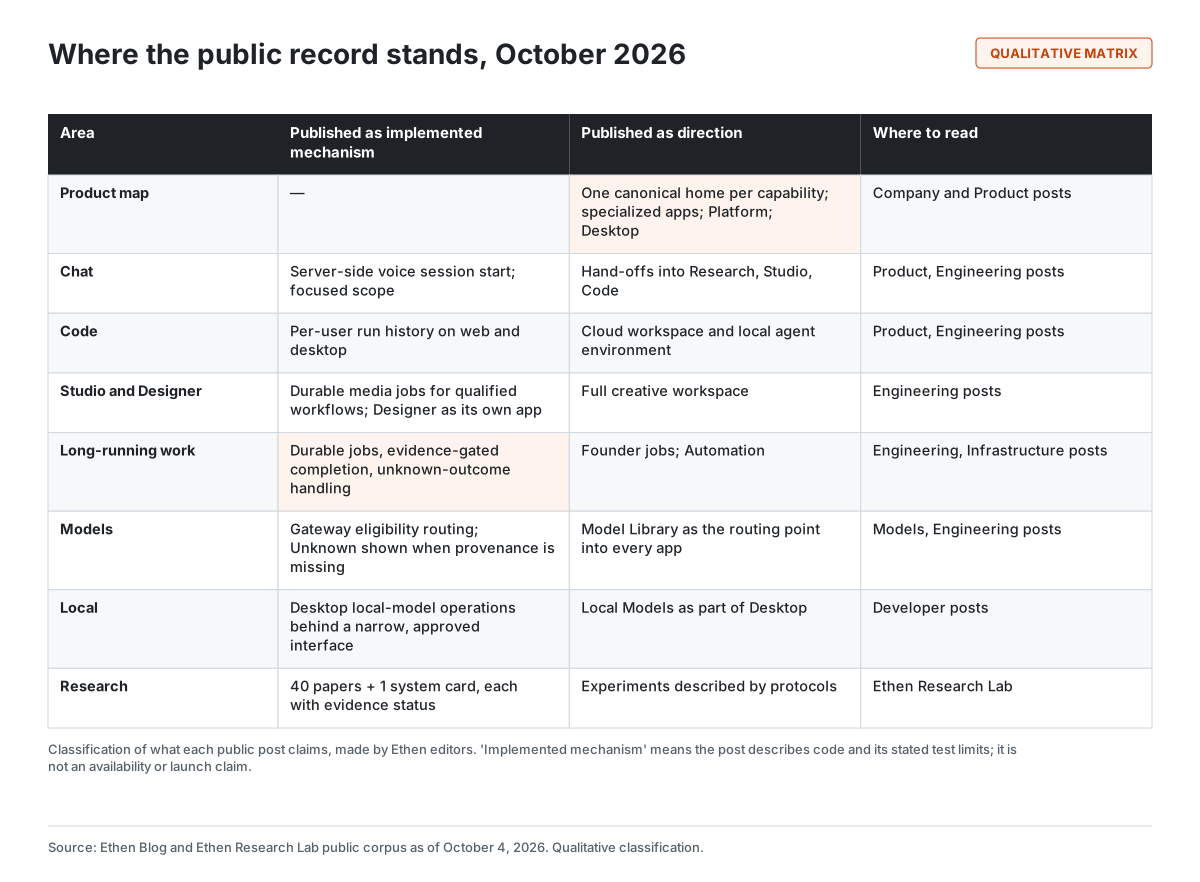
This is a dated snapshot, not a roadmap with promises. Three kinds of statement appear below, and we label them.
- Implemented mechanism. One of our public engineering posts describes code that exists, together with what its tests did and did not cover. That is not the same as general availability.
- Design direction. Our product map assigns a capability a home. Direction tells you where something belongs, not that it has shipped.
- Research. Ethen Research Lab publications are syntheses, proposals, protocols and benchmark designs. They describe what we intend to study, not product behavior.
If a sentence below could be read as a launch announcement, it is not one. Product pages and release notes are the authority on what you can use today.
Why so much of this update is foundation work
A reader might expect a product update to be a list of new features. Most of ours is about plumbing, and that is deliberate. AI work is shifting from answering questions to taking actions: editing repositories, generating assets that cost money, filing records, running for long enough that the person who started the job has moved on. Once software acts, three questions decide whether people can trust it. Did the work actually happen? Did it happen once, not twice? Can someone other than the agent check the result?
None of those questions is answered by a better model alone. A stronger model makes fewer mistakes per step, but it is also trusted with longer and more consequential tasks, so the cost of an unnoticed mistake rises. The protection has to live in the system around the model: in how jobs survive interruptions, in what counts as finished, and in what a person has actually approved. Building that once, as a shared foundation, is what lets Chat, Code, Studio, Founder and the Platform products apply the same rules instead of each inventing a weaker version.
That is also why our engineering posts are so explicit about their limits. A mechanism that has been tested against crashes and duplicate deliveries in a controlled setting is real progress. It is not yet proof of how a system behaves with every live provider, every workload or every user. Saying both things plainly is part of the foundation too.
The product map: focused apps on one foundation
Ethen is being organized so that each capability has one canonical home. The public site, Model Library and Model Intelligence handle discovery. Ethen Chat handles fast, general conversation. Studio, Research, Designer and Founder each own a professional workflow. Platform holds the operational products — the Code workspace, Computer, Automation, Sentinel, AI Gateway and GPU Compute. Desktop holds local chat, local code and local models. The operating rule behind the map is that a capability may appear on several surfaces but has one owner and one shared backend.
The map is recorded in How Upcube Is Organizing Ethen Across Specialized Apps, including the migrations it still requires. We explain the reasoning — why separate apps at all — in Why Ethen Is a Family of Specialized AI Apps, Not One App. Status: design direction, with some separations implemented (for example, Designer now lives in its own application in our codebase, without public activation) and others still in progress.
Chat: staying fast and focused
Ethen Chat is the front door, and we are keeping it deliberately limited: conversation, a model selector, files, artifacts, tools and memory, with lightweight entry points into research, creative work, design and code. When work outgrows a thread, the design is for Chat to hand it off rather than absorb it.
One implemented piece is how a voice session starts. The session begins on the server: the person must be signed in, rate limits are checked, and the browser receives only a short-lived credential while long-lived keys stay server-side. The model used for voice is chosen by the deployment, not by the browser. Status: implemented mechanism, described with its stated test limits; end-to-end live audio testing is not claimed in that write-up. Where Chat goes next is the subject of The Next Phase of Ethen Chat.
Code: one system, three depths
Ethen Code is designed as one system exposed in three places: light conversational help in Chat, a full cloud engineering workspace in Platform, and a local coding-agent environment in Desktop. An implemented detail that matters for trust: coding run history is scoped to the signed-in account on both web and desktop, cleaned up on sign-out, and kept separate across accounts on the same device. Status: surfaces are design direction; run-history isolation is an implemented mechanism. The three surfaces are described in Three Places to Use Ethen Code.
Studio and Designer: creative work with a home
Studio is the home for the full creative model catalog — image, video, audio and voice — and for creative projects. One implemented piece is a durable path for media jobs: a prompt is validated, the cost is quoted, budget is reserved before generation, and uncertain provider outcomes are reconciled rather than resubmitted blindly. That path is qualified for a small number of specific workflows, not the whole catalog. Designer, meanwhile, moved into its own application in our codebase so that it has one clear owner; that move did not include public activation. Status: implemented mechanisms with stated limits; the broader Studio workspace is direction. The media pipeline is described in Building Durable Image and Video Jobs in Ethen Studio.
Long-running work: the foundation under every app
The largest share of our recent engineering is about AI work that outlives a single request. That foundation has four parts.
Durable jobs. Ethen has a shared job service so that work survives a worker crash: only one worker may act on a job at a time, a stale worker cannot overwrite a newer one, and uncertain outcomes are reconciled from evidence instead of being retried by default. Details are in Inside Ethen's Durable Job Service.
Evidence before "done". In Ethen's mission system, the component that performs a task cannot mark it successful on its own. Completion requires a separate check with evidence, and a mission with any unresolved outcome cannot complete. See Making Mission Completion Depend on Evidence.
Unknown is a real state. When an action's outcome is unknown — a timeout after dispatch, a crash before the result was recorded — the system keeps it marked unknown until an observation resolves it. It does not guess either way. See When an Agent Action's Outcome Is Unknown.
Approvals tied to actions. In the computer-use path, each approval is bound to one specific action, run and attempt under a named policy, so a "yes" cannot be reused for something else.
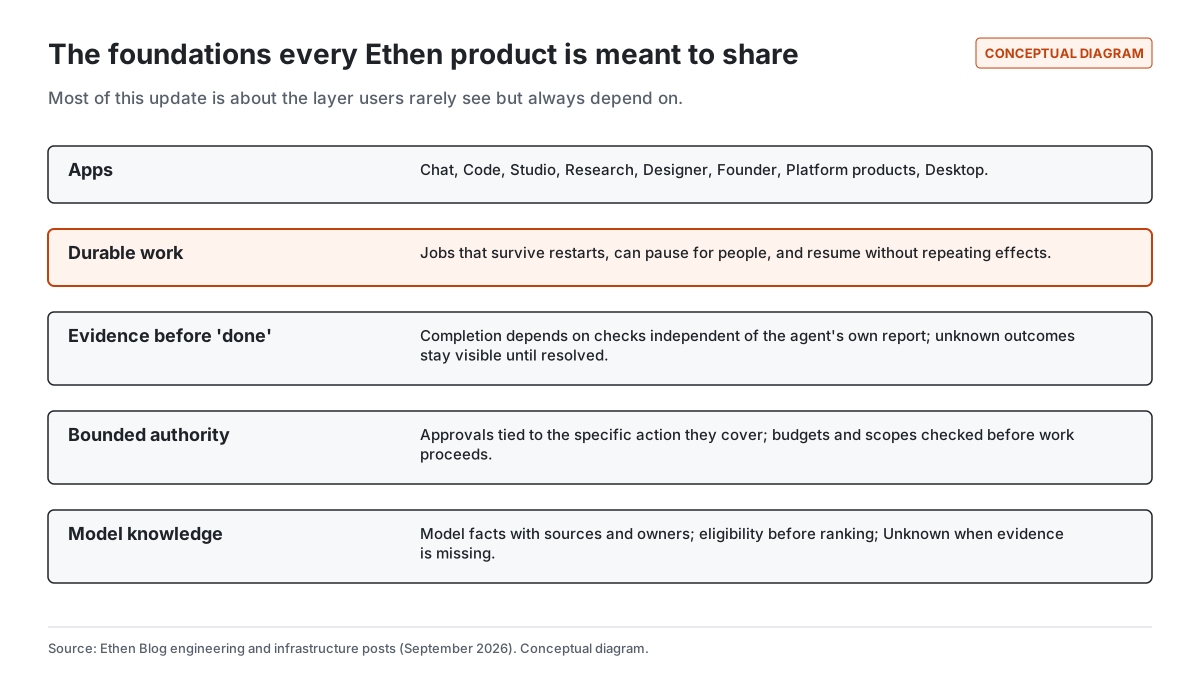
Status: implemented mechanisms, tested under the conditions each post describes. Our posts are explicit that these tests do not establish unattended autonomy or live-provider behavior in every case. Founder — the app for goal-driven jobs — builds on this foundation; its job model is described in How Founder's Job Model Fits Ethen. Founder's end-to-end availability is not claimed here. The user-facing side of this work is the subject of Designing Ethen for Work That Takes Minutes or Hours.
Models: knowledge before preference
Choosing a model is easier when the facts about models are trustworthy. Three implemented pieces are public. The AI Gateway routes by elimination: it removes models that lack a required capability, are unhealthy, or exceed a budget before it ranks anything, and it refuses to pick when nothing is eligible. Model Intelligence shows Unknown when a benchmark value lacks a source, a retrieval date, a methodology or adequate confidence, instead of filling the gap. And each model fact has a named owner, so when two systems disagree there is a defined source of truth. The catalog work also showed how one provider's export collapses into a much smaller set of model families once duplicates are normalized.
Status: implemented mechanisms. Read How Ethen Gateway Chooses an Eligible Model and Showing Unknowns in Ethen Model Intelligence. Why we think this layer deserves investment is in Why Ethen Is Investing in Model Intelligence.
Local: Desktop and local models
Ethen Desktop is the home for local work, including Local Models. The implemented interface between the Desktop window and a local model runtime is deliberately narrow: a fixed set of operations, local addresses only, and a native confirmation from the person before any model is downloaded or deleted. Support differs by runtime, and the code says so rather than pretending every runtime can do everything. Status: implemented mechanism; public Desktop distribution is not claimed in that write-up. See How Ethen Desktop Talks to Local Models.
Research: Ethen Research Lab in public
Ethen Research Lab now publishes its work at the Ethen Research Lab archive: 40 research publications plus the AgentTrustBench system card. The papers are organized into programs — including adaptive intelligence, trust and accountable AI work, evaluation and verification, model intelligence and Faros, data and learning, context and transfer, and enterprise and sovereign AI — and each carries a publication type and evidence status. None of the 40 papers reports a new measured Ethen result. Thirteen are protocols or benchmark designs whose results will only be reported if and when the studies are run. The one measured result in the archive is a system card covering a single pinned build, and it states that it supports no population or live-traffic claim.
The flagship paper, Verified Adaptive Intelligence, sets out the research question that ties the program together: can AI systems learn from work whose outcomes are verified and whose reuse is permitted, in a way that holds up on new work? Why we publish this openly is explained in Why Ethen Research Lab Publishes Its Work in Public.
What this update does not include
We are not publishing launch dates, availability by plan, pricing, customer names, usage numbers or performance metrics in this update. That is a deliberate choice, not an omission. Several of the mechanisms above have been tested under controlled conditions that their posts describe in detail; none of those tests is a certification of production behavior, and we do not want a summary to read stronger than its sources.
What comes next, at a high level
The direction for the coming period follows from the foundations above.
- Carry the foundations into more of the product. The value of durable jobs, evidence-gated completion and bound approvals comes from applying them consistently across apps.
- Make long-running work legible to people. Status, pause, resume and review need to be as clear as the mechanisms underneath.
- Keep model facts honest as the catalog grows. More models make provenance and Unknowns more important, not less.
- Keep authority narrow by default. Approvals, scopes and budgets should become easier to read and harder to bypass, so that delegating more work does not mean trusting more blindly.
- Start running the studies the Lab has specified. When a protocol is run, its results — including negative ones — will be published with the same evidence labels.
Frequently asked questions
Is this Ethen's roadmap? It is a dated description of what we are building and why. It does not include dates or commitments, and direction can change.
Which of these can I use today? Check the relevant product page. This update separates implemented mechanisms from direction, but implemented code is not the same as availability for every customer.
Where do I find the evidence behind each statement? Each section links to the engineering, product or research post it summarizes. Those posts state their own limits.
Update notes
- October 2026: first edition. Future updates will be published as new dated posts; this page will receive notes rather than silent revisions.
Related Ethen research
- Verified Adaptive Intelligence: Learning From Work That Can Be Proven — the research thesis (research synthesis; no measured results).
- Unknown Effects in Autonomous AI Systems — why timeouts are not permission to retry (research synthesis).
Related Ethen products and topics
- AI Agents and Autonomous Work — Ethen's hub for long-running agent work.
- Ethen AI Gateway and Ethen Model Intelligence.
- Ethen Code and Ethen Local Models.
References
- Ethen Blog (2026). How Upcube Is Organizing Ethen Across Specialized Apps. https://upcube.ai/blog/how-upcube-is-organizing-ethen-across-specialized-apps
- Ethen Blog (2026). How Ethen Chat Starts a Voice Session. https://upcube.ai/blog/how-ethen-chat-starts-a-voice-session
- Ethen Blog (2026). Three Places to Use Ethen Code. https://upcube.ai/blog/three-places-to-use-ethen-code
- Ethen Blog (2026). Building Durable Image and Video Jobs in Ethen Studio. https://upcube.ai/blog/building-durable-image-and-video-jobs-in-ethen-studio
- Ethen Blog (2026). Inside Ethen's Durable Job Service. https://upcube.ai/blog/inside-ethens-durable-job-service
- Ethen Blog (2026). Making Mission Completion Depend on Evidence. https://upcube.ai/blog/making-mission-completion-depend-on-evidence
- Ethen Blog (2026). When an Agent Action's Outcome Is Unknown. https://upcube.ai/blog/when-an-agent-actions-outcome-is-unknown
- Ethen Blog (2026). Binding Computer-Use Approvals to Specific Actions. https://upcube.ai/blog/binding-computer-use-approvals-to-specific-actions
- Ethen Blog (2026). How Ethen Gateway Chooses an Eligible Model. https://upcube.ai/blog/how-ethen-gateway-chooses-an-eligible-model
- Ethen Blog (2026). Showing Unknowns in Ethen Model Intelligence. https://upcube.ai/blog/showing-unknowns-in-ethen-model-intelligence
- Ethen Blog (2026). How Ethen Desktop Talks to Local Models. https://upcube.ai/blog/how-ethen-desktop-talks-to-local-models
- Ethen Research Lab (2026). Research Publications V1 and AgentTrustBench system card. https://upcube.ai/resources/research