Why User-Controlled AI Memory Matters
User-controlled AI memory matters because memory is what makes an AI assistant genuinely useful over time — and also what makes it personal, sensitive and capable of being wrong about you. An assistant that remembers your role, your projects and your preferences saves you from repeating yourself. The same memory can go stale, leak from one context into another, influence answers without your knowledge, or hold more than you meant to share. The answer is not to avoid memory but to put it under your control: you should be able to see what is remembered and where it came from, correct or delete it, pause remembering, keep personal and work memory separate, export it, and see when a memory influenced what the assistant did. Those controls are the direction for memory in Ethen.
User-controlled AI memory matters because memory is what makes an AI assistant genuinely useful over time — and also what makes it personal, sensitive and capable of being wrong about you. An assistant that remembers your role, your projects and your preferences saves you from repeating yourself. The same memory can go stale, leak from one context into another, influence answers without your knowledge, or hold more than you meant to share. The answer is not to avoid memory but to put it under your control: you should be able to see what is remembered and where it came from, correct or delete it, pause remembering, keep personal and work memory separate, export it, and see when a memory influenced what the assistant did. Those controls are the direction for memory in Ethen.
Key takeaways
- Memory is personal data. What an assistant remembers about you deserves the same care as any other personal information.
- Control improves accuracy, not just privacy. People who can see and correct memories make them more accurate.
- Separation matters. Work, personal and client contexts should not bleed into each other.
- Explanation builds trust. Knowing which memory shaped an answer lets you judge it.
- Deletion has honest limits. Deleting a memory should stop its use; claims beyond that should be stated carefully.
Why should I let an AI assistant remember anything?
You should let an assistant remember things because repetition is one of the biggest costs of using AI without memory. Without memory, every conversation starts from zero: you re-explain your role, re-paste your project's background, re-state your preferences, and re-describe the decision you made last week. With good memory, the assistant starts informed. It knows you prefer short summaries, that you lead a small design team, that the project you are working on has a deadline at the end of the month, and that you already ruled out one option.
That usefulness is real, and it is exactly why memory needs controls. The more an assistant remembers, the more its behavior depends on things you may not be able to see.
What goes wrong when memory is not under your control?
Uncontrolled memory fails people in five recognizable ways.
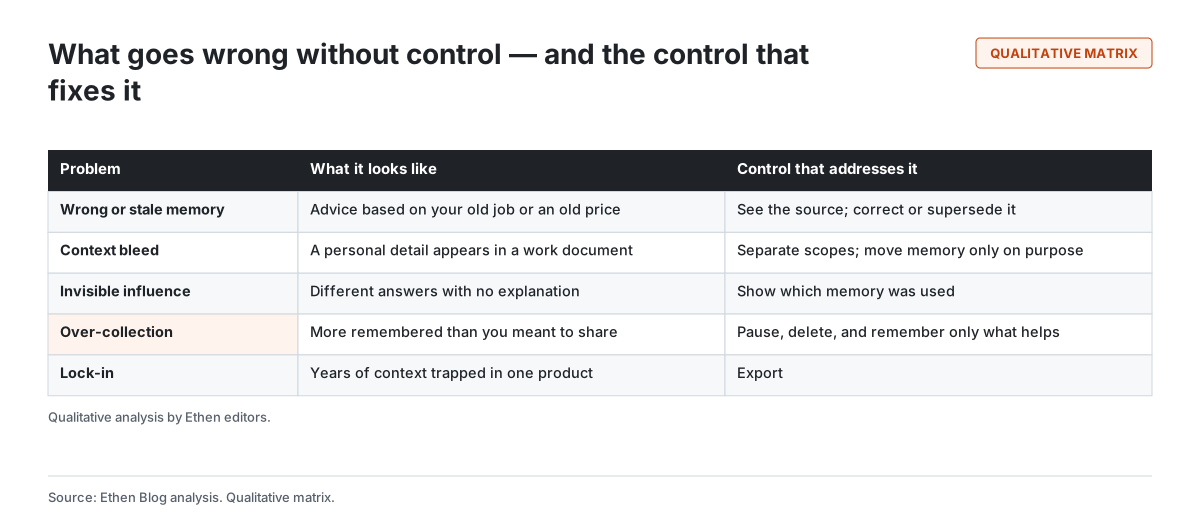
Wrong or stale memory. You changed jobs, a price changed, a plan was cancelled — but the assistant keeps using the old fact. Without a way to see and correct it, you may not even know why its advice is off.
Context bleed. A detail you mentioned in a personal conversation surfaces in a work document, or something about one client appears while you work for another. For professionals who handle confidential information, this is not an inconvenience; it is a breach of trust with their own clients.
Invisible influence. The assistant behaves differently and you cannot tell why. Was it something it remembered? Which thing? Human-AI interaction research has long recommended that AI systems make clear why they did what they did, so that people can calibrate their trust (Amershi et al., 2019).
Over-collection. The assistant remembers more than you meant to share — a passing remark about your health, a family detail, a frustration with a colleague. Memory that accumulates without limits becomes a profile, whether anyone intended it to or not.
Lock-in. Years of accumulated context become a reason you cannot leave a product, rather than a benefit you own.
Why is memory a privacy question?
Memory is a privacy question because memories are personal data, and personal data is more identifying than it looks. It is tempting to think that removing names makes information safe. It often does not. Recent research has shown that language models can link pseudonymous online profiles to the people behind them at scale, reaching high precision in settings where older methods largely failed (Lermen et al., 2026). Ethen Research Lab's work draws the same lesson for AI records generally: pseudonymization is not anonymization, and detailed records should be treated as private unless a specific analysis shows otherwise. See From AI Traces to Verified Experience.
Derived forms of memory deserve the same caution. Summaries, notes and compressed representations of what you said can carry much of the original information. Ethen Research Lab's survey Private AI Improvement Without Raw Data Export puts it bluntly: an embedding is not automatically safe, and an aggregate is not automatically anonymous. Control over memory therefore has to cover not only the facts an assistant stores but what it derives from them.
What does real control look like?
Real control is more than an on/off switch. It has four parts.
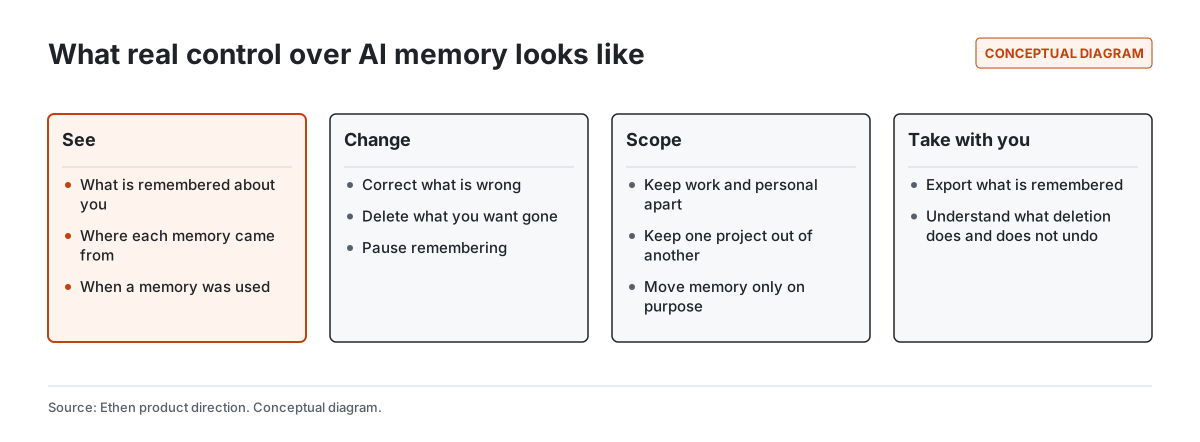
See. You should be able to view what is remembered about you, see where each memory came from — which conversation, which document — and see when a memory was used to shape an answer or an action. Visibility is the foundation of every other control.
Change. You should be able to correct a memory that is wrong, delete one you want gone, and pause remembering entirely when you want a conversation that leaves no trace in memory. Correction matters as much as deletion: a corrected memory makes the assistant more accurate.
Scope. You should be able to keep work and personal memory apart, keep one project's context out of another, and move information between scopes only when you choose to. Ethen's broader direction separates memory into kinds — preferences, personal facts, project context, organizational knowledge, procedures and commitments — precisely so that each can have its own scope; see How We're Rethinking AI Memory Across Ethen.
Take it with you. You should be able to export what is remembered, and understand clearly what deletion does and does not undo.
What are good defaults for AI memory?
Controls matter, but most people will never open a settings page. Defaults decide what actually happens. We think good defaults for memory follow five rules.
Remember what clearly helps. Stated preferences, your role, the projects you are working on — facts you would be annoyed to repeat.
Ask before remembering what is sensitive. Health, finances, family, other people's personal details. If something sensitive seems worth remembering, the assistant should ask rather than assume.
Keep scopes separate by default. Personal memory stays personal; project context stays with its project; client work stays with its client.
Let memories age. Facts about plans, prices and situations go stale. Memories that have not been confirmed or used in a long time should be candidates for review rather than permanent truths.
Make the memory view one step away. If seeing what is remembered takes five clicks, few people will ever look.
What about shared and team settings?
Memory gets more complicated when people work together. A project shared by a team accumulates context that belongs to the team — sources, decisions, open questions — and that context should be visible to everyone on the project and to no one else. Personal memory, by contrast, should never become team memory just because a person mentioned something while working on a shared project. When someone leaves a team, the team's context should stay with the team, and their personal memory should leave with them. Administrators of an organization may need oversight of organizational knowledge; they should not, by default, see individuals' personal memory.
Questions to ask any AI assistant about memory
Whether you use Ethen or another assistant, these questions reveal how much control you really have.
- Can I see everything you remember about me, with where it came from?
- Can I correct a memory, not just delete it?
- Can I keep work and personal memory separate?
- Will you tell me when a memory affected an answer?
- What exactly happens when I delete something — and what doesn't it undo?
- Is my memory used to train models, and can I say no?
- Can I export what you remember?
Can an AI really forget?
An AI system can stop using a memory; whether it can make every trace disappear depends on where the information went. Deleting a stored memory should stop it from being retrieved, shown or used to create new memories. That is the commitment a product can actually keep and verify.
Information that has already shaped something else is harder. A summary written from a deleted memory may still contain it unless it is also removed. And if personal information were ever used to train a model's weights, reliably removing its influence is an open research problem: studies have found that approximately "unlearned" language models can sometimes be prompted to recover removed information after light retraining on related data (Hu et al., 2024). Ethen Research Lab's note Rights as Infrastructure responds to this by recommending honesty — trace what was derived from what, and remove or rebuild it, rather than promising that a model has forgotten. The simplest protection follows from the same reasoning: memory used to help you should stay separate from data used to improve models, and any such use should require its own explicit permission. That separation of purposes is the principle Ethen's research recommends, and it is the direction we hold for memory.
How does this fit with data-protection rules?
Many data-protection regimes give people rights over their personal data that align with these controls — for example, the European Union's General Data Protection Regulation includes rights of access, rectification and erasure (Regulation (EU) 2016/679). User controls over AI memory make it easier to honor such rights in practice. This article describes product design, not legal advice; how specific obligations apply depends on the jurisdiction and the deployment.
What does Ethen do today, and what is direction?
Memory is part of Ethen Chat's defined scope. Some isolation is already implemented: coding run history in Ethen Code is stored per signed-in account on both web and desktop, cleared on sign-out, and kept separate between accounts on the same device; see Keeping Code History Scoped to the Signed-In User. The full set of controls described in this article — seeing sources, scoped memory, explaining influence, export and clear deletion semantics — is the direction for memory across Ethen, not a description of every shipped feature. Ethen's broader approach to protecting data is outlined on Ethen Enterprise Security.
An example
Illustrative example — describes intended controls, not a specific shipped screen.
A freelance writer uses Ethen for personal planning and for two magazine clients. She opens her memory view and sees twelve remembered items, each with a source. One says she lives in a city she moved away from last year; she corrects it. One records a health detail she mentioned in passing while planning a trip; she deletes it, and the view confirms it will no longer be used or included in new summaries. Her client work lives in two separate projects, so notes from one magazine never appear in drafts for the other. Before a sensitive interview, she pauses memory for the session. When Ethen suggests a deadline plan, a short line shows it used "prefers mornings for writing" and "Magazine B deadline: 14th" — and she can see exactly why the plan looks the way it does.
Tradeoffs
More control means more choices, and some people want memory to "just work". Good defaults matter: remember what clearly helps, ask before remembering what is sensitive, and keep scopes separate unless told otherwise. Visible memory can also be uncomfortable — seeing what an assistant knows about you is a different experience from not knowing. We think that discomfort is healthier than the alternative, and that people who can see their memory will trust the assistant more, not less.
Frequently asked questions
Should I let my AI assistant remember things about me? It can save a lot of repetition, and it is most useful when you can see, correct, scope and delete what it remembers.
Can I make an AI forget something I told it? You should be able to delete a memory so it is no longer used. Whether every trace disappears depends on what was derived from it; good products explain that clearly.
Is AI memory used to train models? It should not be by default. Memory used to help you should be separate from data used to improve models, with any such use requiring its own explicit permission.
What memory controls should an AI assistant have? At minimum: view with sources, correct, delete, pause, separate scopes for work and personal use, export, and an indication of when memory was used.
Related reading
- How We're Rethinking AI Memory Across Ethen
- What We Want “My Ethen” to Feel Like
- Rights as Infrastructure — Ethen Research Lab architecture proposal (requires legal review).
References
- Amershi, S. et al. (2019). Guidelines for Human-AI Interaction. Proceedings of CHI 2019. https://www.microsoft.com/en-us/research/publication/guidelines-for-human-ai-interaction/
- Lermen, S. et al. (2026). Large-scale online deanonymization with LLMs. arXiv:2602.16800. https://arxiv.org/abs/2602.16800
- Hu, S. et al. (2024). Unlearning or Obfuscating? Jogging the Memory of Unlearned LLMs via Benign Relearning. arXiv:2406.13356. https://arxiv.org/abs/2406.13356
- Regulation (EU) 2016/679 (General Data Protection Regulation). https://eur-lex.europa.eu/eli/reg/2016/679/oj
- Ethen Blog (2026). Keeping Code History Scoped to the Signed-In User. https://upcube.ai/blog/keeping-code-history-scoped-to-the-signed-in-user
- Ethen Research Lab (2026). From AI Traces to Verified Experience. Research note; research synthesis. https://upcube.ai/resources/research/verified-experience
- Ethen Research Lab (2026). Private AI Improvement Without Raw Data Export. Survey and proposal. https://upcube.ai/resources/research/private-ai-improvement
- Ethen Research Lab (2026). Rights as Infrastructure. Research note; architecture proposal; requires legal review. https://upcube.ai/resources/research/rights-as-infrastructure