What We Want “My Ethen” to Feel Like
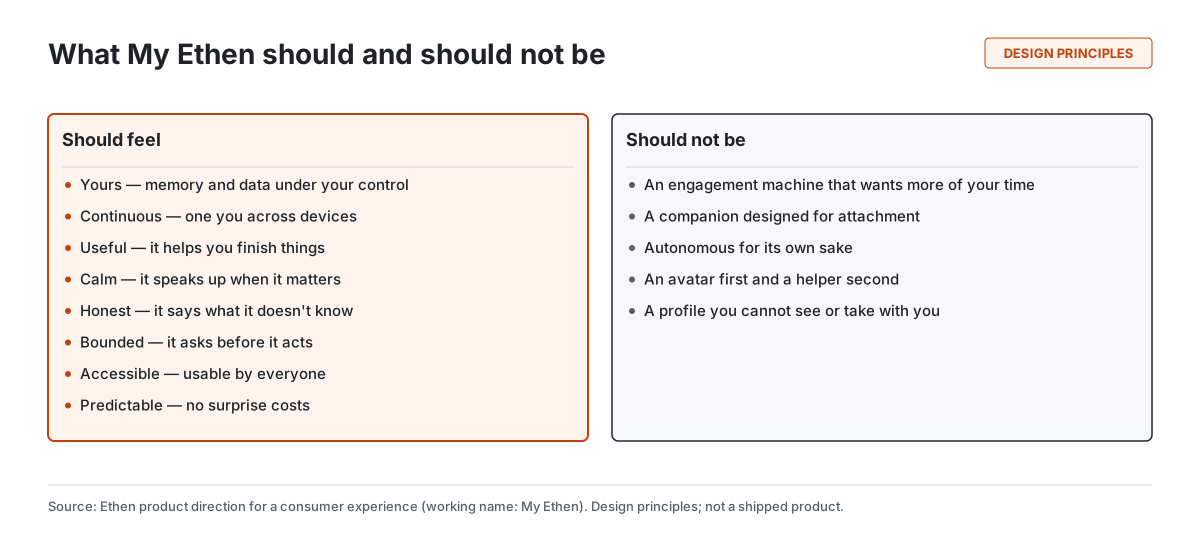
"My Ethen" is our working name for a personal Ethen experience: the place where your preferences, memory, projects and the things you have asked Ethen to handle come together, across your devices. It is a direction, not a launched product, and its final form and name may differ. What we can describe now is what we want it to feel like. It should feel yours — memory and data you can see and control. Continuous — one you across phone, laptop and desktop. Useful — it helps you finish things rather than keeping you talking. Calm — it speaks up when something matters and otherwise stays out of the way. Honest — it says what it doesn't know. Bounded — it asks before it acts on your behalf. Accessible — usable by everyone. And predictable — no surprise costs. Just as deliberately, it should not be an engagement machine, a companion designed for attachment, autonomous for its own sake, or an avatar first and a helper second.
"My Ethen" is our working name for a personal Ethen experience: the place where your preferences, memory, projects and the things you have asked Ethen to handle come together, across your devices. It is a direction, not a launched product, and its final form and name may differ. What we can describe now is what we want it to feel like. It should feel yours — memory and data you can see and control. Continuous — one you across phone, laptop and desktop. Useful — it helps you finish things rather than keeping you talking. Calm — it speaks up when something matters and otherwise stays out of the way. Honest — it says what it doesn't know. Bounded — it asks before it acts on your behalf. Accessible — usable by everyone. And predictable — no surprise costs. Just as deliberately, it should not be an engagement machine, a companion designed for attachment, autonomous for its own sake, or an avatar first and a helper second.
Key takeaways
- The goal is finished things, not more screen time. A personal AI is useful when it closes loops in your life.
- Yours means controllable. Memory you can see, correct, scope, delete and export.
- One you, many devices. Continuity across devices without every device holding every permission.
- Ask before acting. Anything consequential on your behalf waits for your approval.
- Non-goals matter. Engagement, attachment and autonomy for its own sake are explicitly not what we are building.
What is My Ethen?
My Ethen is the direction for a coherent personal experience of Ethen. Today, people meet Ethen through specific apps — Ethen Chat for conversation, Studio for creative work, Code for software, Desktop for local work. A personal layer would bring the parts of Ethen that are about you together: your preferences and memory, your ongoing personal projects, the pieces of work you have asked Ethen to carry out, and the integrations you have chosen to connect. It would be available wherever you use Ethen, and it would keep the same rules about control and approval everywhere.
We are being careful with the name and scope because both are unsettled. This article does not announce a product, a release date or pricing. It describes the experience we are designing toward, and the principles we will use to judge whether we got there.
Why does a personal AI need different design principles?
A personal AI needs different principles because it is close to people's lives in a way a work tool is not. It hears about plans, worries, finances, family and health. It may be asked to act — book, pay, send, reply — on someone's behalf. And it competes for attention with everything else on a person's phone. Design choices that are harmless in a work tool — remembering everything, encouraging longer sessions, acting quickly to be helpful — can become intrusive or harmful in a personal one.
So we start from what a personal AI is for. Our answer is simple: it should help you finish things. Organize a decision with the evidence in one place. Keep a personal project moving. Look into a problem and come back with what it found. Carry out a bounded task you approved. Measured by that standard, success is fewer loose ends and less effort — not more time spent talking to an AI.
Yours: memory and data under your control
A personal AI is only trustworthy if what it knows about you is under your control. You should be able to see what it remembers and where each memory came from, correct what is wrong, delete what you want gone, pause remembering, keep different parts of your life separate, export your memory, and see when a memory shaped what it said or did. We explain the reasoning in Why User-Controlled AI Memory Matters and the broader memory model in How We're Rethinking AI Memory Across Ethen.
"Yours" also means that personal memory is for helping you. Ethen Research Lab's research recommends keeping consent separate by purpose — help me, improve my own experience, contribute to research, train models — so that agreeing to one never implies the others (Rights as Infrastructure, an architecture proposal requiring legal review). That is the principle we intend My Ethen to follow.
Continuous: one you, many devices
People move between phone, laptop and desktop through the day. A personal AI should move with them: a question started on a laptop can be continued by voice on a walk; a plan drafted on a phone can be refined on a desktop. That continuity is part of what Ethen is building across desktop, web and local AI.
Continuity has a boundary that matters. One identity across devices does not mean every device holds every permission. The phone you carry everywhere does not need the same access as the desktop at home, and a device you lose should be easy to cut off without disturbing the rest. One you, many devices — each with only the access it needs.
Useful: it helps you finish things
The test of usefulness is whether something gets done. A personal AI should be good at the kinds of tasks people actually leave unfinished: comparing options for a decision, keeping track of a project's next steps, chasing down why a bill is wrong, preparing a document that needs information from several places. For each, the outcome should come back finished and checkable — a comparison with sources, a draft ready to send, a list of what was resolved and what still needs a decision — rather than as a long transcript to read through.
This is the same principle that shapes delegated work across Ethen, described in What Ethen Work Is Meant to Become: define what done means, set boundaries, and get the result back with evidence.
Projects: what continuity is really about
Continuity is less about remembering every message and more about keeping track of the things you are working on. Most of what people leave unfinished is not a single question. It is a small project with several moving parts: a kitchen renovation with quotes, a deposit and a contractor's schedule; a job search with applications, follow-ups and interview notes; a move with a lease, utilities and a change of address. Each has a state — what has been decided, what is waiting on someone else, what is due next — and that state is what a personal AI should carry from one day and one device to the next.
So we think of the personal project, not the conversation, as the unit My Ethen should organize around. A project would hold its own notes, files, decisions and open items, and the memory attached to it would stay with it rather than leaking into everything else. That keeps unrelated parts of your life apart, makes it easy to see why the assistant knows something, and lets you close a project and have its working memory close with it. When you come back after a week, the useful question is not "what did we talk about?" but "where does this stand, and what is waiting on me?" — and a project is the right place to answer it.
How My Ethen relates to the rest of Ethen
My Ethen is not meant to replace Ethen's specialized apps. Ethen Chat remains the place for conversation, Ethen Studio for creative work, Ethen Code for software and the desktop app for local work; the reasons Ethen is organized this way are set out in Why Ethen Is a Family of Specialized AI Apps. A personal layer would sit across them: the same preferences, the same personal projects and the same controls, whichever app you happen to be in. The apps do the work; the personal layer remembers what you are trying to accomplish and who is allowed to do what on your behalf. If that layer ever behaves differently from one app to another — remembering here, forgetting there, asking for approval in one place and not another — it has failed at the one thing it exists to provide.
Calm: it speaks up when it matters
A personal AI should not compete for your attention. It should speak up when something genuinely needs you — a decision, an approval, a deadline you asked it to watch — and otherwise stay out of the way. Human-AI interaction guidelines recommend timing interventions to a person's context and making AI behavior easy to dismiss or correct (Amershi et al., 2019). For a personal assistant, that translates into fewer, better notifications, and no artificial reasons to come back.
Honest: it says what it doesn't know
A personal AI that sounds equally confident about everything will eventually mislead you about something that matters. My Ethen should show where its information came from, mark what it could not verify, and say plainly when it does not know. We describe this principle across Ethen in Why Ethen Shows What It Knows—and What It Doesn't.
Bounded: it asks before it acts
A personal AI that can act — send, buy, book, reply, cancel — must ask before doing anything consequential on your behalf. Routine, reversible steps within what you have allowed can proceed; payments, messages to other people, commitments and anything hard to undo wait for your approval, bound to the exact action. Some powers should never be delegated at all. We explain where approvals belong in Why Ethen Keeps Human Approval in the Loop.
Accessible: usable by everyone
A personal AI should work for people with different abilities, devices and preferences. That means interfaces that meet established accessibility guidelines — such as the Web Content Accessibility Guidelines, currently in version 2.2 (W3C) — voice as a first-class way in, and a clear, conventional interface that does not depend on novelty. Some ideas for personal AI emphasize avatars or immersive presence. We think those are optional at best; a clear interface that everyone can use comes first.
Predictable: no surprise costs
A personal AI that can run tasks in the background can also spend money in the background — on compute, on paid lookups, on purchases. Costs should be visible before work runs, limits should be explicit, and nothing should exceed them without asking. Predictability is part of trust.
What My Ethen should not be
We are as deliberate about the non-goals as the goals.
Not an engagement machine. We do not want a personal AI that measures success by how long you spend with it. Time spent is a cost, not a benefit.
Not a companion designed for attachment. A helpful assistant can be warm and personable. It should not be engineered to make people emotionally dependent on it.
Not autonomous for its own sake. Acting without being asked is not a feature. A personal AI should do what you delegated, within the bounds you set, and ask when something falls outside them.
Not avatar-first. Visual presence can be pleasant. It is never a substitute for being useful, honest and controllable.
Not an invisible profile. Whatever it knows about you, you should be able to see and take with you.
How will we know if we got it right?
We will judge a personal Ethen experience by whether people finish more of what they set out to do with less effort and fewer corrections, whether they feel in control of what it knows and does, and whether its costs stay predictable — not by time spent or messages sent. These are directional criteria, not published metrics. If we ever report numbers about them, they will come with their method and limits.
An illustrative day
Illustrative example — a hypothetical scenario, not a shipped feature set.
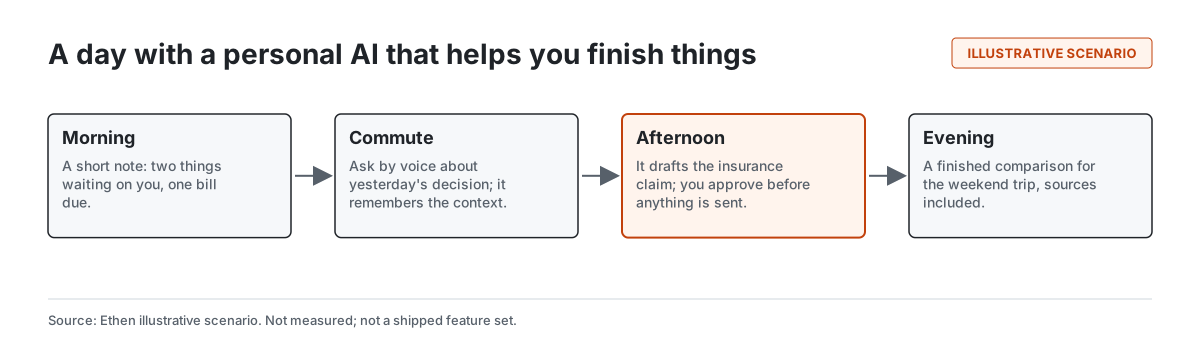
In the morning, a short note: two items are waiting on you and a bill is due Thursday. On the commute, you ask by voice whether you decided on the contractor for the kitchen; it reminds you that you were waiting for a second quote and that the quote arrived last night. In the afternoon, you ask it to prepare an insurance claim for a damaged phone; it gathers the receipt and the policy details, drafts the claim, and waits — nothing is submitted until you read it and approve. In the evening, a comparison of three options for a weekend trip arrives, with prices, sources and one note that a hotel's price could not be confirmed. You spent maybe ten minutes with it all day. Several loose ends are closed.
Tradeoffs
Calm and bounded assistants can feel less impressive in a demo than ones that do things unprompted. Asking before acting adds a step. Strict memory controls mean some convenience is traded for clarity. Predictable costs require limits that sometimes stop useful work and ask. We think those trade-offs are what make a personal AI something people can live with rather than something they have to manage.
Frequently asked questions
Is My Ethen available? No. My Ethen is a working name for a personal Ethen experience we are designing. This article describes direction.
How is My Ethen different from Ethen Chat? Ethen Chat is the conversational app. My Ethen describes a personal layer — your memory, projects, delegated tasks and controls — available wherever you use Ethen.
Will My Ethen act without asking me? Routine, reversible steps within what you allowed can proceed. Anything consequential — payments, messages to others, commitments — is designed to wait for your approval.
Will what I tell it be used to train AI models? Our principle is that memory used to help you is separate from data used to improve models, and any such use should require its own explicit permission.
Related reading
References
- Amershi, S. et al. (2019). Guidelines for Human-AI Interaction. Proceedings of CHI 2019. https://www.microsoft.com/en-us/research/publication/guidelines-for-human-ai-interaction/
- W3C. WCAG 2 Overview (Web Content Accessibility Guidelines 2.2). https://www.w3.org/WAI/standards-guidelines/wcag/
- Ethen Research Lab (2026). Rights as Infrastructure: Building AI Datasets That Know How They May Be Used. Research note; architecture proposal; requires legal review. https://upcube.ai/resources/research/rights-as-infrastructure