Why Ethen Founder Is About Outcomes, Not More Chat
Ethen Founder is built around a simple idea: founders do not need another place to talk to AI; they need work carried through to a result they can check. So Founder's unit of work is the job, not the conversation. You state a goal and its limits. Founder plans the steps, does the research and the work, stops for your approval before anything consequential, checks the result against the goal, and hands back an outcome with its evidence, spend and history attached. That design makes Founder a separate app from Ethen Chat rather than a chat mode. It also comes with explicit limits on what Founder may do on your behalf. This article explains the thinking, what is published about Founder's design, and what has not yet been proven.
Ethen Founder is built around a simple idea: founders do not need another place to talk to AI; they need work carried through to a result they can check. So Founder's unit of work is the job, not the conversation. You state a goal and its limits. Founder plans the steps, does the research and the work, stops for your approval before anything consequential, checks the result against the goal, and hands back an outcome with its evidence, spend and history attached. That design makes Founder a separate app from Ethen Chat rather than a chat mode. It also comes with explicit limits on what Founder may do on your behalf. This article explains the thinking, what is published about Founder's design, and what has not yet been proven.
Key takeaways
- Founder's unit is the job. A job is a goal carried to a result, not a reply.
- Outcomes need evidence. A job is done when its result is checked, not when the agent says so.
- Approvals are part of the product. Consequential steps wait for a person's decision.
- Authority has limits. Founder can plan, recommend and prepare; it does not commit you, hire for you or spend without limits.
- Design is published; end-to-end operation is not yet proven. We say which is which.
What is Ethen Founder?
Ethen Founder is Ethen's standalone app for autonomous jobs. It is designed for founders and small teams who want to hand over a piece of work — research a market, compare suppliers, prepare a monthly update for stakeholders, organize a launch checklist — and get back a finished, reviewable result.
The published engineering description, How Founder's Job Model Fits Ethen, describes the product's shape. Founder has its own surfaces organized around the life of a job: creating jobs and tracking them; following plans, runs and tasks; recording evidence and results; granting approvals; and keeping files, connections, spend and activity attached to the work. A job is a durable object with a plan, a spend record, an approval history and evidence — not a single model response.
That same post is careful about status, and so are we. It shows the standalone app boundary and a guarded job lifecycle in code. It states plainly that end-to-end integration with Ethen's wider execution infrastructure and unattended autonomous operation are not yet proven, and it makes no availability claim. This article explains why Founder is designed the way it is. It does not announce a launch.
Why outcomes instead of more chat
A chat assistant is excellent at producing answers. Ask it how to structure a pricing page, and it will tell you. But the founder still has to do the work: find competitor pages, collect the facts, draft the page, check the claims, get it reviewed. The answer is the beginning of the work, not the end of it.
Most of a founder's AI wish list looks like the second half of that sentence. Founders are short on time, not on advice. What they want is for a bounded piece of work to be finished well enough that they can review it in minutes instead of doing it in hours.
Doing that inside a chat thread is awkward for three reasons.
Work outlives a conversation. A real job takes longer than a chat session. It may need to wait for a reply, pause overnight, retry after a failure or resume after an approval. A thread is a poor container for that: it has no notion of a step that is pending, a decision that is waiting or a run that failed halfway.
Work needs a record. When a job is done, you need to know what was done, what it cost, what sources it used and who approved what. A transcript is a record of what was said, which is not the same thing.
Work needs a finish line. In chat, the conversation ends when the reply ends. A job ends when its result has been checked against the goal. Without that check, "done" is just the agent's opinion.
Figure 1 summarizes the difference.
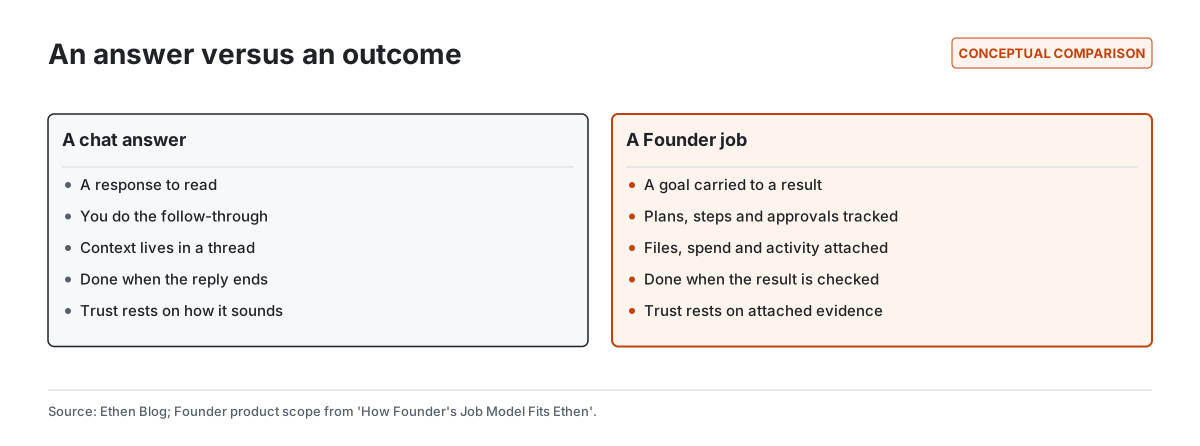
None of this is a criticism of chat. Chat remains the right tool for thinking, asking and drafting, and Ethen Chat is deliberately kept focused on that, as explained in Keeping Ethen Chat Focused. Founder exists because finished work needs a different container.
How a Founder job is meant to move
A Founder job is designed to move through six stages, as Figure 2 shows: goal, plan, research and action, approval, verification and delivery.
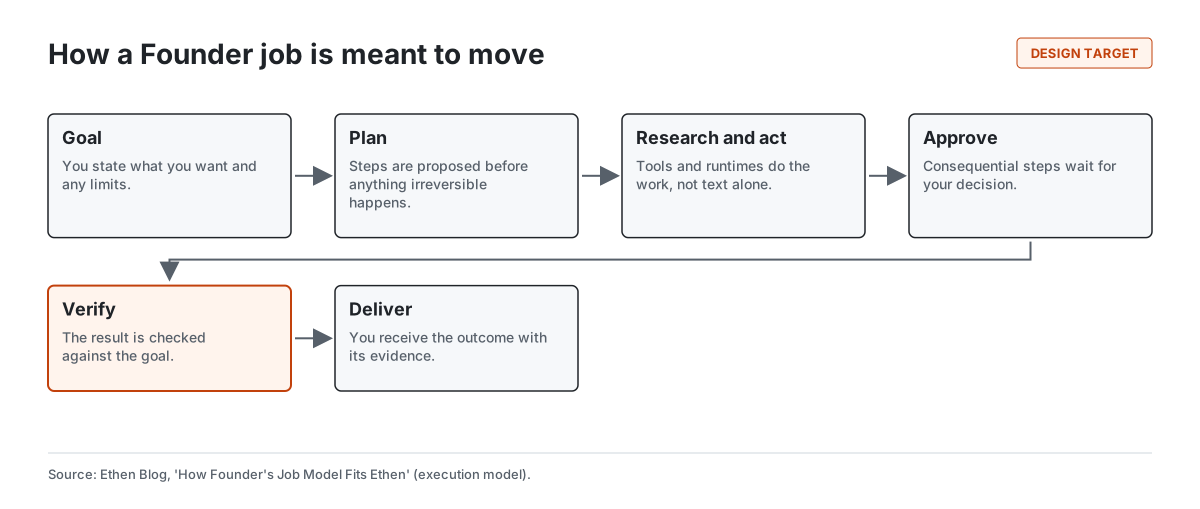
Goal. You state what you want, and the limits that apply: a budget, a deadline, sources to use or avoid, things not to do. A clear goal is the most important input, because it is what the result will be checked against.
Plan. Founder proposes the steps before taking any of them. Planning first means you can catch a misunderstanding before anything irreversible happens, and it gives the job a structure to report progress against.
Research and act. Founder does the work using tools and runtimes, not only text: gathering sources, comparing information, drafting documents, preparing actions. This is the part most people picture when they think of an AI agent.
Approve. Steps with consequences — sending something to another person, committing money, publishing, changing a shared system — wait for your decision. We explain why we keep people in the loop in Why Ethen Keeps Human Approval in the Loop.
Verify. The result is checked against the goal. Were all the requested items covered? Do the facts in the draft match the sources gathered? Is anything still unfinished? This stage is highlighted because it is the one most AI tools skip.
Deliver. You receive the outcome together with its evidence, spend and history, so you can review it quickly rather than redo it.
The published job lifecycle includes another property that matters to anyone delegating real work. When a job fails and is retried, the retry continues the same logical job as a new attempt rather than creating a duplicate. That sounds like a detail, but it is the difference between a system that can be retried safely and one that quietly multiplies work — or messages, or payments.
What makes an outcome checkable
An outcome is checkable when someone other than the agent can confirm it meets the goal. In practice that means a delivered job should carry three kinds of evidence.
What was asked. The goal, the limits and any changes you made along the way. Without this, there is nothing to check the result against.
What was done. The steps taken, the sources used, the actions performed, the approvals granted and the spend incurred. This is the trail that lets you audit a surprising result.
What was confirmed. Which parts of the result were checked and how, and which parts could not be confirmed. An honest outcome distinguishes "verified" from "believed done".
Ethen Research Lab has explored what a durable record of this kind could look like in Work Receipts: A Verifiable Record for Autonomous AI Work, a technical report, and how an agent can keep track of what is still unfinished in Commitment Graphs, a research proposal. Neither is a description of shipped Founder behavior. Both reflect the same principle: completion should depend on evidence, which we discuss more broadly in What "Done" Should Mean for an AI Agent.
Where Founder's authority stops
An outcome-focused product needs clear limits as much as it needs capability. A founder delegating work is trusting the system with their company's reputation, money and relationships. Figure 3 sets out the boundaries Founder is designed around.
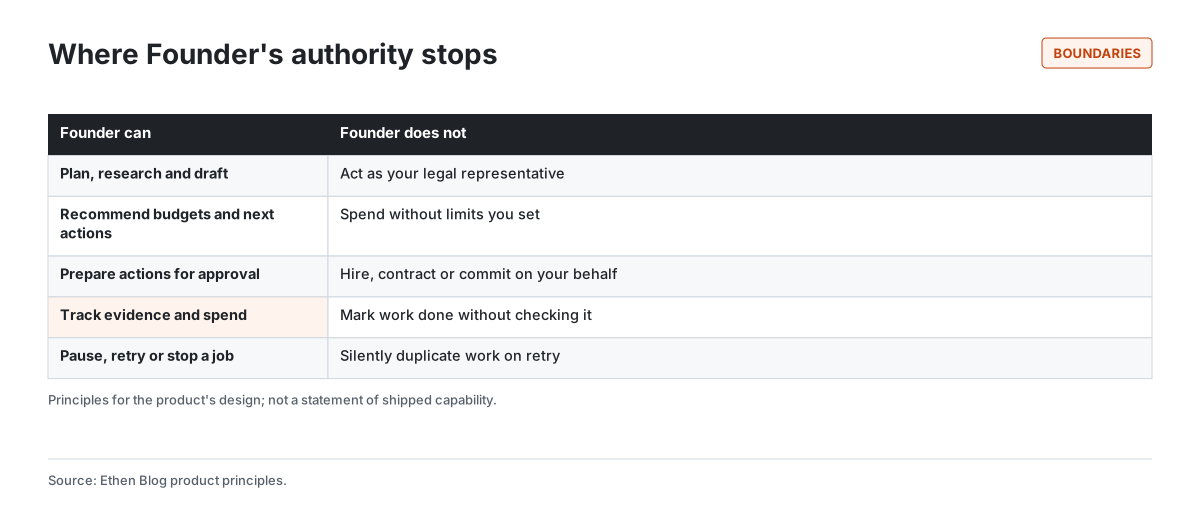
Founder can plan, research, draft, recommend budgets and next actions, prepare actions for your approval, and track what was done and what it cost. It is not designed to become your legal representative, your finance function, your employer of record or an unrestricted purchaser. It should not sign agreements, hire people, make commitments in your name or spend beyond the limits you set.
These limits are deliberate. Research on automation has long distinguished between levels of automation — from systems that only suggest, through systems that act after approval, to systems that act and merely inform — and argued that the right level depends on the function and the cost of errors. Founder applies that idea per step rather than per product: research can be highly autonomous; sending a message to a customer should wait for you; signing a contract should not be delegated at all.
Ethen Research Lab's Mandates research note explores how a person's intent could be turned into bounded authority that an agent cannot exceed. It is research, not a shipped feature, but it is the direction: authority defined up front, approvals for what falls outside it.
Why this matters more as models improve
It might seem that better models will make all this structure unnecessary: a capable enough model will just get things right. The evidence points the other way. Research from METR measuring how long a task AI systems can complete found that the length of tasks frontier models can finish has been growing quickly, roughly doubling every seven months over several years. Longer tasks are exactly where structure matters most. A ten-minute task that goes wrong costs ten minutes. A two-day job that goes wrong — and reports success — can cost a customer.
As agents take on longer work, the questions Founder is designed around become more important, not less: what exactly was asked, what was done, what was approved, what was checked, and what is still unfinished. We make the broader version of this argument in Why Better AI Models Don't Eliminate the Need for Better Products.
What a good first Founder job looks like
Founder is designed for bounded work with a clear finish line. The following examples are illustrative; they describe the kind of work we have in mind, not supported workflows.
- Competitive research. "Compare the pricing pages of these five competitors and summarize differences, with links." The outcome is checkable against the sources.
- Supplier comparison. "Find three suppliers for this component and compare price, lead time and minimum order, with sources." Contacting suppliers waits for approval.
- Monthly update draft. "Draft this month's update from these notes and metrics." Sending it is your decision.
- Launch checklist. "Build a launch checklist from these documents and flag anything missing." Unresolved items are listed, not hidden.
Poor first jobs share the opposite traits: no clear finish line, high-stakes actions without review, or judgment calls that you would not hand to a new colleague. We discuss the general difference between asking and delegating in Asking AI vs Delegating Work to AI, and how we think about AI for founders and small teams more broadly in How We're Thinking About AI for Founders and Small Teams.
How Founder relates to the rest of Ethen
Founder is one of Ethen's specialized apps. Chat is for conversation and quick work and can hand longer jobs to Founder. Ethen's platform capabilities, such as supervised computer use and automation, are designed to be used by Founder jobs rather than rebuilt inside Founder, so that each capability has one owner. We explain the overall structure in Why Ethen Is a Family of Specialized AI Apps and the longer-term direction for delegated work in What Ethen Work Is Meant to Become.
Tradeoffs and limitations
Structure costs speed. Planning, approvals and verification make Founder slower than an agent that simply acts. For consequential work, we think that trade is right.
Verification is only as good as the goal. A vague goal produces a result that is hard to check. Founder can ask clarifying questions, but clear goals remain the user's responsibility.
Not everything can be verified. Some outcomes — the quality of a strategy, the tone of a message — depend on judgment. Founder should say so rather than claim verification it cannot provide.
End-to-end operation is not yet proven. The published design and lifecycle are real. Unattended operation and full integration with Ethen's wider execution infrastructure have not been demonstrated publicly, and nothing here should be read as a launch.
FAQ
What is Ethen Founder? Ethen's standalone app for autonomous jobs: you state a goal, and Founder carries it through planning, research, action, approval and verification to a reviewable outcome.
How is Founder different from a chatbot? A chatbot produces answers in a conversation. Founder manages jobs: durable units of work with plans, approvals, spend, evidence and a checked result.
Can Founder act on my behalf? Within limits. It can research, draft and prepare actions; consequential steps wait for your approval; and it is not designed to sign agreements, hire people or spend beyond limits you set.
Is Ethen Founder available? This article does not announce availability. Status will be stated on Ethen's product pages.
What happens if a Founder job fails? The design is for failures to be visible and recoverable: a retry continues the same job as a new attempt, rather than starting a duplicate.
Related reading
- How Founder's Job Model Fits Ethen
- Asking AI vs Delegating Work to AI
- How We're Thinking About AI for Founders and Small Teams
- What Makes an AI Agent Job Verifiable
- What Ethen Work Is Meant to Become
References
- Ethen Blog. How Founder's Job Model Fits Ethen. https://upcube.ai/blog/how-founders-job-model-fits-ethen
- Kwa, T., West, B., Becker, J., Deng, A., Garcia, K., et al. (2025). Measuring AI Ability to Complete Long Tasks. arXiv:2503.14499. https://arxiv.org/abs/2503.14499
- Parasuraman, R., Sheridan, T. B., & Wickens, C. D. (2000). A model for types and levels of human interaction with automation. IEEE Transactions on Systems, Man, and Cybernetics — Part A, 30(3), 286–297. https://doi.org/10.1109/3468.844354
- Ethen Research Lab (2026). Work Receipts: A Verifiable Record for Autonomous AI Work. Technical report. https://upcube.ai/resources/research/work-receipts
- Ethen Research Lab (2026). Commitment Graphs: Why AI Agents Need to Know What Is Still Unfinished. Research proposal. https://upcube.ai/resources/research/commitment-graphs
- Ethen Research Lab (2026). Mandates: Compiling Human Intent Into Bounded Agent Authority. Research note. https://upcube.ai/resources/research/agent-mandates