From Screen to Physical World: How We Think About Ethen Robotics
The Ethen Robotics Research Lab is a research direction, not a hardware program. It studies the problems every acting agent faces — pursuing goals over many steps, understanding the state of its environment, predicting what its actions will do, recovering when they go wrong, knowing when to stop, and proving that a task is done — and it studies them in software first. Its research questions run from near-term work on reliable action in software, through skills that survive changes in models and tools and digital state models that predict effects before acting, to the far-off question of grounding any of this in the physical world. Physical work, if it ever happens, would come through integration with existing systems, ground truth gathered with partners, and control only by qualified robotics and safety teams under recognized standards. No products, partnerships, dates or results are announced here. This article explains what the Lab studies and how we think about the path from screen to physical world.
The Ethen Robotics Research Lab is a research direction, not a hardware program. It studies the problems every acting agent faces — pursuing goals over many steps, understanding the state of its environment, predicting what its actions will do, recovering when they go wrong, knowing when to stop, and proving that a task is done — and it studies them in software first. Its research questions run from near-term work on reliable action in software, through skills that survive changes in models and tools and digital state models that predict effects before acting, to the far-off question of grounding any of this in the physical world. Physical work, if it ever happens, would come through integration with existing systems, ground truth gathered with partners, and control only by qualified robotics and safety teams under recognized standards. No products, partnerships, dates or results are announced here. This article explains what the Lab studies and how we think about the path from screen to physical world.
Key takeaways
- A research direction, not a hardware program. The Lab does not build robots.
- The problems are shared. Goals, state, prediction, recovery, stopping and proof.
- Software first. Questions are studied where outcomes can be checked exactly.
- Prediction is never fact. Digital state models estimate effects; they do not replace observation.
- Physical work is gated. Partners own motion control and physical safety.
- No results yet. The agenda is published; findings will be published when they exist.
What is the Ethen Robotics Research Lab?
The Ethen Robotics Research Lab is the part of Ethen's research concerned with agents that act — first in software, and possibly, one day, in the physical world. Figure 1 summarizes its scope.
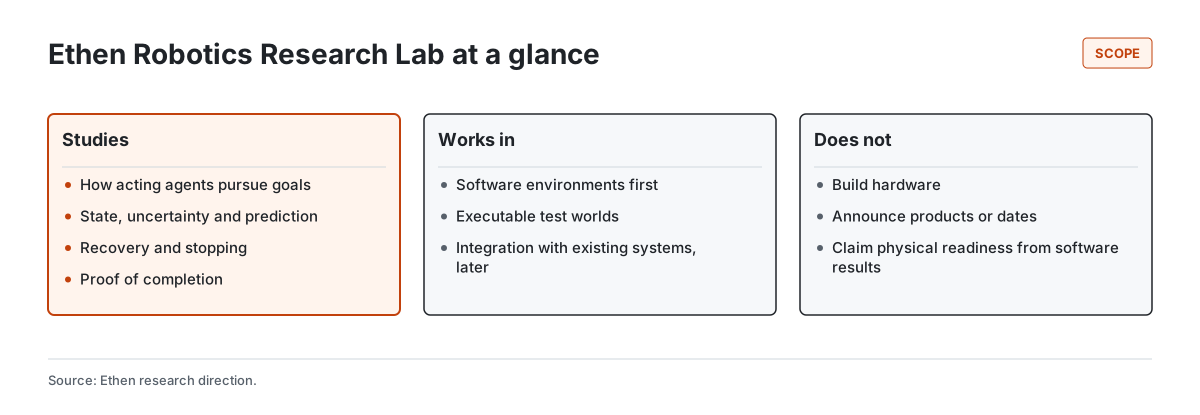
It studies how acting agents pursue goals, represent state and uncertainty, recover from failure, decide when to stop, and prove completion. It works in software environments and executable test worlds first, and would only later study integration with existing physical systems. It does not build hardware, announce products or dates, or claim that results in software establish readiness in the physical world.
The Lab shares methods and standards with Ethen Research Lab as a whole: published questions, explicit evidence statuses, protocols before results. Robotics is a research frontier for Ethen, and we are deliberately cautious about claiming authority in it before we have done meaningful work.
Why the screen comes first
We explain the full reasoning in Why Ethen Is Researching Digital Robots Before Physical Robots. In brief: software environments can be reset, observed and checked far more cheaply and safely than physical ones, and the decision problems that matter most — what to do next, whether it worked, what to do when unsure — are shared between digital and physical robots. Software agents are also useful today, which gives the research real tasks and real outcomes to learn from.
What software cannot teach is motor control, force, contact and physical safety. Those belong to robotics, and to robotics experts.
The research questions
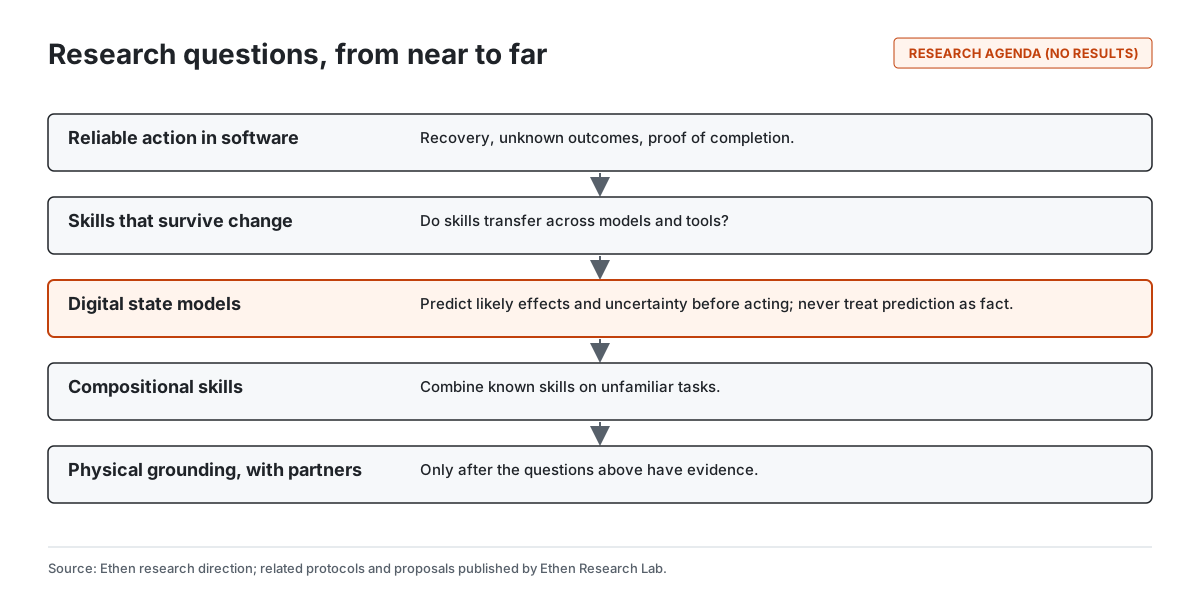
Figure 2 sets out the Lab's research questions, from near to far. None of them has published results yet.
Reliable action in software
How should an agent recover when an action fails partway, or when it cannot tell whether an action succeeded? How should it decide between retrying, reconciling, escalating and stopping? How can it prove a task is complete? Ethen Research Lab has published work on each: Recovery Atlas, a research proposal on recovery decisions; Unknown Effects in Autonomous AI Systems, a research note on uncertain outcomes; and Ethen Synthetic Enterprise, a proposal for an executable test world in which such questions can be studied.
Skills that survive change
If an agent learns to do something well, does that skill survive when the underlying model is upgraded, or when a tool changes? This matters for any robot, because both models and environments change constantly. Ethen Research Lab's Skill IR proposal explores representing skills independently of any particular model, and the VerifiedWork Transfer benchmark design describes how transfer across model and tool changes could be measured. Neither has results yet.
Digital state models
This question is highlighted because it is where robotics research and digital agents meet most directly. Before acting, a capable agent should be able to predict what is likely to happen — what will change, what might go wrong, how confident it is — and then compare that prediction with what actually happens.
Research on "world models" in machine learning explores how agents can learn internal models of their environment to plan with; an influential 2018 paper by David Ha and Jürgen Schmidhuber showed agents learning and planning inside a learned model of their environment. Our interest is narrower and more practical: predicting the effects of actions in software environments, with calibrated uncertainty, under the permissions the agent actually has.
One principle is non-negotiable: a prediction is never treated as fact. A digital state model can suggest that a form submission probably succeeded; only observing the confirmation establishes that it did. And a model that generates convincing video of what might happen is not necessarily a useful model of what an action will do. Attractive predictions and accurate ones are different things.
Compositional skills
Can an agent combine skills it has learned separately to handle a task it has never seen? People do this constantly; current AI agents do it unreliably. This is a longer-term question, and we would study it in software, where tasks and outcomes can be constructed and checked.
Physical grounding, with partners
Only after the questions above have evidence would it make sense to ask whether any of it helps physical robots. Robotics research has shown both promise and difficulty here. Work such as RT-2 showed that models trained on web data and robot data together can carry some general knowledge into robot control, and collaborations pooling data from many robots have reported some transfer between platforms. Those are results within robotics, by robotics teams, with physical data. They are not evidence that software agent skills transfer to physical control.
The path from screen to physical world
If Ethen's work ever reaches the physical world, it would follow a gated path: software agents doing verifiable work; integration, where agents coordinate with existing physical systems through software without controlling motion; ground truth, where outcomes from real operations are measured with partners; and, only where a specific use case justifies it, trusted control with qualified robotics and safety teams. We explain the conditions for any hardware involvement in Why We're Not Rushing Ethen Into Hardware.
Who owns what
Software research does not qualify anyone to own physical safety. Figure 3 sets out the responsibility model we would apply to any future physical work.
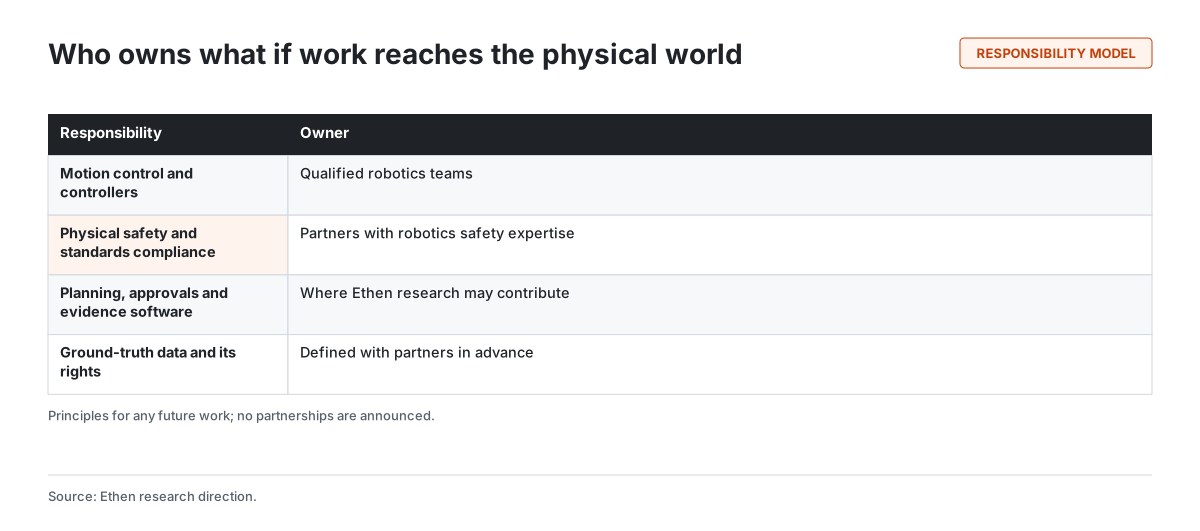
Motion control belongs to qualified robotics teams. Physical safety and standards compliance belong to partners with robotics safety expertise. Industrial robot safety is governed by established standards — the ISO 10218 series, revised in 2025, now also covers requirements for collaborative applications where people and robots share space. Planning, approvals and evidence software is where Ethen's research might contribute: the layers that decide what should be done, ask permission, and prove what happened. Ground-truth data and its rights would be defined with partners in advance, including what may be used for research and what may not.
No partnerships are announced. This is how we would approach one.
A worked example: one research question, end to end
The following example is illustrative of how a question moves through the Lab's process. Take the question: can an agent predict whether a form submission will succeed before it submits?
Question and proposal. A short proposal describes why the question matters — failed submissions waste time and sometimes create partial records — and what a useful prediction would look like: a probability of success, the most likely failure reasons, and a confidence level.
Protocol. Before any experiment, a protocol fixes the method: which software environments and forms, how predictions are recorded before each submission, how actual outcomes are observed, how calibration is measured, and what result would count as useful or as a failure.
Experiment in a test world. The protocol runs in an executable test environment where forms, failures and outcomes can be constructed and checked exactly.
Results. Whatever happens is published with its scope: which environments, which forms, how well-calibrated the predictions were, and where they failed. A null result is published too.
Only then, a further question. If predictions are useful in software, a later question might ask whether similar prediction helps in an integration setting — for example, predicting whether a warehouse system will accept a scheduling change — still in software, still without controlling motion.
At no point does this sequence produce a claim about physical robots. It produces evidence about one decision problem, in one kind of environment.
What would change our mind
A research direction should say what evidence would change it. Several findings would lead us to revise this approach. If software-first research consistently failed to produce insights that robotics teams found useful, the case for it would weaken. If a specific, valuable use case emerged where physical integration was the only way to learn, with a qualified partner and clear safety ownership, the gated path would move forward faster for that case. And if the decision problems turned out to differ fundamentally between digital and physical agents, we would narrow the Lab's scope to digital agents only.
We would report any of these changes publicly, with the reasoning.
What the Lab is deliberately not doing
Building or buying robots. Owning hardware without a specific use case and safety expertise is an expensive way to learn little.
Training large world models for video generation. Generating convincing video is a different problem from predicting the effects of actions.
Making humanoid demonstrations. Demonstrations are easy to stage and hard to interpret; they are not evidence.
Claiming physical relevance for software results. Every result will be described in the environment where it was obtained.
How robotics connects to the rest of Ethen
Robotics research at Ethen is not separate from the products. The same problems appear in Ethen Computer, where agents operate software through interfaces; in Ethen Founder, where agents carry jobs to verified outcomes; and in the approval, evidence and recovery mechanisms that run across Ethen. Our digital robot design project, iBOT, explores how an acting agent should present itself; see What We're Learning From Designing iBOT and Why a Digital Robot Needs More Than an Avatar.
The Robotics Research Lab is one part of a broader research program that also explores questions beyond any single product, which we describe in What Ethen Research Lab Is Exploring Beyond AI Products.
How we will report progress
Progress will be reported the way all Ethen Research Lab work is reported: questions and protocols first, results only when experiments have run, every publication labeled with its evidence status, and negative results published alongside positive ones. A result in a software environment will be described as exactly that, never as evidence of physical capability.
Tradeoffs and limitations
Slower than building hardware. A software-first, gated approach means Ethen will not have physical robots soon, and may never.
Some knowledge only comes from the physical world. Digital research cannot answer every robotics question.
Partners are essential and not yet in place. Any physical work depends on partnerships that do not exist today.
An agenda is not evidence. Every question in this article is open.
FAQ
What is the Ethen Robotics Research Lab? Ethen's research direction for agents that act — studied in software first — covering goals, state, prediction, recovery, stopping and proof of completion.
Is Ethen building robots? No. The Lab does not build hardware, and no robotics products are announced.
How does Ethen think about physical AI? As a gated extension of research on acting agents: integration first, ground truth with partners, and physical control only by qualified robotics and safety teams under recognized standards.
What is a digital state model? A model that predicts the likely effects of an agent's actions, with uncertainty, before it acts — always checked against what actually happens.
Has the Lab published results? Not yet. Related protocols, proposals and benchmark designs are published in Ethen Research Lab, each labeled with its evidence status.
Related reading
- Why Ethen Is Researching Digital Robots Before Physical Robots
- Why We're Not Rushing Ethen Into Hardware
- Why a Digital Robot Needs More Than an Avatar
- What Ethen Research Lab Is Exploring Beyond AI Products
- Ethen Research Lab
References
- Brohan, A., Brown, N., Carbajal, J., et al. (2023). RT-2: Vision-Language-Action Models Transfer Web Knowledge to Robotic Control. arXiv:2307.15818. https://arxiv.org/abs/2307.15818
- Ha, D., & Schmidhuber, J. (2018). World Models. arXiv:1803.10122. https://arxiv.org/abs/1803.10122
- ISO 10218-1:2025. Robotics — Safety requirements — Part 1: Industrial robots. https://www.iso.org/standard/73933.html
- Ethen Research Lab (2026). Skill IR: Toward Model-Independent Agent Capabilities. Research proposal. https://upcube.ai/resources/research/skill-ir
- Ethen Research Lab (2026). VerifiedWork Transfer. Benchmark design; results gated. https://upcube.ai/resources/research/verifiedwork-transfer
- Ethen Research Lab (2026). Ethen Synthetic Enterprise. Research proposal. https://upcube.ai/resources/research/synthetic-enterprise