Why a Digital Robot Needs More Than an Avatar
The difference between an AI avatar and an AI agent is the difference between appearance and action. An avatar is how an AI system looks or sounds: a face, a character, a voice. An agent perceives its environment and acts on it. What we call a digital robot is an agent with everything that makes acting trustworthy: an identity with a stated owner, bounded authority for each task, memory that people can see and control, approvals before consequential actions, evidence of what it did, and the ability to recover when something goes wrong. An avatar is optional on top of all that. The problem with many "AI avatar" products is that the face arrives without the robot behind it — signaling understanding, memory and accountability the system does not provide. This article explains what has to sit behind the face, and why Ethen designs that part first.
The difference between an AI avatar and an AI agent is the difference between appearance and action. An avatar is how an AI system looks or sounds: a face, a character, a voice. An agent perceives its environment and acts on it. What we call a digital robot is an agent with everything that makes acting trustworthy: an identity with a stated owner, bounded authority for each task, memory that people can see and control, approvals before consequential actions, evidence of what it did, and the ability to recover when something goes wrong. An avatar is optional on top of all that. The problem with many "AI avatar" products is that the face arrives without the robot behind it — signaling understanding, memory and accountability the system does not provide. This article explains what has to sit behind the face, and why Ethen designs that part first.
Key takeaways
- An avatar is appearance. It can be a useful interface, but it does nothing on its own.
- An agent perceives and acts. That is where capability and risk come from.
- A digital robot is an accountable agent. Identity, authority, memory, approvals, evidence and recovery.
- Faces make promises. People read understanding and accountability into them.
- Build the robot before the face. Trust is created in the layers the avatar sits on.
What is an AI avatar?
An AI avatar is a visual or audible representation of an AI system: an animated character, a rendered human face, a mascot, or a distinctive voice. Avatars are increasingly used as virtual receptionists, shopping guides, support assistants and presenters. Some are connected to capable systems behind them; many are primarily a presentation layer over a chatbot.
Avatars can be genuinely useful. They can make an interface more approachable, help people recognize a consistent assistant, and show what a system is doing. But an avatar is a surface. On its own it cannot look anything up, take an action, remember responsibly or be held to account.
What is an AI agent?
The classic textbook definition of an agent, from Stuart Russell and Peter Norvig, is anything that perceives its environment and acts on it. For AI systems today, that means a system that observes — reads a page, a file, a message — decides what to do toward a goal, and acts — sends, edits, submits, buys — over many steps.
Agents are where both the value and the risk of AI increasingly sit. Researchers studying increasingly agentic systems have argued that as AI pursues goals with less direct supervision, the potential for harm grows and needs explicit governance. An agent does not need an avatar. Many of the most useful agents have no visual presence at all.
What is a digital robot?
A digital robot, as we use the term, is an agent that is built to act responsibly in software over time. Figure 1 compares the three concepts.
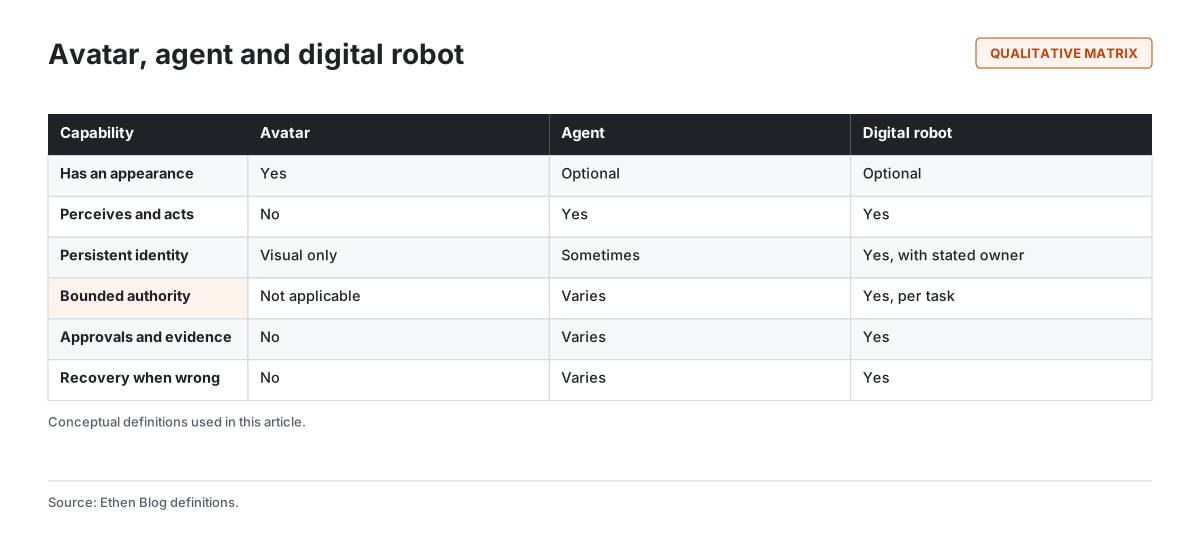
A digital robot perceives and acts like any agent. In addition, it has a persistent identity with a stated owner, authority bounded to each task, memory that people can see and control, approvals before consequential actions, evidence of what it did, and recovery when things go wrong. It may have an avatar. It does not need one. We explain why Ethen studies digital robots before physical ones in Why Ethen Is Researching Digital Robots Before Physical Robots.
What sits behind the face
Figure 2 shows the layers that make a digital robot trustworthy, with the avatar as the optional top layer.
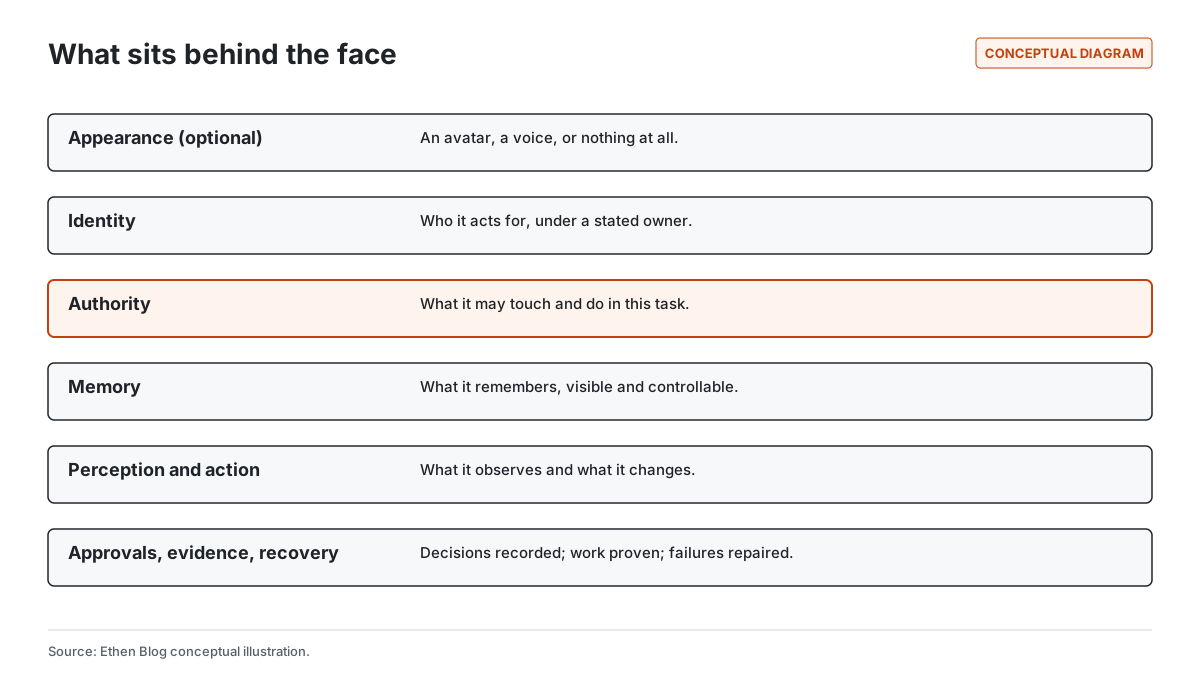
Appearance (optional). An avatar, a voice, or nothing at all.
Identity. Who the robot acts for, under a stated owner. A digital robot acting for a person and one acting for an organization have different owners and different rules. A consistent identity across devices helps people recognize and continue working with the same agent — but it must not become a license to share every device's permissions. An agent on your phone should have only the access granted there.
Authority. What it may touch and do in this task: which files, which accounts, which actions, which budget. Bounded authority limits the damage from mistakes and from manipulation. Ethen Research Lab's Mandates research note explores how a person's intent could become authority an agent cannot exceed.
Memory. What it remembers about you and your work, visible and controllable. A face that seems to remember you creates expectations; the memory behind it should be something you can inspect and correct. We discuss this in Why User-Controlled AI Memory Matters, and Ethen Research Lab's Evidence-Preserving Context proposal explores how to compress memory without losing obligations.
Perception and action. What it observes and what it changes. This is the agent itself.
Approvals, evidence and recovery. Consequential actions need a person's decision, bound to the specific action. Completed work needs evidence, which Ethen Research Lab's Work Receipts technical report proposes a format for. And when an outcome is unclear, the robot should reconcile before retrying, as argued in Unknown Effects in Autonomous AI Systems.
Why a face without a robot is a problem
People respond to faces and voices socially, even on computers. Research in the "computers are social actors" tradition found that people apply social expectations to computers that show even minimal human-like cues. An avatar is a strong cue. Figure 3 shows what it can signal, what may be missing, and the result.
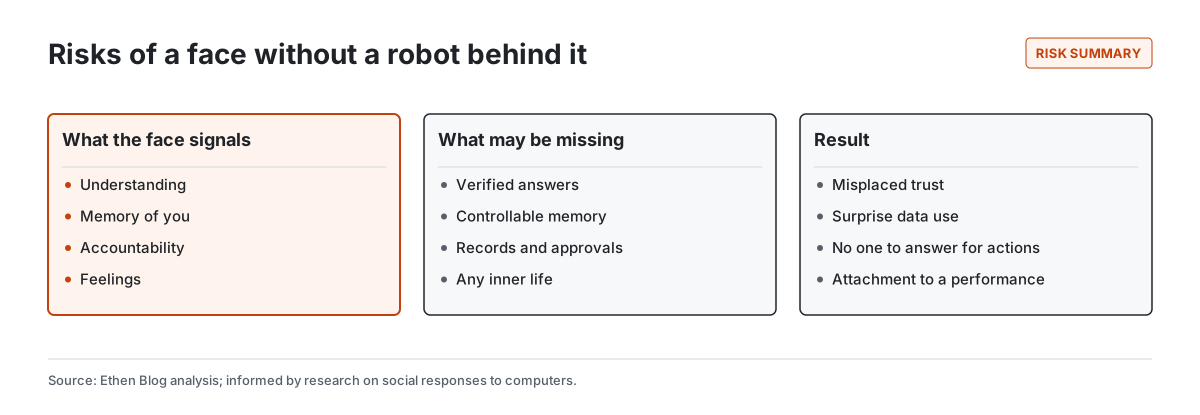
Understanding. A face that nods and smiles signals that it understood. If the system behind it produces unverified answers, people trust them more than they should.
Memory. A character that greets you by name signals that it remembers you. If that memory is invisible and uncontrollable, people are surprised — sometimes unpleasantly — by what it knows.
Accountability. A human-like assistant signals that someone is responsible for what it does. If there are no records or approvals behind it, no one can answer for its actions.
Feelings. Expressive faces signal emotions. An AI has no inner life to match, and people who form attachments to a performance are being misled, however gently.
In each case, the avatar raises expectations that only the lower layers can meet. That is why we design those layers first.
Impersonation and synthetic people
A further risk applies when avatars look or sound like real people. Generated faces and cloned voices make it possible to create an assistant that resembles a specific person — a celebrity, an employee, a customer's own relative. Even with permission, that blurs who is speaking. Without permission, it is impersonation.
Our position is straightforward. A digital robot should never impersonate a real person. If a real person's likeness or voice is used — for example, a company's own spokesperson recording a voice for its assistant — it should be with explicit, recorded permission for that use, and the assistant should still be clearly identified as an AI. The character should make it easier, not harder, to know who and what you are dealing with.
Building the layers in order
If you are building a digital robot, the order matters as much as the layers.
Start with authority. Decide what the agent may touch and do before deciding how it looks. Every other layer depends on this.
Add approvals and evidence early. Consequential actions need decision points and records from the first version, not as a later compliance project.
Make memory visible before making it rich. A small memory people can see and correct is better than a large one they cannot.
Design recovery before scale. Decide what happens when an action's outcome is unclear before the agent handles enough volume for it to matter.
Add the face last, if at all. By then you know what the agent can honestly promise, and you can design an appearance that promises no more.
Teams that start with the avatar often discover, too late, that the face has already promised capabilities and accountability the system cannot deliver. Teams that start with the lower layers can choose an appearance that fits what they built.
When an avatar does help
None of this means avatars are bad. An avatar can help when:
- Introducing an agent. A consistent figure helps people understand that they are dealing with one assistant across surfaces.
- Showing state. Visual cues can show whether an agent is idle, listening, working or finished.
- Demonstrating actions. In tutorials and walkthroughs, a figure can make an agent's actions easier to follow.
- Accessibility for some users. Some people find a visual presence easier to engage with than text alone.
In every case, the avatar works best when it is honest about what the system is: clearly an AI, not performing feelings, and backed by the layers beneath it. Our design approach for Ethen's digital robot character is described in What We're Learning From Designing iBOT.
A worked example: two support assistants
The following example is illustrative. A customer asks an online store's assistant for a refund on a damaged item.
Assistant A is a realistic animated face over a chatbot. It apologizes warmly, says the refund has been processed, and wishes the customer a good day. Nothing was processed; the chatbot has no ability to issue refunds and no record of the conversation that a human agent can see. The customer, reassured by a convincing face, waits for a refund that never arrives.
Assistant B is a digital robot with a simple visual presence. It checks the order, confirms the item is eligible under the store's policy, prepares a refund within its authority, and — because the amount exceeds its limit for automatic refunds — sends it to a person for approval, telling the customer exactly that. When the refund is approved and issued, the customer receives a confirmation with a reference number, and the store has a record of every step.
Assistant A had the better face. Assistant B was the better assistant.
Questions to ask about any "AI avatar" product
If you are evaluating an avatar-based AI product, the face is the least important part. Ask instead:
- What can the system actually do, beyond talking?
- Whose identity does it act under, and who is responsible for its actions?
- What authority does it have, and how is that limited?
- What does it remember, and can users see and delete it?
- Which actions need human approval?
- What record exists of what it said and did?
- What happens when it is wrong or unsure?
- Is it always clear to users that they are talking to an AI?
How Ethen approaches digital robots
Ethen builds the lower layers first. Approvals are bound to specific actions. Voice sessions in Ethen Chat start with no tools granted. Memory is designed to be visible and user-controlled. Agent work is designed to finish with evidence, and uncertain outcomes are reconciled rather than guessed. We describe how these appear in the product in Why Ethen Is Treating AI Safety as a Product Experience, and the principles behind them in What We Mean by Responsible Autonomy.
A visual character, where we use one, comes last and stays optional.
Tradeoffs and limitations
Building layers takes longer than building a face. An avatar demo can be built quickly; accountable agents take much longer.
Avatars can genuinely help engagement. Some people respond better to a visual presence, and choosing restraint may make a product feel less friendly to them.
Definitions are ours. "Digital robot" is the term we use; others draw the lines differently.
Some layers are research. Mandates and evidence-preserving memory are research proposals and notes, not shipped features.
FAQ
What's the difference between an AI avatar and an AI agent? An avatar is how an AI looks or sounds. An agent perceives its environment and acts on it. An agent does not need an avatar, and an avatar alone cannot act.
Are AI avatars just talking heads? Some are presentation layers over chatbots; others front capable agents. The face tells you little — ask what the system behind it can do and how it is held accountable.
What makes a digital robot trustworthy? A stated owner and identity, bounded authority, visible and controllable memory, approvals for consequential actions, evidence of its work, and honest recovery when things go wrong.
Should AI assistants have human-like avatars? Only if the system behind them meets the expectations the avatar creates. A realistic face over a limited system misleads people.
Does Ethen use avatars? Ethen's digital robot character, iBOT, is a design project and always optional. Ethen builds the accountable layers first.
Related reading
- What We're Learning From Designing iBOT
- Why Ethen Is Researching Digital Robots Before Physical Robots
- Why Ethen Is Treating AI Safety as a Product Experience
- What We Mean by Responsible Autonomy
- Why User-Controlled AI Memory Matters
References
- Russell, S., & Norvig, P. (2020). Artificial Intelligence: A Modern Approach (4th ed.). Pearson.
- Nass, C., Steuer, J., & Tauber, E. R. (1994). Computers are social actors. Proceedings of CHI 1994. https://doi.org/10.1145/191666.191703
- Chan, A., Salganik, R., Markelius, A., et al. (2023). Harms from Increasingly Agentic Algorithmic Systems. Proceedings of FAccT 2023. https://doi.org/10.1145/3593013.3594033
- Ethen Research Lab (2026). Mandates: Compiling Human Intent Into Bounded Agent Authority. Research note. https://upcube.ai/resources/research/agent-mandates
- Ethen Research Lab (2026). Work Receipts: A Verifiable Record for Autonomous AI Work. Technical report. https://upcube.ai/resources/research/work-receipts
- Ethen Research Lab (2026). Evidence-Preserving Context. Research proposal. https://upcube.ai/resources/research/evidence-preserving-context