Why Ethen Is Researching Digital Robots Before Physical Robots
The difference between digital robots and physical robots is where they act, not what they need to get right. A digital robot is an AI agent that perceives, plans and acts inside software — browsers, applications, files and services — under a persistent identity and bounded authority. A physical robot does the same in the physical world, with motors, sensors and real objects. Both have to pursue goals over many steps, act on incomplete information, notice when something has gone wrong, recover, stop when they should, and prove that a task is actually done. Ethen researches those shared problems in software first, because software environments can be reset, observed and checked far more cheaply and safely than the physical world. Some of what we learn may transfer to physical robots. Some of it — motor control, force, contact and physical safety — does not transfer at all. This article explains the reasoning and the limits.
The difference between digital robots and physical robots is where they act, not what they need to get right. A digital robot is an AI agent that perceives, plans and acts inside software — browsers, applications, files and services — under a persistent identity and bounded authority. A physical robot does the same in the physical world, with motors, sensors and real objects. Both have to pursue goals over many steps, act on incomplete information, notice when something has gone wrong, recover, stop when they should, and prove that a task is actually done. Ethen researches those shared problems in software first, because software environments can be reset, observed and checked far more cheaply and safely than the physical world. Some of what we learn may transfer to physical robots. Some of it — motor control, force, contact and physical safety — does not transfer at all. This article explains the reasoning and the limits.
Key takeaways
- A digital robot acts in software. It perceives, plans and acts in applications and services, under bounded authority.
- The hard problems are shared. Goals, uncertainty, recovery, stopping and proof of completion matter in both worlds.
- Software is a better laboratory. It is cheaper to reset, easier to observe and safer to fail in.
- Some lessons may transfer; some never will. Planning and evidence may; motor control and physical safety do not.
- Physical work is gated. It requires specific conditions, partners and expertise. Not doing it is a legitimate outcome.
What is a digital robot?
We use "digital robot" to mean an AI agent that operates in software the way a robot operates in the world. It perceives its environment — a screen, a web page, a set of files, an API response. It decides what to do next toward a goal. It acts — clicking, typing, calling a service, writing a file. It observes the result. And it continues, over many steps, until the goal is reached or it should stop.
What distinguishes a digital robot from a chat assistant is that it acts, over time, with consequences. What distinguishes it from a script is that it decides what to do based on what it observes, rather than following fixed steps. Computer-use agents, which operate applications through their interfaces, are one kind of digital robot; we discuss them in Why Computer Use Is More Than Clicking Buttons.
A digital robot also has an identity and limits: who it acts for, what it is permitted to touch, how much it may spend, and which actions require a person's approval. Those limits matter as much as its capabilities.
The problems every robot shares
Strip away the motors and sensors, and physical and digital robots face many of the same problems.
Goals over many steps. Both must break a goal into steps and keep track of what remains unfinished.
Partial observability. Neither sees everything. A physical robot cannot see behind an object; a digital robot cannot see state hidden in another tab or a back-end system.
Delayed and uncertain outcomes. Both act and must then work out whether the action had the intended effect — and sometimes cannot tell.
Recovery. Both will fail partway through tasks and must decide whether to retry, adjust, ask for help or stop.
Knowing when to stop. Both must recognize when continuing would be unsafe or pointless.
Proving completion. Both must show that a task is actually done, not just believe it.
Ethen Research Lab's publications address several of these directly: Unknown Effects in Autonomous AI Systems on uncertain outcomes, Recovery Atlas on when to retry, reconcile, escalate or stop, and Verified Adaptive Intelligence on learning only from work that can be proven. All are research notes, proposals or position papers, not results.
Why software is the better laboratory
Software environments are not easy — any team building agents knows how messy real applications are. But for studying the shared problems above, they have decisive advantages. Figure 1 compares the two environments.
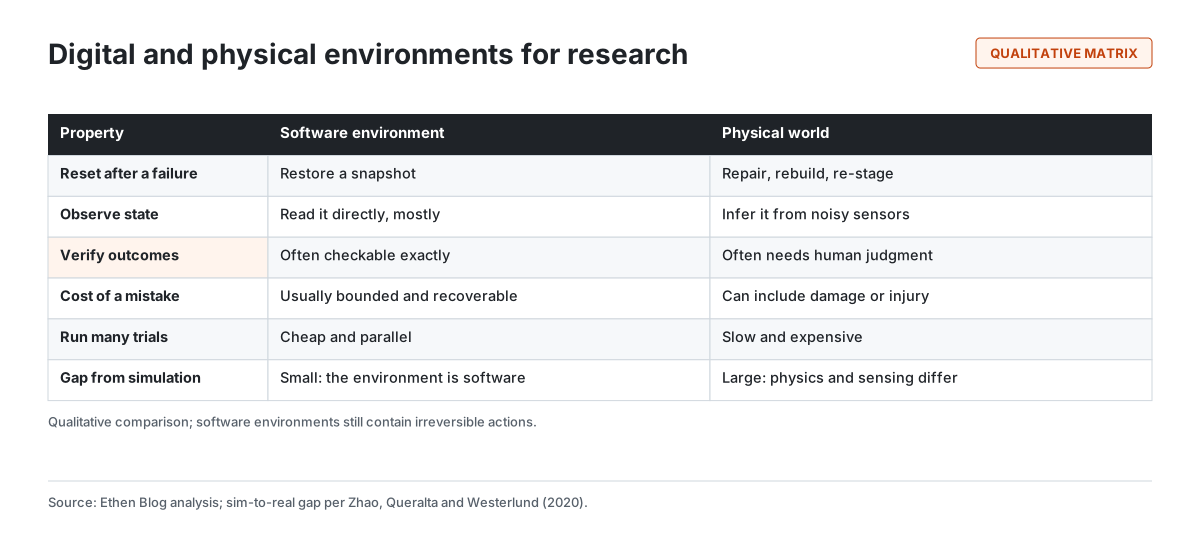
Reset. A software environment can be restored to a known state in seconds. A physical setup after a failure may need repair or re-staging.
Observation. Software state can often be read directly. Physical state has to be inferred from noisy sensors.
Verification. Whether a digital task succeeded is often checkable exactly — the record was saved, the file exists, the message was sent. Physical outcomes often need human judgment.
Cost of mistakes. Most software mistakes are bounded and recoverable, though not all. Physical mistakes can damage equipment or hurt people.
Number of trials. Software experiments can be run many times in parallel. Physical experiments are slow and expensive.
Simulation gap. A software test environment can be very close to the real thing, because the real thing is also software. In robotics, the gap between simulation and reality is a well-known obstacle: a widely cited survey of sim-to-real transfer describes how differences between simulated and real physics degrade the performance of policies trained in simulation once they run on real robots.
Ethen Research Lab's Ethen Synthetic Enterprise proposal describes an executable software world for testing enterprise agents — exactly the kind of laboratory these advantages make possible. It is a proposal, not a built system.
Digital robots are useful now
There is also a practical reason to start in software: digital robots are useful today. Agents that research, prepare documents, operate applications without APIs, or carry delegated jobs through to checked outcomes create value now, and every lesson learned building them carries forward. We describe that work in Why Ethen Founder Is About Outcomes, Not More Chat and What We're Building for Ethen Computer.
A research program that starts with something useful also gets something researchers prize: real tasks and real outcomes to learn from, under real constraints.
What may transfer, and what does not
It would be easy to overclaim here, so we want to be precise. Figure 2 sets out our hypotheses.
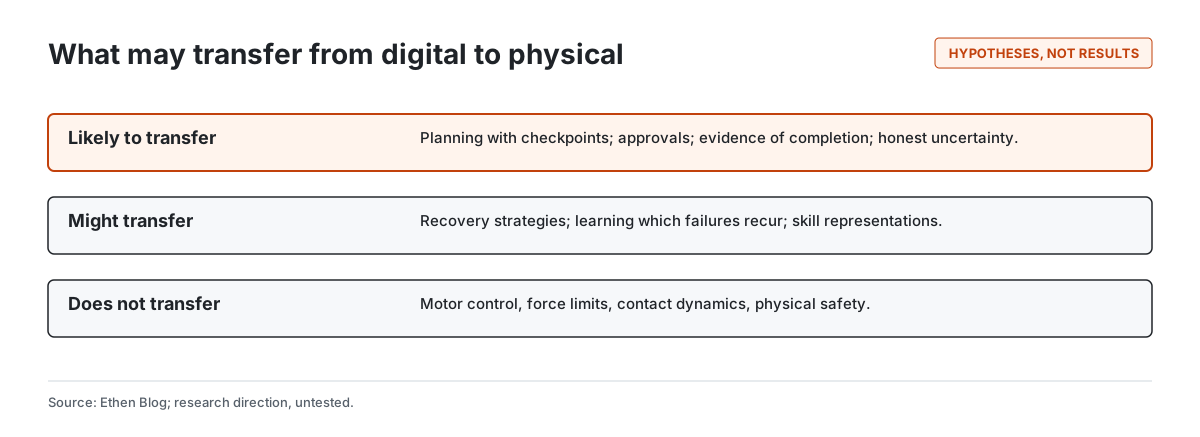
Likely to transfer. The structure around action: planning with checkpoints, approvals before consequential steps, evidence of completion, and honest handling of uncertainty. These are about how an agent decides and reports, not how it moves.
Might transfer. Recovery strategies, knowledge of which failures tend to recur, and ways of representing skills so they survive changes in the underlying model. Whether these carry over to physical tasks is an open research question.
Does not transfer. Motor control, force limits, contact dynamics and physical safety. Software agents learn nothing about how hard to grip, how to balance or how to move safely near people. Skills learned from screens or internet video do not establish physical competence.
Work in robotics itself points to both the promise and the difficulty. The Open X-Embodiment collaboration pooled data from many robots across many institutions and reported that a single model trained on it could transfer some experience between robot platforms. That is encouraging for learning across embodiments within robotics. It is not evidence that software skills transfer to physical control.
Common objections, answered
"Real intelligence needs a body." Some researchers argue that general intelligence requires physical embodiment, because so much of what people know comes from acting in the world. That may be right for some kinds of knowledge. It does not change the fact that the decision problems described above — goals, uncertainty, recovery, stopping, proof — can be studied productively in software, and that doing so first is cheaper and safer.
"Software agents are just automation." Scripts follow fixed steps; digital robots decide what to do based on what they observe, and must cope with changing interfaces, partial information and unexpected outcomes. That is much closer to the robotics problem than to traditional automation.
"Simulation is good enough for physical robots now." Simulators have improved greatly, and they are essential tools in robotics. But the gap between simulated and real physics remains a central research problem, which is why robotics teams still test extensively on real hardware.
"Waiting means falling behind." Physical AI is attracting enormous investment, and some companies will move faster. Moving fast into hardware without a specific use case, safety expertise and real data is also a common way to spend heavily and learn little. A focused research program can contribute to the shared problems without owning hardware.
"Digital robots are lower stakes, so the research is less important." Software agents increasingly act on money, messages and records. The stakes are already real, and the lessons about acting responsibly are needed now.
Questions the research is trying to answer
The digital-first program is organized around a few open questions. Can an agent learn when to retry, reconcile, escalate or stop from examples of past failures? Can it keep track of what remains unfinished in long tasks? Can it represent skills in a way that survives a change in the underlying model? Can it tell, reliably, whether a task is done? Each of these is studied first where outcomes can be checked exactly, and each would matter for any robot that acts in the world.
A gated path
If Ethen's work ever extends into the physical world, it will follow a gated path, shown in Figure 3.
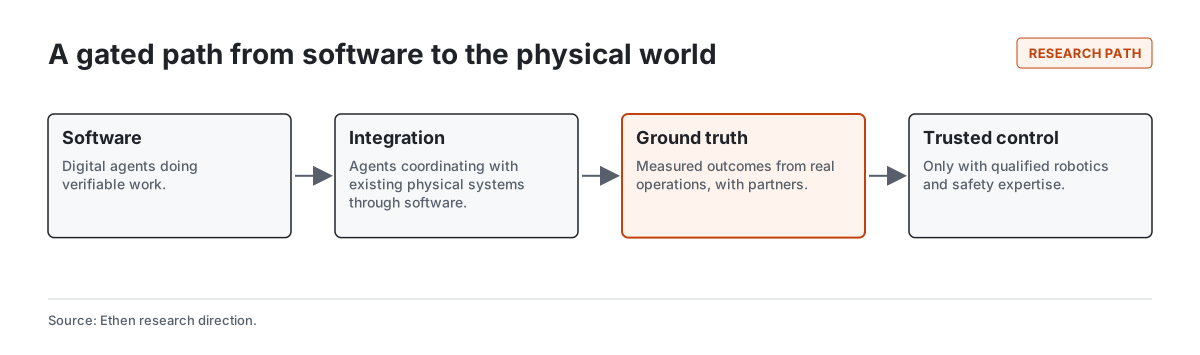
Software. Digital agents doing verifiable work.
Integration. Agents coordinating with existing physical systems through software — scheduling, monitoring, reporting — without controlling motion.
Ground truth. Measured outcomes from real operations, with partners who own the physical systems and their safety.
Trusted control. Only with qualified robotics and safety expertise, and only where a specific use case justifies it.
Each stage is a gate with conditions, not a step on a timeline. We explain the conditions for hardware in Why We're Not Rushing Ethen Into Hardware and the broader robotics research direction in From Screen to Physical World: How We Think About Ethen Robotics.
What this means for Ethen today
Ethen does not build physical robots, and nothing in this article announces plans to. The Ethen Robotics Research Lab is a research direction focused on the shared problems of acting agents, studied in software. Our digital robot design work, including the character we call iBOT, is about how a digital agent should present itself and behave, which we discuss in What We're Learning From Designing iBOT and Why a Digital Robot Needs More Than an Avatar.
A worked example of a shared problem
The following example is illustrative. Consider the problem of an action whose outcome is uncertain.
A digital robot submits a supplier order through a web form, and the page times out. Did the order go through? The agent should not retry blindly — that could place a duplicate order. It should check the supplier portal's order list, or the confirmation inbox, and only then decide. If it cannot confirm, it should say so and ask.
A warehouse robot places a box on a shelf, and its sensor reading is ambiguous. Is the box stable? The robot should not simply move on, and should not repeat the placement blindly. It should observe again from another angle, or stop and ask.
The motor skills are completely different. The decision problem — act, observe, reconcile before retrying, ask when unsure — is the same. Studying it in software, where outcomes can be checked exactly and failures are cheap, is how we hope to understand it well.
Tradeoffs and limitations
Software is not the physical world. Lessons from digital agents are hypotheses for physical robots, not results.
Some software actions are irreversible too. Payments, messages and deletions have real consequences; software is safer, not safe.
Digital-first can delay physical learning. Some knowledge only comes from physical deployment. We accept that delay in exchange for safety and focus.
This is a research direction. No robotics results are reported here, and no physical products are announced.
FAQ
What is a digital robot? An AI agent that perceives, plans and acts inside software — applications, web pages, files and services — over many steps, under a defined identity and bounded authority.
Why study software agents before physical robots? Because the shared problems — goals, uncertainty, recovery, stopping and proof of completion — are far cheaper and safer to study where environments can be reset, observed and checked exactly.
Do software agent skills transfer to robots? Some decision-making structure may; motor control, force and physical safety do not. Transfer is a research hypothesis, not an established result.
Is Ethen building physical robots? No. Physical work is a gated possibility that depends on specific conditions, partners and expertise.
What is the sim-to-real gap? The drop in performance when a policy trained in simulation runs on a real robot, caused by differences between simulated and real physics and sensing.
Related reading
- From Screen to Physical World: How We Think About Ethen Robotics
- Why We're Not Rushing Ethen Into Hardware
- Why a Digital Robot Needs More Than an Avatar
- Why Computer Use Is More Than Clicking Buttons
- Ethen Synthetic Enterprise
References
- Xie, T., Zhang, D., Chen, J., et al. (2024). OSWorld: Benchmarking Multimodal Agents for Open-Ended Tasks in Real Computer Environments. arXiv:2404.07972. https://arxiv.org/abs/2404.07972
- Open X-Embodiment Collaboration (2023). Open X-Embodiment: Robotic Learning Datasets and RT-X Models. arXiv:2310.08864. https://arxiv.org/abs/2310.08864
- Zhao, W., Queralta, J. P., & Westerlund, T. (2020). Sim-to-Real Transfer in Deep Reinforcement Learning for Robotics: a Survey. IEEE Symposium Series on Computational Intelligence. arXiv:2009.13303. https://arxiv.org/abs/2009.13303
- Ethen Research Lab (2026). Ethen Synthetic Enterprise: An Executable World for Enterprise-Agent Research. Research proposal. https://upcube.ai/resources/research/synthetic-enterprise
- Ethen Research Lab (2026). Recovery Atlas. Research proposal. https://upcube.ai/resources/research/recovery-atlas
- Ethen Research Lab (2026). Verified Adaptive Intelligence: Learning From Work That Can Be Proven. Position paper. https://upcube.ai/resources/research/verified-adaptive-intelligence