What We Mean by Responsible Autonomy
By responsible AI autonomy, we mean an AI system that acts on its own only as far as two things allow: the authority it has been given for the task, and the reliability it has demonstrated on that kind of task. Within those limits it can work independently. Beyond them, it asks. And throughout, it stays visible, so people can see what it is doing; interruptible, so they can stop it; accountable, so every consequential action traces to a decision and a record; and recoverable and honest, so failures are surfaced and repairable and unknowns stay unknown. Responsible autonomy is not maximum autonomy, and it is not a requirement to approve everything. It is autonomy that is earned per kind of task, with evidence, and that contracts again when the evidence says it should. This article explains each part of that definition and how it shapes Ethen.
By responsible AI autonomy, we mean an AI system that acts on its own only as far as two things allow: the authority it has been given for the task, and the reliability it has demonstrated on that kind of task. Within those limits it can work independently. Beyond them, it asks. And throughout, it stays visible, so people can see what it is doing; interruptible, so they can stop it; accountable, so every consequential action traces to a decision and a record; and recoverable and honest, so failures are surfaced and repairable and unknowns stay unknown. Responsible autonomy is not maximum autonomy, and it is not a requirement to approve everything. It is autonomy that is earned per kind of task, with evidence, and that contracts again when the evidence says it should. This article explains each part of that definition and how it shapes Ethen.
Key takeaways
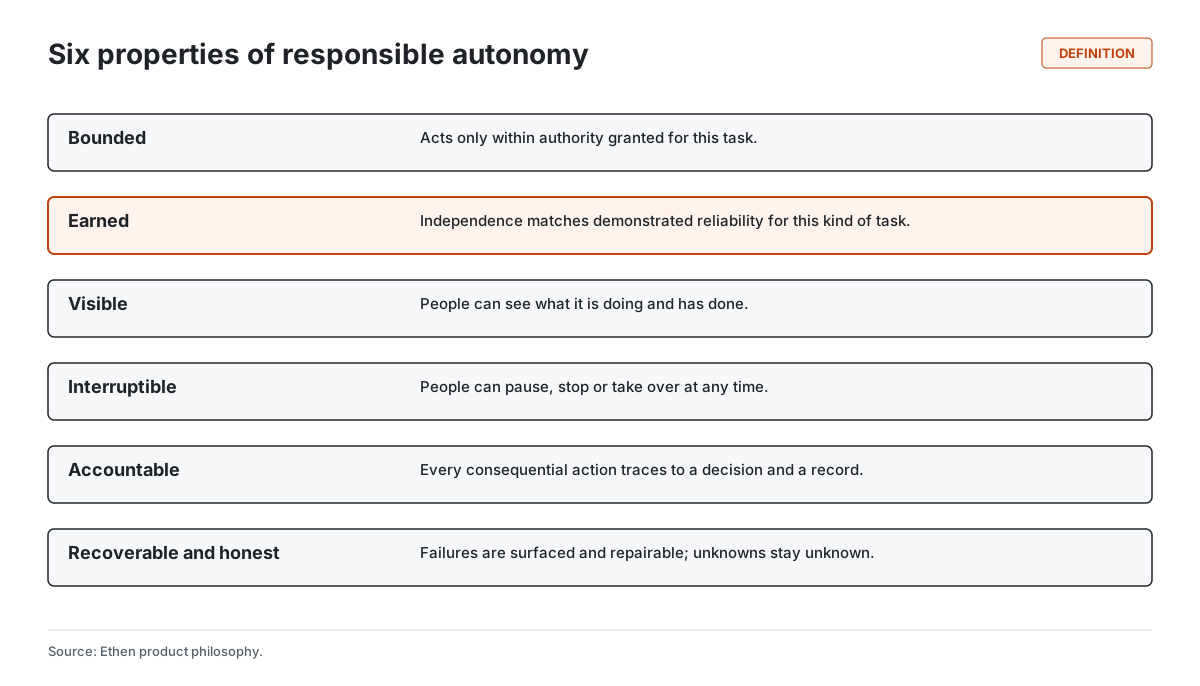
- Bounded: an AI acts only within authority granted for the task.
- Earned: independence grows with demonstrated reliability on that kind of task.
- Visible and interruptible: people can see and stop what it is doing.
- Accountable: consequential actions trace to decisions and records.
- Recoverable and honest: failures are surfaced; unknowns are not guessed.
- Not a slogan: each property should be checkable in the product.
Why define it at all?
"Responsible AI" and "autonomous AI" are both used so widely that they risk meaning nothing. Many companies list values — transparency, fairness, safety — without saying how anyone could tell whether a product lives up to them. As AI systems move from answering questions to taking actions, vague values are not enough. People delegating real work need to know what the system will do on its own, what it will ask about, and what happens when something goes wrong.
The stakes are rising because the work is getting longer. Research measuring how long a task AI agents can complete has found that the length has grown quickly over several years. Longer tasks mean more steps taken without a person watching each one, and more opportunities for small errors to compound. Researchers studying increasingly agentic systems have argued that the more a system pursues goals with limited supervision, the more important it becomes to understand and govern the harms it could cause.
So we want a definition precise enough that someone could check whether Ethen meets it. Figure 1 sets out the six properties.
Bounded: authority for this task, and no more
An autonomous system should act only within the authority granted for the task at hand. If a task needs read access to one folder, the system should not have write access to the whole drive. If it needs to draft messages, it should not be able to send them without approval.
Bounding authority is the most reliable protection against both mistakes and manipulation. An agent that reads untrusted content — a web page, an email — can be influenced by it. The damage that influence can do is limited by what the agent is allowed to do.
Ethen Research Lab's Mandates research note explores how a person's intent could be compiled into bounded authority — a mandate — that an agent cannot exceed, so that approvals are needed only for what falls outside it. That is research, not a shipped feature, but it reflects the direction.
Earned: independence that matches evidence
The second property is the one that most distinguishes responsible autonomy from the alternatives. An AI system should act independently on a kind of task only to the extent it has shown it can do that kind of task reliably. Figure 2 shows the idea as a ladder.
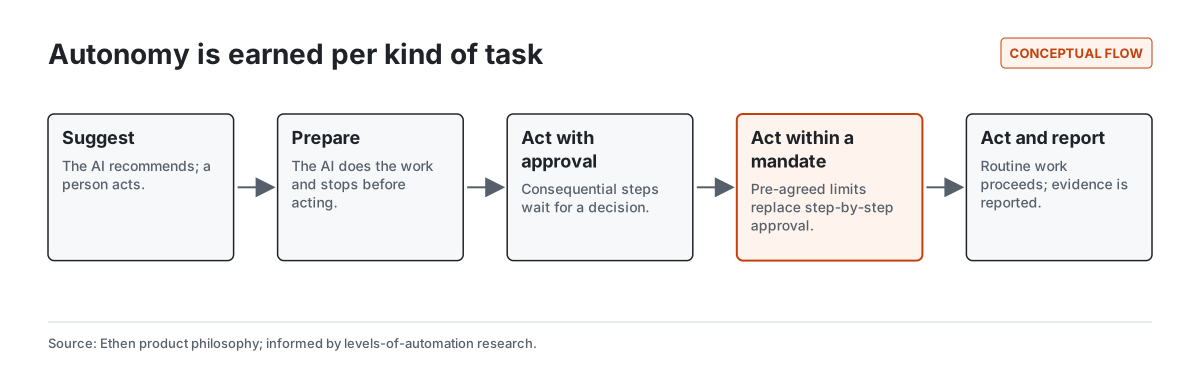
At the bottom, the AI suggests and a person acts. Then it prepares work and stops before acting. Then it acts, with approval for consequential steps. Then it acts within a pre-agreed mandate, without step-by-step approval. At the top, routine work proceeds and the AI reports what it did, with evidence.
Two features matter. First, the ladder applies per kind of task, not per system. An agent may be trusted to file expense reports on its own while still needing approval to send a message to a customer. Second, movement goes both ways. If an agent fails on a kind of task, its autonomy for that task should contract until it has shown it can be trusted again.
This is why evaluation matters so much to responsible autonomy. Claims about reliability need evidence on the actual kind of task, not a demonstration. Ethen Research Lab's VerifiedWork Control benchmark design sets out how delegation, approval, revocation and agent authority could be evaluated; it is a design, and its results are not yet available.
Visible: people can see what it does
A system that acts out of sight cannot be supervised, corrected or trusted. Visibility means people can see what an AI is doing now, what it has done, and what is waiting for their decision. It also means the AI's account of its actions is backed by evidence — the sent message, the saved record — rather than narration alone.
Practices proposed for governing agentic AI systems, published by researchers at OpenAI in 2023, include making agent actions legible and keeping them attributable. Visibility is the product form of both. We describe how visibility appears in Ethen's interface in Why Ethen Is Treating AI Safety as a Product Experience.
Interruptible: stop means stop
People must be able to pause an autonomous system, stop it or take over, at any time, with immediate effect. A stop that takes effect only after the current batch of actions is not interruptibility.
Interruptibility also needs to work in practice, not just in principle. That means a stop control that is easy to find, a clear state after stopping, and an agent that looks again at the situation after a person hands control back, rather than assuming nothing changed.
Accountable: every action traces to a decision
Every consequential action should trace back to a decision — a person's approval or a mandate they agreed — and leave a record. Accountability is what lets an organization answer the question every incident eventually raises: who decided this, on what basis, and what happened?
Ethen's approach to approvals is designed around this. In computer use, an approval is bound to one exact action, within one run and one attempt, under the policy in force when it was requested, and can be used once. That makes each decision precise and traceable. We explain the reasoning in Why Ethen Keeps Human Approval in the Loop.
Recoverable and honest: failures surface, unknowns stay unknown
Autonomous systems will fail. Responsible autonomy is not a promise that they will not, but a commitment to what happens when they do. Failures should be surfaced rather than hidden. Work should be recoverable where possible. And when the system does not know whether an action succeeded — a payment request timed out, a confirmation never arrived — it should say so, not guess, and certainly not retry blindly.
We discuss recoverability in Why Ethen Is Building for Recoverable AI Work and unknown outcomes in When an Agent Action's Outcome Is Unknown. Ethen Research Lab's Recovery Atlas proposal explores how agents could learn when to retry, reconcile, escalate or stop — a research proposal, untested.
A worked example: one task, climbing the ladder
The following example is illustrative. A finance team wants an AI agent to handle routine expense reports.
Suggest. At first, the agent reads each submitted report and suggests a category and whether it complies with policy. A person makes every decision. Over several weeks the team compares the agent's suggestions with their own.
Prepare. The suggestions match the team's decisions closely for routine items such as meals and travel under the policy limits. The agent now prepares the approval records for those items and stops; a person reviews and submits.
Act with approval. For routine items, the agent submits approvals after a person confirms a batch. Unusual items — foreign currency, missing receipts, amounts near limits — still go to a person individually.
Act within a mandate. The team agrees a mandate: the agent may approve routine items under a set amount, in known categories, with a receipt attached, and must route everything else to a person. Within that mandate it no longer asks.
Contract on failure. One month, a change in the travel policy is not reflected in the agent's rules, and it approves several items that now exceed the limit. The issue is caught in the weekly record review. The mandate is suspended for travel items until the rules are updated and the agent's decisions are checked again for a period.
Throughout, the agent's actions are visible in a record, any person can stop it, every approval traces to either a person or the agreed mandate, and the failure was surfaced and repaired rather than hidden. That is responsible autonomy in practice: not a fixed level, but a level that tracks evidence.
Responsible autonomy across different kinds of work
The same six properties apply differently depending on the work.
Research and analysis. The main risks are wrong conclusions and unsupported claims. Bounds are about sources and scope; recoverability is about showing evidence so errors can be caught.
Actions in software. Sending, submitting, buying and deleting have direct consequences. Bounds and precise approvals carry most of the weight; honest handling of unclear outcomes prevents duplicates.
Recurring automation. Work that runs on a schedule without anyone watching needs strong records and clear limits, because the visibility comes after the fact.
Voice and real-time interaction. Speed matters, and confirmations must be quick. Consequential actions should still be confirmed where the user can see the details.
What responsible autonomy is not
The definition is as much about what we refuse to claim as what we aim for. Figure 3 lists the main clarifications.
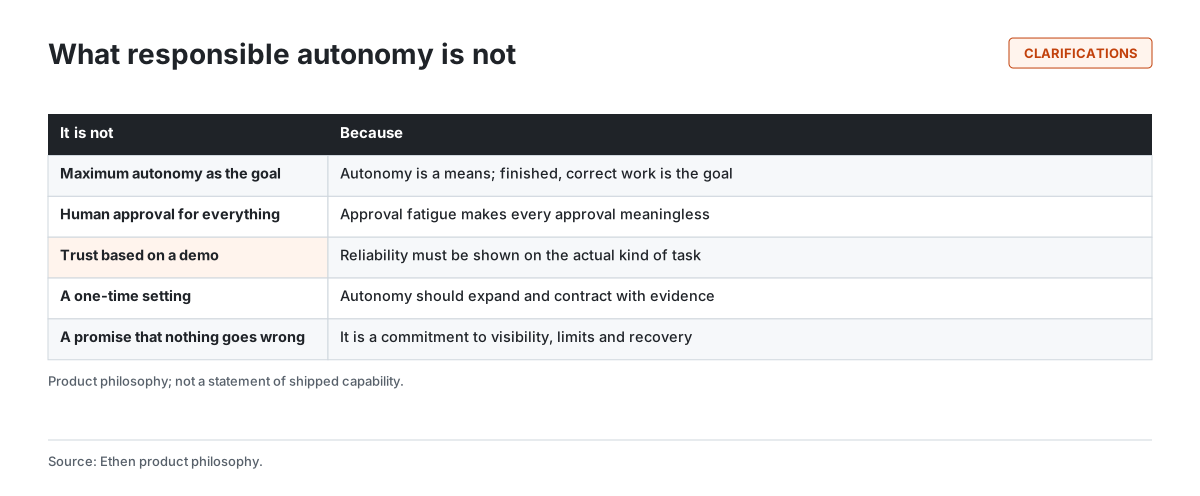
Not maximum autonomy as a goal. Autonomy is a means. The goal is finished, correct work. More autonomy is only better when it produces that.
Not approval for everything. Requiring a person to approve every step causes approval fatigue, and fatigued approvals are not real decisions. Responsible autonomy concentrates human attention on the decisions that matter.
Not trust based on a demo. A system that performs well in a demonstration has shown it can do that demonstration. Reliability needs evidence on the actual kind of task, in conditions like real use.
Not a one-time setting. Autonomy should expand and contract with evidence over time.
Not a promise that nothing goes wrong. It is a commitment to limits, visibility and recovery when things do.
How this shapes Ethen
Responsible autonomy is the reason several Ethen design choices look the way they do.
Products for delegated work are separate from chat. Ethen Founder is designed around jobs with plans, approvals, spend and evidence, rather than open-ended conversation. See Why Ethen Founder Is About Outcomes, Not More Chat.
Approvals are precise. One decision for one action.
Completion needs evidence. Work is not done because the agent says so. See What "Done" Should Mean for an AI Agent.
Boundaries are tested, and results are scoped. Ethen Research Lab's one system card reports how one pinned Ethen build behaved against its stated autonomy boundaries across an enumerated set of conditions: 194 of 197 matched both the pre-run prediction and a separate oracle on two ordered passes. It makes no claim beyond that build and that set. See the AgentTrustBench system card.
Capabilities start narrow. New capabilities — computer use, voice actions, automation — start with tight bounds and expand only as evidence accumulates.
How to check us
A definition is only useful if it can be checked. Here are questions anyone evaluating Ethen — or any autonomous AI product — can ask.
- What authority does the agent have in this task, and can I see it?
- What will it do without asking, and what will it ask about? Why that line?
- Can I stop it immediately and take over?
- What record exists of what it did and who approved it?
- What happens when it is unsure whether an action worked?
- What evidence supports giving it more independence on this kind of task?
If a product cannot answer these clearly, its autonomy is not responsible, whatever its values page says.
Tradeoffs and limitations
Earned autonomy is slower to grow. Starting narrow and expanding with evidence means some capabilities feel cautious at first.
Evidence is expensive. Demonstrating reliability per kind of task requires evaluation work that a demo does not.
Bounds can be wrong. Authority can be set too tight, frustrating users, or too loose. Setting it well is an ongoing judgment.
Some properties are still being built. Mandates and earned-autonomy tracking are directions and research topics, not finished features.
FAQ
What is responsible autonomy in AI? An AI acting on its own only within granted authority and demonstrated reliability for that kind of task, while remaining visible, interruptible, accountable, recoverable and honest about what it does not know.
How much autonomy should AI agents have? As much as their demonstrated reliability on a specific kind of task justifies, within authority granted for that task — and less after a failure.
How do companies govern autonomous AI agents? By bounding what agents can do, requiring approval for consequential actions, keeping actions visible and attributable, ensuring they can be interrupted, and expanding autonomy only with evidence.
Does responsible autonomy mean humans approve everything? No. Approving everything causes fatigue. Responsible autonomy focuses human decisions on what matters.
Has Ethen measured its autonomy boundaries? On one pinned build, against an enumerated set of conditions, as reported in the AgentTrustBench system card. That result does not extend beyond that build and set.
Related reading
- Why Ethen Is Treating AI Safety as a Product Experience
- Why Ethen Keeps Human Approval in the Loop
- Why Ethen Is Building for Recoverable AI Work
- Asking AI vs Delegating Work to AI
- AgentTrustBench system card
References
- Shavit, Y., Agarwal, S., Brundage, M., et al. (2023). Practices for Governing Agentic AI Systems. OpenAI. https://openai.com/index/practices-for-governing-agentic-ai-systems/
- Chan, A., Salganik, R., Markelius, A., et al. (2023). Harms from Increasingly Agentic Algorithmic Systems. Proceedings of FAccT 2023. https://doi.org/10.1145/3593013.3594033
- Kwa, T., West, B., Becker, J., et al. (2025). Measuring AI Ability to Complete Long Tasks. arXiv:2503.14499. https://arxiv.org/abs/2503.14499
- National Institute of Standards and Technology (2023). Artificial Intelligence Risk Management Framework (AI RMF 1.0). https://doi.org/10.6028/NIST.AI.100-1
- Ethen Research Lab (2026). Mandates: Compiling Human Intent Into Bounded Agent Authority. Research note. https://upcube.ai/resources/research/agent-mandates
- Ethen Research Lab (2026). VerifiedWork Control. Benchmark design; results gated. https://upcube.ai/resources/research/verifiedwork-control
- Ethen Research Lab (2026). Recovery Atlas. Research proposal. https://upcube.ai/resources/research/recovery-atlas