Why Model Families Matter More Than Huge Model Counts
AI model families are the useful unit for comparing AI platforms, because a family groups every version and variant of one underlying model line under a name you can reason about. Model counts are not. A platform that advertises hundreds or thousands of models is usually counting endpoints — one model offered for several tasks, at several speeds, through several providers — plus aliases, superseded versions and entries that are listed but cannot actually be run. In Ethen's own September 2026 catalog snapshot, 1,499 endpoints represented 491 families. What matters for your work is not the count but whether the families you need for your tasks are present, runnable for you, backed by evidence, and stable over time, with sensible fallbacks. This article explains what a model family is, what large counts hide, and five questions to ask instead.
AI model families are the useful unit for comparing AI platforms, because a family groups every version and variant of one underlying model line under a name you can reason about. Model counts are not. A platform that advertises hundreds or thousands of models is usually counting endpoints — one model offered for several tasks, at several speeds, through several providers — plus aliases, superseded versions and entries that are listed but cannot actually be run. In Ethen's own September 2026 catalog snapshot, 1,499 endpoints represented 491 families. What matters for your work is not the count but whether the families you need for your tasks are present, runnable for you, backed by evidence, and stable over time, with sensible fallbacks. This article explains what a model family is, what large counts hide, and five questions to ask instead.
Key takeaways
- A family is one model line. Versions, variants and endpoints sit underneath it.
- Counts inflate easily. Endpoints, aliases, tiers and old versions all add to the number.
- Listed is not runnable. Ask which models you can actually use.
- Evidence beats breadth. A few well-understood families beat many thin entries.
- Stability matters. Versions change behavior; pinning and testing matter.
- Choose by task. Start from your work, not from the catalog's size.
What is an AI model family?
An AI model family is a group of models that share an underlying model line from one developer: the same architecture and training lineage, released over time as versions, and often offered in several variants. Figure 1 shows the layers.
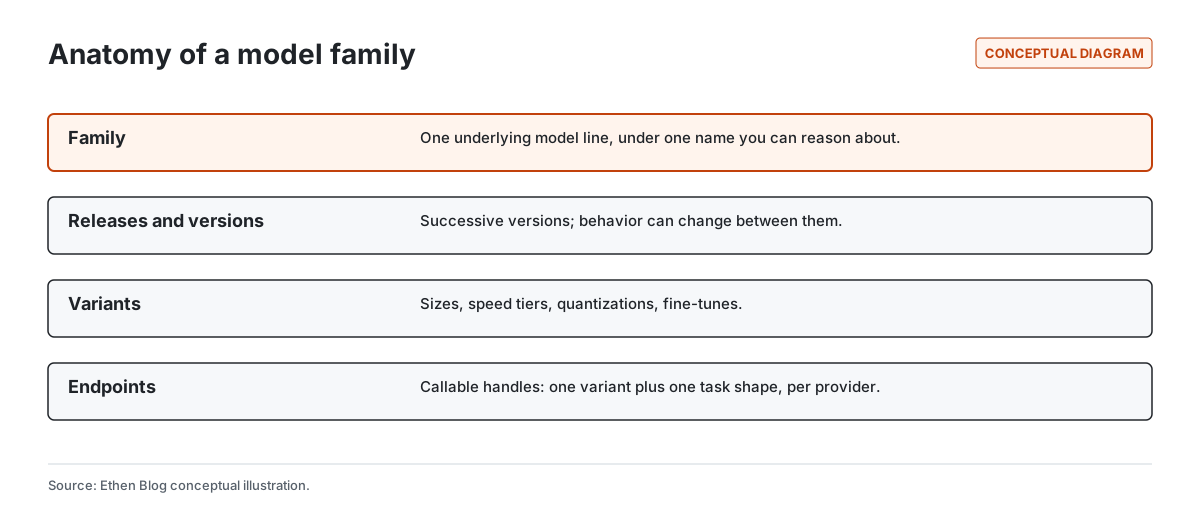
Family. The model line, under a name you can reason about: what it is designed for, who makes it, how it has evolved.
Releases and versions. Successive versions of the line. Behavior can change between versions, sometimes substantially.
Variants. Different sizes, speed tiers, quantized versions for cheaper hardware, or fine-tuned versions for particular tasks.
Endpoints. The callable handles through which you use a variant for a specific task, often offered by more than one provider. A single image model offered for text-to-image and for image editing is two endpoints.
Thinking in families helps you ask the right questions. "Is this family good at product photography?" is answerable. "Is endpoint number 847 good at product photography?" is not a question anyone can reason about.
What a large model count hides
Model counts are an easy number to market and a hard one to interpret. Figure 2 lists what typically inflates them.
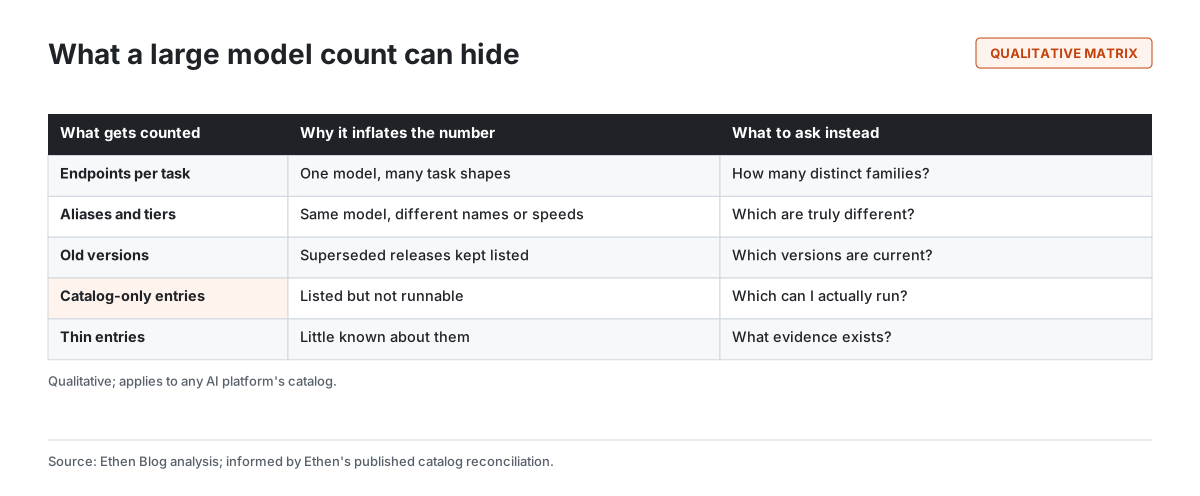
Endpoints per task. One model offered for several tasks counts several times.
Aliases and tiers. The same model under different names, or at different speed and price tiers, counts several times.
Old versions. Superseded releases often stay listed alongside current ones.
Catalog-only entries. Models that are listed but cannot actually be run by you — because they are not available in your region, not permitted by your organization's policy, or simply not wired up — still count.
Thin entries. Models about which almost nothing is known beyond a name.
Ethen's own catalog shows how much difference this makes. In a September 2026 snapshot, 1,499 provider endpoints grouped into 491 families, and only 128 of those families had enough substance for a public page. We describe that reconciliation in From Provider Endpoints to Ethen Model Families and the lessons we drew in What 1,499 AI Endpoints Taught Us About Model Catalog Design. If we had marketed the endpoint count as a model count, we would have overstated our catalog roughly threefold.
Why model counts became a marketing number
Model counts became popular for understandable reasons. They are easy to compute, easy to compare and easy to put in a headline. For a few years, the number of available models was also growing so quickly that breadth genuinely signaled something: access to the newest releases.
That signal has weakened. Most platforms now offer the major model families, often through the same underlying providers, so raw breadth no longer distinguishes them. What distinguishes them is everything a count leaves out: whether models are actually available to you, how well you can understand them before choosing, how carefully version changes are handled, and what happens when a provider has an outage. Those are harder to put in a headline, which is why they are worth asking about.
Why families are the right unit
Families are the right unit for three practical reasons.
Capabilities belong to families. A family's strengths and weaknesses are broadly consistent across its versions and variants: an image family known for photorealism tends to remain so; a coding-focused language model line tends to remain strong at code. Reasoning about families lets you carry knowledge across versions — with care, as the next section explains.
Evidence accumulates on families. Evaluations, documentation and community experience attach to model lines. A broad, multi-metric approach to evaluation — such as the Holistic Evaluation of Language Models project, which assessed models across many scenarios and metrics rather than a single score — produces the kind of evidence that is useful at the family level.
Decisions are made on families. Organizations approve providers and model lines, not individual endpoints. Teams standardize on a family for a task and choose variants for cost and speed.
Versions matter within a family
Families are useful, but they are not uniform. Versions within a family can behave differently, and that matters for anyone relying on consistent results.
A well-known 2023 study by Lingjiao Chen, Matei Zaharia and James Zou compared versions of widely used hosted language models a few months apart and found substantial changes in behavior on some tasks — improvements on some, declines on others. The lesson is not that newer versions are worse, but that a version change is a change, and should be tested.
That is why Ethen treats model versions carefully. A new version of a family we already use is not adopted automatically; it is checked on the tasks it will serve. We explain the reasoning in Why Ethen Doesn't Always Use the Newest Model, and Ethen Research Lab's Model Change Assurance research note explores how to test upgrades before they reach real work.
Five questions that matter more than a count
When comparing AI platforms, or deciding whether a catalog meets your needs, five questions are more useful than any model count. Figure 3 puts them in order.
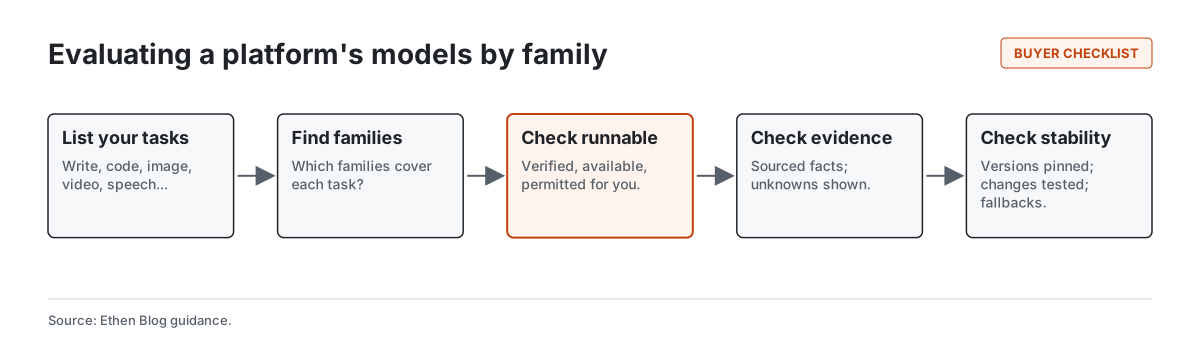
1. What are your tasks? Write them down: drafting, coding, research, image generation, image editing, video, speech. This is the list you will check the catalog against.
2. Which families cover each task? For each task, identify the families that are designed for it. A handful of strong families per task is usually enough.
3. Can you actually run them? Check that each family is available to you — in your region, under your organization's policies, through a working route. In Ethen's Gateway, for example, eligibility is decided per request by capability, health, budget and policy before any model is chosen; see How Ethen Gateway Chooses an Eligible Model.
4. What evidence exists? Look for sourced information about each family: what it does well, what it costs, how it has been evaluated, and what is unknown. A catalog that shows unknowns honestly is easier to trust than one that fills every cell. See Why Ethen Shows What It Knows—and What It Doesn't.
5. How stable is it? Can you pin a version? Are version changes tested before rollout? Is there a fallback family if one becomes unavailable?
For a fuller step-by-step process, see How to Choose an AI Model.
Families look different across modalities
The family idea applies across kinds of AI, but what varies inside a family differs by modality.
Language models. Families typically come in several sizes and speed tiers, with versions released every few months. The main variables are capability, context length, speed and cost. Version changes can shift behavior on specific tasks, so pinning matters.
Image models. One family is often offered for several tasks — generating from text, editing from a reference, upscaling — each as a separate endpoint. This is where endpoint counts inflate most. The useful question is which tasks a family supports and how well.
Video models. Families vary by duration, resolution and whether they start from text or from an image. Endpoints multiply across these options. Cost per clip varies widely within a family.
Speech and audio models. Families vary by voice, language coverage, latency and whether they generate speech, transcribe it or both. Voices are not models; a family may offer many voices through one model.
In every modality, the pattern is the same: one family, many ways to call it. Grouping by family makes the catalog legible; listing every way to call it makes it look bigger without making it more useful.
Questions to ask about any model catalog
When a vendor quotes a model count, five follow-up questions reveal what it means.
- Is that number endpoints, model versions or distinct model families?
- How many of those can my account actually run today, under my organization's policies?
- Which entries are superseded versions that remain listed?
- For the families I need, what sourced information is available, and what is unknown?
- When a version changes, will I be told, and can I stay on the previous version while I test?
A vendor that can answer these clearly is offering something more useful than a large number.
How Ethen presents models
Ethen's approach follows from the points above.
One page per family. The Model Library publishes families, with variants and endpoints listed under each, rather than separate pages for every endpoint.
Publication is earned. A family gets a public, indexable page only when there is enough substance to help someone decide. Others remain in the catalog without a public page until their information improves.
Facts have owners. Each model fact — identity, provenance, availability, routing eligibility — has a defined owner and source, as described in Who Owns Each Model Fact in Ethen.
Unknowns are shown. Values without complete provenance appear as unknown.
Runnable is separate from listed. Products that run models, such as Ethen Studio, execute only through verified routes, not catalog membership.
Multiple families, used deliberately. Ethen uses several model families because different tasks need different strengths, as explained in Why Ethen Is Built Around Multiple Models Instead of One.
A worked example
The following example is illustrative. A marketing team is comparing two AI platforms. Platform A advertises "over 800 models". Platform B lists 40 model families.
The team writes down its tasks: drafting copy, generating product images, editing those images, and producing short videos. On Platform A, they find that the 800 entries include the same few image families listed across many endpoints and tiers, several superseded versions, and a large number of entries with no description. Three families cover their image needs; two are listed but not available in their region. On Platform B, four families cover their image needs, all are runnable for them, each has sourced information and shows what is unknown, and versions are pinned with a stated fallback.
For this team's work, Platform B's 40 families are more useful than Platform A's 800 entries. The count was never the point.
When breadth does matter
Breadth is not worthless. A wide catalog helps when you need specialized capabilities — an unusual language, a niche media style, a particular speech voice — or when you want options to compare. It also provides fallbacks when a preferred family is unavailable.
But useful breadth is breadth in families that are runnable, evidenced and relevant to your work. The question is not "how many?" but "how many of the right kind?"
Tradeoffs and limitations
Families blur at the edges. Fine-tunes and derived models can be hard to place; reasonable people may group them differently.
Family reputations can mislead. A family's general strengths do not guarantee performance on your specific task. Test on your own examples.
Fewer pages mean less coverage. Publishing only well-supported families leaves some models without public pages.
Catalog numbers are snapshots. The figures quoted here describe one September 2026 export.
FAQ
What is an AI model family? A group of models from one model line — its versions and variants, offered through one or more endpoints — that share design and training lineage.
Does a platform with more models mean better? Not necessarily. Counts are inflated by endpoints, aliases, tiers, old versions and entries you cannot run. What matters is whether the families you need are runnable, evidenced and stable.
What's the difference between a model version and a variant? A version is a successive release of a model line over time. A variant is a different form of the same release, such as a smaller size, faster tier or fine-tuned edition.
How many AI models do I need? Usually a few strong families per task, plus a fallback. Start from your tasks, not the catalog.
Should I always use the newest version in a family? Not automatically. Version changes can alter behavior; test new versions on your tasks before switching.
Related reading
- What 1,499 AI Endpoints Taught Us About Model Catalog Design
- How to Choose an AI Model
- Why Ethen Doesn't Always Use the Newest Model
- From Provider Endpoints to Ethen Model Families
- Ethen Model Library
References
- Chen, L., Zaharia, M., & Zou, J. (2023). How is ChatGPT's behavior changing over time? arXiv:2307.09009. https://arxiv.org/abs/2307.09009
- Liang, P., Bommasani, R., Lee, T., et al. (2022). Holistic Evaluation of Language Models. arXiv:2211.09110. https://arxiv.org/abs/2211.09110
- Ethen Blog. From Provider Endpoints to Ethen Model Families (September 2026). https://upcube.ai/blog/from-provider-endpoints-to-ethen-model-families
- Ethen Research Lab (2026). Model Change Assurance: Testing AI Upgrades Before They Reach Real Work. Research note. https://upcube.ai/resources/research/model-change-assurance