Why Not Everything Ethen Researches Needs to Become a Product
The relationship between research and product development at Ethen comes down to one rule: every research question ends in one of three outcomes — build, publish only, or stop — and only one of those is a product. Research becomes a product when five things line up: evidence from results rather than proposals, a real need from people doing real work, a cost of ownership we can sustain as models and data change, clearance on safety, privacy and rights, and a natural place in an existing product. Much valuable research meets some of those and not others. It may produce a method others can reuse, a benchmark, a safeguard inside Ethen, a design principle, or a negative result that saves everyone time. That is why a research publication from Ethen is never a product announcement, and why "publish only" and "stop" are normal outcomes rather than failures. This article explains the rule and how to read Ethen research with it in mind.
The relationship between research and product development at Ethen comes down to one rule: every research question ends in one of three outcomes — build, publish only, or stop — and only one of those is a product. Research becomes a product when five things line up: evidence from results rather than proposals, a real need from people doing real work, a cost of ownership we can sustain as models and data change, clearance on safety, privacy and rights, and a natural place in an existing product. Much valuable research meets some of those and not others. It may produce a method others can reuse, a benchmark, a safeguard inside Ethen, a design principle, or a negative result that saves everyone time. That is why a research publication from Ethen is never a product announcement, and why "publish only" and "stop" are normal outcomes rather than failures. This article explains the rule and how to read Ethen research with it in mind.
Key takeaways
- Three outcomes. Build, publish only, or stop.
- Five criteria to build. Evidence, need, cost of ownership, safety and rights, fit.
- Research is not an announcement. A paper about an idea does not mean a feature is coming.
- Value without features. Methods, benchmarks, safeguards, principles and negative results all matter.
- Stopping is a result. A question answered "no" is reported, not buried.
Why the question matters
When a technology company publishes research, readers naturally ask what it means for the products. Will this become a feature? Is this what the company is building next? For AI companies, the pressure to connect research to products is especially strong, because research attracts attention and products earn revenue.
That pressure creates a specific risk: research publications get read as product announcements, and research directions get treated as commitments. A proposal about private model improvement becomes "Ethen will train on your data privately". A benchmark design becomes "Ethen's agents pass this benchmark". Neither is true, and both harm trust when the gap is discovered.
We address the communication side of this in Why Ethen Keeps Research Separate From Product Claims. This article addresses the decision side: what actually happens to a research question, and why most do not become products.
Three outcomes
Figure 1 shows the three outcomes.
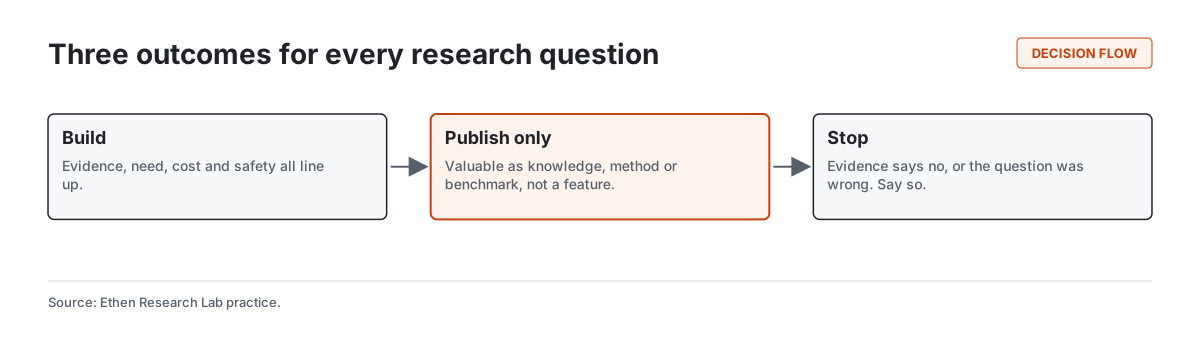
Build. The research produces evidence that something works, people need it, it can be maintained, it is safe and permitted, and it fits a product. It becomes part of a product, with its own product claims, documentation and testing.
Publish only. The research produces something valuable — a method, a benchmark, a finding, a principle — that should not or cannot become a product feature. It is published as a contribution and may shape Ethen's work indirectly.
Stop. The evidence says the idea does not work, or the question turns out to be the wrong one. The result is published, the reason is stated, and the work ends.
Every research question at Ethen is expected to name, in advance, what result would lead to stopping. Writing a stopping criterion before results arrive is one of the best defenses against continuing a project because of momentum rather than evidence.
Five criteria for building
Figure 2 lists the criteria a research result must meet before it becomes part of a product.
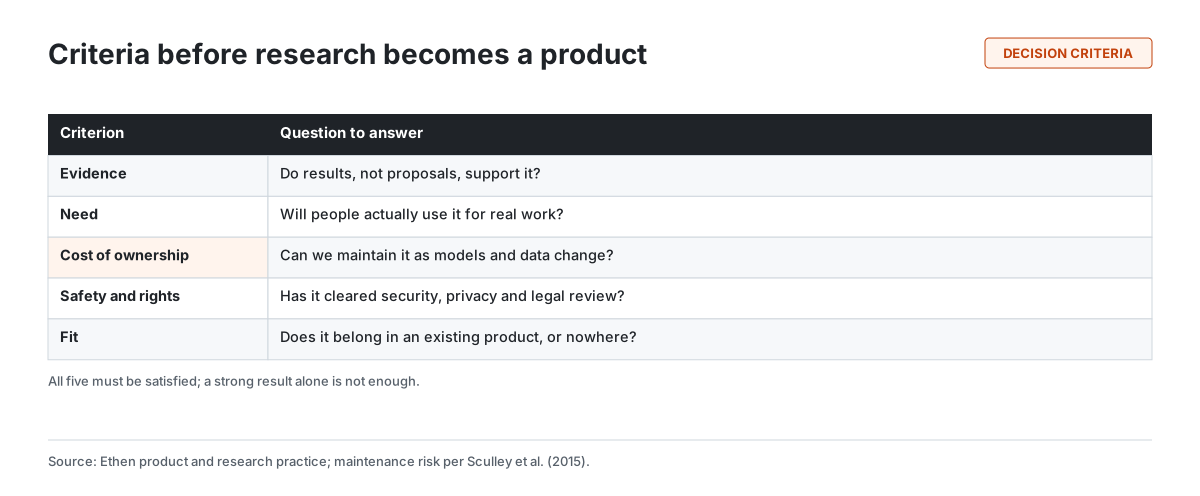
Evidence. Results, not proposals. A research proposal describes an idea; a protocol describes a test; only results show whether the idea works. Ethen Research Lab labels every publication with its evidence status for exactly this reason. Most current publications are proposals, protocols and benchmark designs, which means most are not yet candidates for building at all.
Need. People doing real work have to need it. An elegant method that solves a problem nobody has does not belong in a product.
Cost of ownership. Machine learning systems are expensive to maintain. A well-known 2015 paper on hidden technical debt in machine learning systems, by D. Sculley and colleagues at Google, showed how ML components accumulate ongoing costs through entangled dependencies, data dependencies, feedback loops and changes in the outside world. A research result that works in a paper but would be costly to keep working as models and data change may not be worth building. This is the criterion most often underestimated.
Safety and rights. Some research involves data, privacy or security questions that need review before anything is built. Several Ethen Research Lab publications state explicitly that they require legal, privacy or security review — a clear signal that they are not product-ready regardless of their technical merit.
Fit. The result has to belong somewhere. Ethen is organized as a family of specialized apps; a result that fits none of them, or would add a confusing feature to one, may be better published than built. We explain why depth matters more than feature count in Why We're Choosing Depth Over Feature Count.
All five must be satisfied. A strong result alone is not enough.
What research produces besides products
Counting only features would undervalue most of what research produces. Figure 3 lists other outputs.
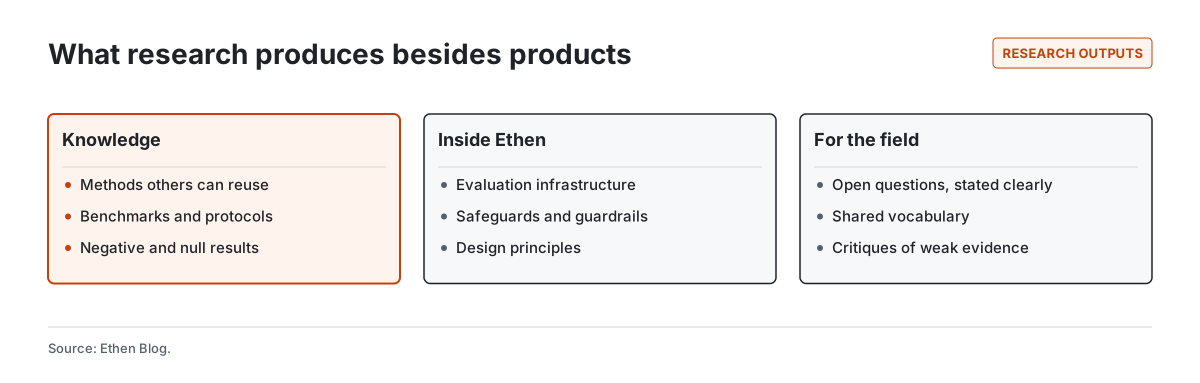
Knowledge. Methods others can reuse, benchmarks and protocols that let anyone test a claim, and negative or null results that save the field from repeating dead ends.
Inside Ethen. Evaluation infrastructure that checks products without being a feature; safeguards and guardrails that shape how products behave; design principles that guide decisions across products.
For the field. Clearly stated open questions, shared vocabulary for discussing hard problems, and critiques of weak evidence.
The political scientist Donald Stokes argued in Pasteur's Quadrant that the old split between "basic" and "applied" research misses an important category: use-inspired basic research, which seeks fundamental understanding while being motivated by practical problems — as Louis Pasteur's work on microbiology was. Much of Ethen Research Lab's work aims to sit there: motivated by problems AI products face, but valuable as understanding whether or not it becomes a feature.
How this looks in Ethen's research
Some examples from the published archive show the three outcomes in practice. These describe the kind of outcome each publication is suited to, not decisions that have been made.
Benchmark designs tend toward "publish" and internal infrastructure. Ethen Research Lab's VerifiedWork benchmark designs describe how agent capabilities could be tested. Benchmarks are rarely product features. Their value is in making claims checkable, for Ethen and for others.
Some proposals require review before anything else. Proposals involving datasets, private improvement or enterprise data — such as A Rights-Aware Dataset Compiler for AI Training and Evaluation — state that they require legal, privacy or security review. They may become products, may remain research, or may stop, depending on what that review and further evidence show.
Surveys and taxonomies serve the field. A literature survey and taxonomy proposal such as Toward a Failure Genome of Software Agents, which proposes a taxonomy of how agents fail, is valuable as shared vocabulary even if it never becomes a feature.
Some research argues for the simpler option. The survey Why Learned AI Model Routing Must Beat Good Rules argues that learned routing should be adopted only if it beats strong rule-based baselines. If the experiments it calls for find that it does not, the right outcome is to keep the rules — a research result that leads to building less.
Robotics hardware may never be built. Our decision rule for hardware explicitly treats "never" as acceptable, as explained in Why We're Not Rushing Ethen Into Hardware.
The cost of building too early
Turning research into a product before it is ready has costs that are easy to miss.
Users rely on it. Once a capability ships, people build their work around it. If the research behind it turns out to be weaker than it looked, removing or changing it disrupts them.
Claims harden. Product pages, documentation and sales conversations describe what a feature does in confident terms. A research result with caveats becomes a product claim without them.
Maintenance starts immediately. A shipped feature has to keep working as models, data and the surrounding software change. Research prototypes rarely account for that.
Attention moves. A team maintaining a premature feature is not doing the research that would have made it solid.
Trust erodes when gaps appear. If a feature built on an untested proposal fails in public, the damage extends to the research program that produced it.
Waiting for results, and for the other four criteria, is slower. It is also much cheaper than unwinding a feature that should not have shipped.
Why publishing helps even when we build
Even when research does become a product, publishing it separately has value. The research publication records what was tested, how, and with what limits, in a place that does not change when product marketing does. It lets outsiders check the reasoning. And it gives product teams a stable reference for what the evidence actually supports, which is useful when the temptation arises to claim more.
The product and the research then live side by side: the product page describes what the feature does today, and the research publication describes what was found and how. Each links to the other, and neither borrows the other's authority.
How to read Ethen research with this in mind
If you are reading Ethen Research Lab publications, a few habits help.
Check the evidence status first. A proposal or protocol is not a candidate for a product yet.
Do not infer product plans. A paper about an idea tells you what Ethen is studying, not what it is building.
Look for the stopping criterion. Good protocols say what result would count as failure. That tells you the question is genuinely open.
Read product claims on product pages. What Ethen's products do is described in documentation and product posts, with their own evidence.
How a "stop" is reported
Stopping is the outcome most organizations hide. We think it should be reported as carefully as any other result. A stop report should say what was tried, what was found, why it led to stopping, and what others might learn from it. Earlier publications on the topic should be updated with a visible note pointing to the stop report. The aim is that a reader who finds the original proposal also finds out what happened to it.
A worked example
The following example is illustrative. Suppose a protocol tests whether agents that learn from verified past work recover from failures better than agents that do not.
If the result is positive and robust, the next questions are the product criteria: Do users need better recovery in a specific product? Can the learning be maintained as models change? Does it raise privacy questions about learning from customers' work? Does it fit an existing product? Only if all five line up does it become a build candidate.
If the result is positive but narrow — it helps only on certain tasks, or only with a specific model — the right outcome may be "publish only": a useful finding that informs design without becoming a feature.
If the result is null, the right outcome is "stop": publish the null result, update the original proposal, and redirect effort.
All three outcomes produce knowledge. Only one produces a feature.
Tradeoffs and limitations
Some valuable ideas wait a long time. Strict criteria mean promising research may not reach products quickly.
"Publish only" can look like waste to some. We think it is the most common good outcome of research, but it does not show up as features.
Criteria require judgment. "Need" and "fit" are not mechanical; reasonable people may disagree.
Outcomes described here are illustrative. No product decisions are announced for any specific publication.
FAQ
Why would a company do research that never becomes a product? Because research produces methods, benchmarks, safeguards, principles and negative results that improve products indirectly and contribute to the field, even when building a feature is not justified.
How do AI companies decide which research to productize? At Ethen, research must meet five criteria: evidence from results, a real user need, sustainable cost of ownership, safety and rights clearance, and fit with an existing product.
Does Ethen research mean a new feature is coming? No. A research publication describes what Ethen is studying, labeled with its evidence status. Product plans are not inferred from research.
What happens when research fails? It is reported as a result — what was tried, what was found and why work stopped — and earlier publications are updated.
What is use-inspired basic research? Research that seeks fundamental understanding while being motivated by practical problems, a category described by Donald Stokes in Pasteur's Quadrant.
Related reading
- Why Ethen Keeps Research Separate From Product Claims
- What Ethen Research Lab Is Exploring Beyond AI Products
- Why We're Not Rushing Ethen Into Hardware
- Why We Made Ethen Research Look More Like a Journal Than a Blog
- Ethen Research Lab
References
- Stokes, D. E. (1997). Pasteur's Quadrant: Basic Science and Technological Innovation. Brookings Institution Press.
- Sculley, D., Holt, G., Golovin, D., Davydov, E., Phillips, T., Ebner, D., Chaudhary, V., Young, M., Crespo, J.-F., & Dennison, D. (2015). Hidden Technical Debt in Machine Learning Systems. Advances in Neural Information Processing Systems 28. https://papers.nips.cc/paper/5656-hidden-technical-debt-in-machine-learning-systems
- Ethen Research Lab (2026). Why Learned AI Model Routing Must Beat Good Rules. Survey. https://upcube.ai/resources/research/learned-routing-vs-rules
- Ethen Research Lab (2026). A Rights-Aware Dataset Compiler for AI Training and Evaluation. Research proposal; requires legal review. https://upcube.ai/resources/research/rights-aware-dataset-compiler
- Ethen Research Lab (2026). Toward a Failure Genome of Software Agents. Research paper (survey and taxonomy proposal). https://upcube.ai/resources/research/failure-genome