Why We Made Ethen Research Look More Like a Journal Than a Blog
We chose a journal-like research publication format for Ethen Research Lab because blog conventions make it too easy to confuse an idea with a finding. A blog post has a date, an author and a persuasive headline; it rarely says what kind of document it is or what kind of evidence it holds. Journals solved that problem long ago with typed publications, abstracts, numbered references and stable identifiers. We borrowed those conventions, adapted some — stating evidence status in plain words on every page and treating proposals and protocols as first-class publications — and declined one: we do not imply peer review, because our publications have not been through it. This article explains the reasoning, what each convention is for, and where our format deliberately differs from a journal.
We chose a journal-like research publication format for Ethen Research Lab because blog conventions make it too easy to confuse an idea with a finding. A blog post has a date, an author and a persuasive headline; it rarely says what kind of document it is or what kind of evidence it holds. Journals solved that problem long ago with typed publications, abstracts, numbered references and stable identifiers. We borrowed those conventions, adapted some — stating evidence status in plain words on every page and treating proposals and protocols as first-class publications — and declined one: we do not imply peer review, because our publications have not been through it. This article explains the reasoning, what each convention is for, and where our format deliberately differs from a journal.
Key takeaways
- Format carries meaning. How a document looks tells readers how much to trust it.
- Blog conventions blur evidence. Announcements, opinions and findings look the same in a blog feed.
- Journal conventions make evidence legible. Types, abstracts, references and identifiers help readers judge claims.
- We state evidence status explicitly. Journals imply it through the venue; we write it on the page.
- We publish methods before results. Following preregistration practice, protocols come first.
- We do not imply peer review. A journal's form without a journal's claim.
The problem with research as blog posts
Many technology companies publish research on their blogs. The posts are often excellent: clear, well illustrated, quick to read. But the blog format has a structural weakness when it carries research.
Everything looks the same. In a blog feed, a product announcement, an opinion piece, an engineering write-up and a research finding share the same layout, the same author bylines and the same kind of headline. Readers have to infer from the prose which one they are reading.
Headlines persuade. Blog headlines are written to be clicked and shared. Research claims written that way tend to sound stronger than the evidence behind them.
Evidence is implicit. A blog post rarely states whether it reports a measurement, describes a method or argues a position. The reader is left to work it out.
Posts are hard to cite precisely. Without stable identifiers, versions or numbered references, a blog post is hard to cite, hard to check and hard to update honestly.
None of this matters much for product news. It matters a great deal for research, because research pages lend authority. A claim under a "Research" heading is read as more established than the same claim elsewhere, and summaries by search engines and AI assistants amplify whatever the page appears to say.
What journals got right
Academic journals are imperfect, but their conventions evolved to solve exactly the problem above: helping readers judge what a document claims and how well it supports those claims. Figure 1 compares the conventions.
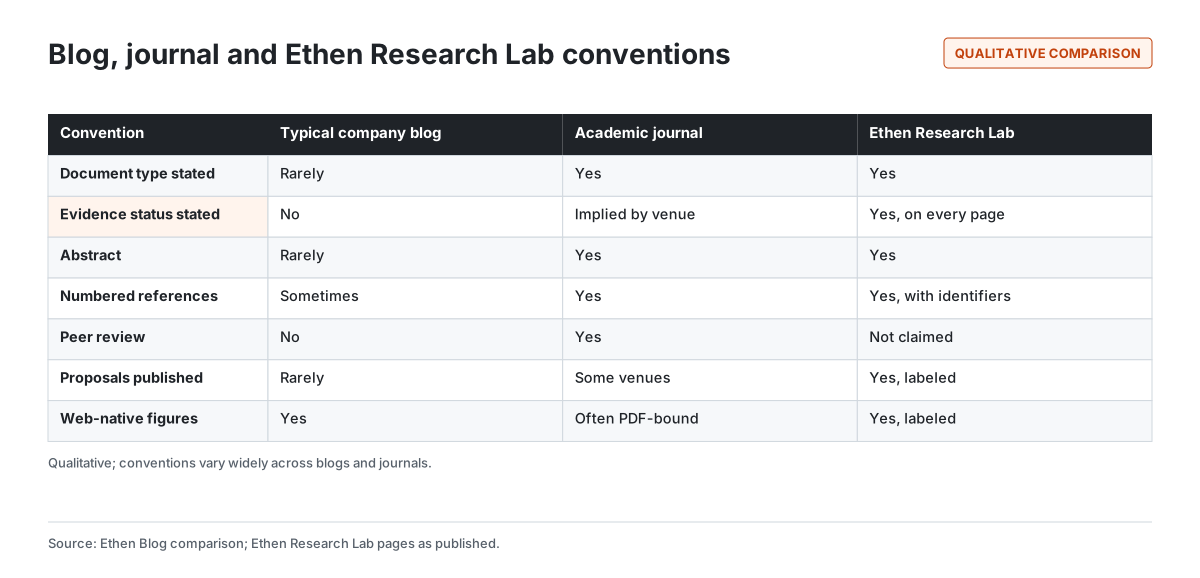
Typed publications. Journals distinguish research articles, reviews, commentaries, perspectives and methods papers. The type tells readers what to expect before they read.
Abstracts. A short summary of the question, approach and conclusion lets readers decide whether the document is relevant and gives them an accurate picture even if they read no further.
Numbered references with identifiers. Every claim that depends on prior work points to a specific, retrievable source.
Stable identity. A paper has a fixed identifier and a version, so a citation points to the same text years later.
Limitations. Good papers state what they do not show.
These conventions are not about prestige. They are tools for reading critically. That is why we adopted them.
What each convention protects against
It helps to think of each journal convention as a defense against a specific way readers get misled.
Typed publications protect against category errors. Without a type, a reader can mistake a position paper — an argument — for a research paper reporting experiments. The type sets expectations before the first sentence.
Evidence status protects against inflation. As a claim travels from a paper to a summary to a social post, qualifiers fall away. "We propose that verified outcomes could improve learning" becomes "Ethen shows verified outcomes improve learning". Putting the evidence status at the top, in plain words, gives every downstream summary the qualifier it needs.
Abstracts protect the skimmer. Most readers do not finish long documents. An abstract written to be accurate on its own means that partial reading still produces a correct impression.
Numbered references protect against unsupported claims. When every external claim points to a numbered source with a persistent identifier, readers can check it, and authors are reminded to have a source.
Limitations sections protect against overreach. Writing down what a document does not show is the most reliable way to stop it being read as showing more.
Stable identifiers and versions protect the record. If a publication changes, a reader who cited the earlier version should be able to see what it said. Silent edits erode trust faster than visible corrections.
Institutional authorship protects against personality-driven reading. Research read through the lens of a well-known author tends to be judged by reputation. Attributing publications to the Lab puts the emphasis on the evidence, and makes the institution accountable for the labels.
None of these defenses is perfect. Together, they make it much harder for a careful reader to come away believing more than the evidence supports — which is the whole point of a research publication.
What we borrowed, adapted and declined
We did not copy the journal model wholesale. Figure 2 sorts the decisions.
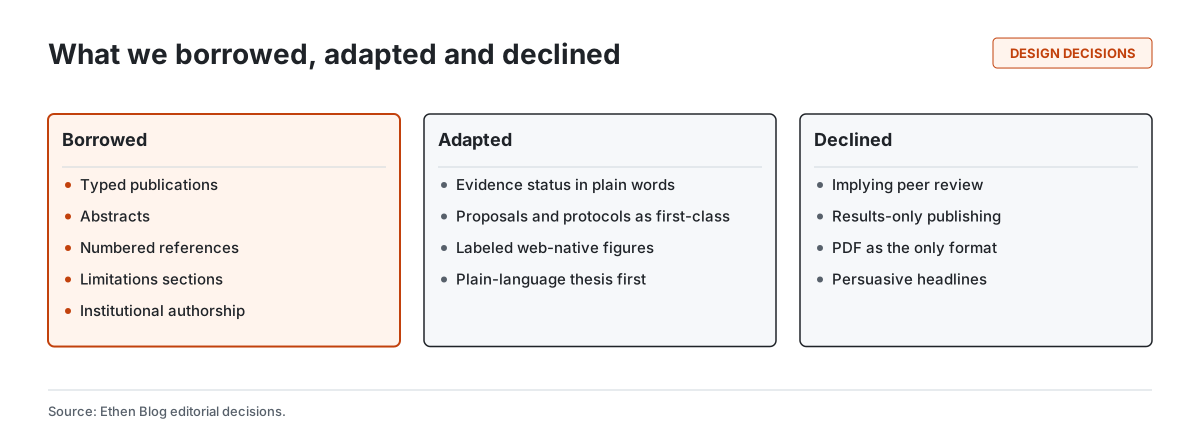
Borrowed
Typed publications. Every Ethen Research Lab publication carries a type: position paper, research note, research proposal, research protocol, benchmark design, methods paper, technical report, survey, research paper or system card. We explain what each means in How to Explore Ethen Research Lab.
Abstracts and a stated thesis. Each publication opens with its argument and an abstract.
Numbered references. References are numbered and keep their DOIs or arXiv identifiers.
Limitations. Publications state what they do not establish.
Institutional authorship. Publications are authored by Ethen Research Lab as an institution. That keeps attention on the work and makes clear that the Lab, not an individual, stands behind the evidence labels.
Adapted
Evidence status, written on the page. In journals, the strength of evidence is partly implied by the venue and the article type. We could not rely on a venue, so every publication states its evidence status explicitly — from measured results through system evidence, synthesis, protocols and benchmark designs to untested proposals — with a sentence explaining what that status means. This is the single most important adaptation, and we describe how it appears on the page in Inside the Redesign of Ethen's Research Publications.
Proposals and protocols as first-class publications. Many journals publish mainly results. We publish ideas, methods and planned experiments too, clearly labeled, for reasons explained below.
Web-native, labeled figures. Journals are often bound to PDF. Our figures are web-native and carry an evidence label in the image itself, so a conceptual diagram cannot be mistaken for data when shared. In an influential essay published in the interactive journal Distill, Chris Olah and Shan Carter argued that the field underinvests in explanation — what they called "research debt". Clear figures are one of the cheapest ways to pay some of it down.
Plain language first. Each publication leads with a plain-language thesis so that a non-specialist reader leaves with an accurate picture.
Declined
Implying peer review. Our publications have not been peer reviewed by external journals, and nothing about their presentation suggests otherwise. The page metadata uses a type that describes scholarly writing without asserting review.
Results-only publishing. We publish methods before results.
PDF as the only format. Publications are web pages first, readable on any device and accessible to assistive technology.
Persuasive headlines. Titles state the question or the position, not a conclusion the evidence has not reached.
Why publish methods before results
The most unusual thing about Ethen Research Lab, compared with a typical company blog, is how much of it is not results. Of 41 publications, fifteen are proposals or hypotheses, seven are protocols and five are benchmark designs. One system card reports results on one pinned build.
We publish that way deliberately, and the reasoning comes from the scientific reform movement of the last decade. Researchers concerned about selective reporting and flexible analysis have argued for preregistration: stating the hypothesis, method and analysis plan before collecting data. Registered reports, a publishing format introduced at the journal Cortex in 2013, go further: the method is reviewed and accepted before results are known, so publication cannot depend on whether the results are exciting.
The same logic applies to company research, perhaps more strongly. A company has obvious incentives to publish favorable results and quietly drop unfavorable ones. Publishing a protocol before running it removes some of that freedom. If the experiment later produces a null or negative result, the protocol is already public, and omitting the result would be visible. Figure 3 shows the lifecycle we are aiming for.
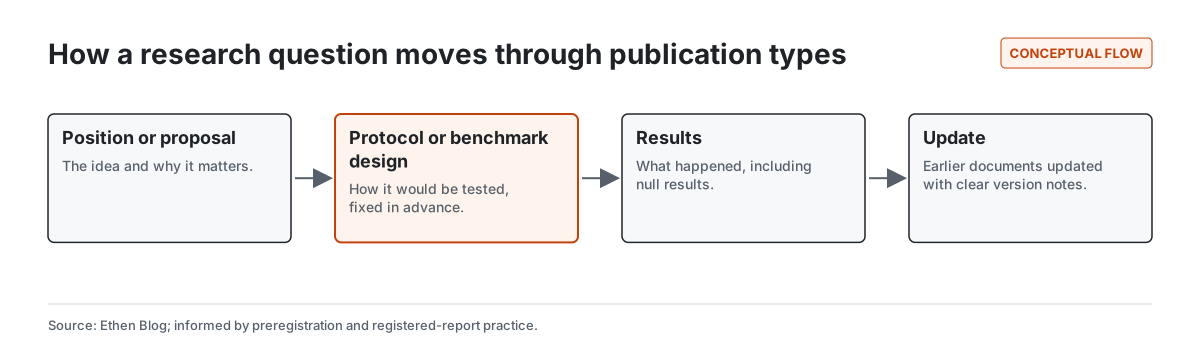
This approach has a cost: an archive with many proposals and few results can look thin to a casual reader. We would rather be clear about where the program stands than fill the archive with results that cannot be checked. Our broader reasons for publishing in public are in Why Ethen Research Lab Publishes Its Work in Public.
Why not just submit to journals?
A fair question is why we do not simply submit work to established journals and conferences. Some work may eventually go there. But three considerations shape the current approach.
Speed and scope. Many of our publications are proposals, protocols and benchmark designs. Few venues publish those, and fewer do so quickly.
Connection to products. Ethen's research is closely tied to questions about how AI systems should do verifiable work. Publishing on the same site as the products, with clear separation, lets readers move between a research question and the product context without confusing the two. We explain how the separation works in Why Ethen Keeps Research Separate From Product Claims.
Openness. Publications are free to read, with no paywall.
The trade-off is the absence of external peer review. We address that by stating it plainly, by publishing methods before results, and by inviting scrutiny of the published protocols.
How the format helps different readers
A journal-like format serves several audiences at once.
Researchers can see immediately whether a publication contains anything new and of what kind, and can check every reference.
Journalists and analysts get the right qualifier to use when quoting — "an untested proposal", "a protocol for an experiment not yet run" — rather than "Ethen research shows".
Buyers and partners can separate what Ethen has demonstrated from what it proposes to investigate.
AI systems summarizing the pages encounter the evidence status in plain text near the top, which makes accurate summaries more likely.
Where this format can still mislead
No format guarantees honest reading, and a journal-like look carries its own risk: it can make unreviewed work look more authoritative than it is. We counter that in four ways: never implying peer review; putting evidence status above the argument; labeling every figure; and keeping the visual design restrained rather than mimicking prestigious journals.
We also expect to get some classifications wrong. When a publication's evidence status or type turns out to be misjudged, the right response is to correct it with a visible update rather than silently.
Where blog posts still belong
None of this means blog posts are the wrong format for everything. The Ethen Blog explains what we build, how it works and why we made particular choices. Engineering posts describe mechanisms. Product posts describe direction. Those are valuable, and they belong on the Blog. Research publications belong in the Research Lab. We describe how we route each piece of writing to the right place in How We Decide Whether Something Belongs in Blog, Docs, or Research.
Tradeoffs and limitations
More structure, more effort. Typed publications with abstracts, evidence statuses and numbered references take longer to produce than blog posts.
A thin-looking archive. Publishing methods before results means the archive has more plans than findings for now.
No external review. The format does not substitute for peer review, and we do not claim it does.
Categories simplify. Some publications mix types; each carries its primary type, and the text explains the rest.
FAQ
Why do AI companies publish research as blog posts? Blogs are fast, flexible and readable. The drawback is that they rarely state what kind of evidence a post contains, which makes findings easy to confuse with opinions or announcements.
What makes a research publication credible? Clear statements of what kind of document it is and what evidence it contains, traceable references, stated limitations, a method that could be checked, and ideally independent review.
Should research proposals be published before results? Publishing methods before results — preregistration — reduces selective reporting and makes later results more trustworthy. It works best when proposals are clearly labeled as untested.
Are Ethen Research Lab publications peer reviewed? No. They are not presented as peer reviewed, and the page metadata does not claim it.
Does Ethen Research Lab only publish results? No. It publishes proposals, protocols, benchmark designs, syntheses and one system card, each with its evidence status stated.
Related reading
- Inside the Redesign of Ethen's Research Publications
- Why Ethen Research Lab Publishes Its Work in Public
- Why Ethen Keeps Research Separate From Product Claims
- Why Ethen Uses System Cards and Research Notes Differently
- Ethen Research Lab
References
- Olah, C., & Carter, S. (2017). Research Debt. Distill. https://doi.org/10.23915/distill.00005
- Nosek, B. A., Ebersole, C. R., DeHaven, A. C., & Mellor, D. T. (2018). The preregistration revolution. Proceedings of the National Academy of Sciences, 115(11), 2600–2606. https://doi.org/10.1073/pnas.1708274114
- Chambers, C. D. (2013). Registered Reports: A new publishing initiative at Cortex. Cortex, 49(3), 609–610. https://doi.org/10.1016/j.cortex.2012.12.016
- Ginsparg, P. (2011). ArXiv at 20. Nature, 476, 145–147. https://doi.org/10.1038/476145a
- Ethen Research Lab. Research Lab index. https://upcube.ai/resources/research