Why Local AI Still Matters in a Cloud-First World
People run AI locally for five main reasons, and they hold even as cloud models get larger and cheaper. Work processed entirely on your own machine is not sent to a model provider. Local models keep working without a network connection. You decide when a local model changes, so its behavior does not shift under you. Costs are paid up front in hardware rather than growing with every request. And local runtimes are an open playground for experimenting with models. The trade-offs are real: local models are smaller than the largest hosted ones, quality depends on your hardware, you maintain the setup yourself, and the privacy benefit applies only to the steps that actually stay on your machine. This article explains when local AI is worth it, what it does and does not protect, and how Ethen approaches it.
People run AI locally for five main reasons, and they hold even as cloud models get larger and cheaper. Work processed entirely on your own machine is not sent to a model provider. Local models keep working without a network connection. You decide when a local model changes, so its behavior does not shift under you. Costs are paid up front in hardware rather than growing with every request. And local runtimes are an open playground for experimenting with models. The trade-offs are real: local models are smaller than the largest hosted ones, quality depends on your hardware, you maintain the setup yourself, and the privacy benefit applies only to the steps that actually stay on your machine. This article explains when local AI is worth it, what it does and does not protect, and how Ethen approaches it.
Key takeaways
- Local AI is a control choice. It trades some capability and convenience for privacy, offline use, version stability and cost predictability.
- The privacy benefit is exact, not general. It covers work that stays local, and nothing that leaves the machine.
- Version stability is underrated. Hosted models can change behind a stable name; a local model changes only when you change it.
- Check operations, not labels. "Supports local models" means different things for different runtimes.
- Local and cloud work best together. The useful question is which steps of a task belong where.
Why run AI locally when cloud models are bigger?
Running AI locally makes sense when control matters more than maximum capability. The largest hosted models are more capable than anything most people can run on a laptop or desktop, and they are easier: nothing to install, no hardware to buy, no models to manage. For many tasks, that settles it.
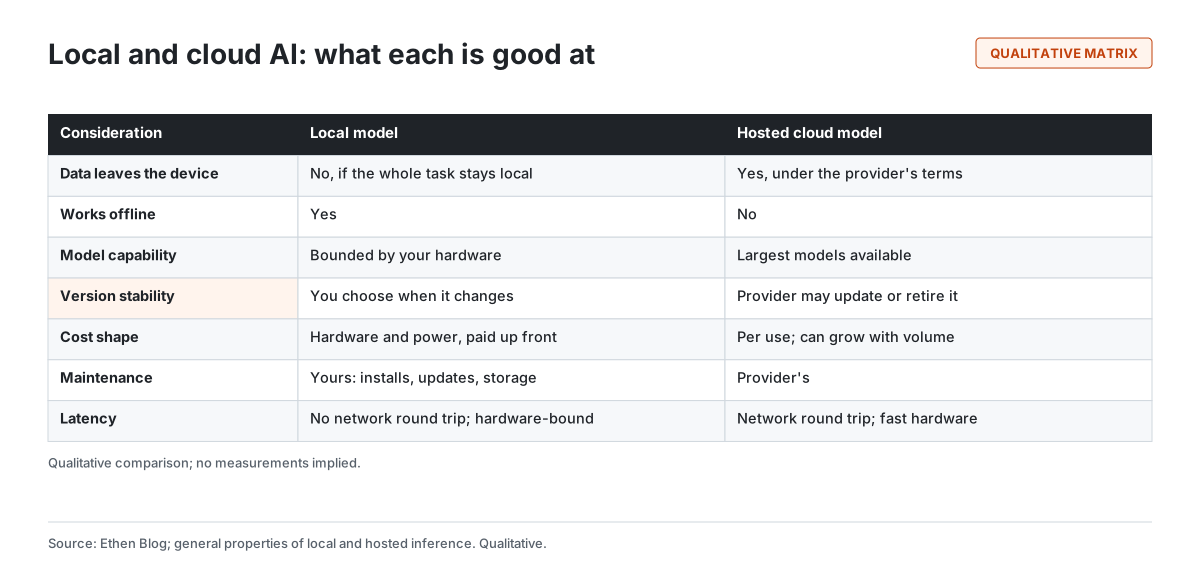
But a meaningful share of everyday AI work does not need the largest model. Summarizing a document, classifying files, drafting a reply, searching your own notes, extracting fields from a form, or explaining a code snippet are tasks that smaller models often handle adequately. For those tasks, the remaining differences between local and cloud — where data goes, whether a connection is needed, who controls updates and how costs behave — can matter more than the capability gap. Figure 1 summarizes the trade-off.
Privacy: what stays on the machine
The clearest benefit of local AI is that prompts and files processed by a local model are not sent to a model provider. For information people are reluctant or not permitted to share, such as personal records, confidential documents, unreleased code or customer data, that difference can decide whether AI can be used at all.
Two qualifications keep this honest. First, the protection applies only to the steps that run locally. If a task uses a local model to summarize a document and then sends the summary to a cloud service, the summary has left the machine. Second, removing obvious identifiers does not make data safe to send. Research has shown that language models can re-identify people from pseudonymous text at scale (Lermen et al.), and Ethen Research Lab's own work treats pseudonymized records as private rather than anonymous. For sensitive material, keeping the whole task local is stronger than trying to clean data before sending it.
Offline: AI without a connection
A local model works when the network does not: on a plane, in a building with poor coverage, on a restricted network, or during a provider outage. For some people this is a convenience. For others, such as field workers, people in regions with unreliable connectivity, or teams in restricted environments, it is the only way AI is available at all.
Stability: a model that changes only when you change it
Hosted models can change. Providers release new versions, retire old ones and sometimes adjust behavior behind a familiar name. A study of a widely used hosted model found substantial differences in its behavior on several tasks between versions released months apart (Chen et al.). For a workflow tuned to a model's quirks, an unannounced change can mean a silent regression.
A local model changes only when you download a different one. That makes local models useful wherever repeatability matters: a classification step in a data pipeline, a fixed evaluation, or a workflow you have tested and do not want to retest every month. Ethen takes model change seriously in general; why Ethen does not automatically switch to the newest model is discussed in Why Ethen Sometimes Won't Use the Newest Model.
Cost: paid up front, not per request
Local inference shifts cost from usage to ownership. You pay for hardware and electricity rather than per token or per request. For light, occasional use, cloud models are usually cheaper because you pay only for what you use. For steady, high-volume, small-model workloads, local inference can be more predictable, and its marginal cost is close to zero once the hardware exists. The right answer depends on the workload, and the capability-first way to compare execution paths is set out in Local AI or GPU Hosting: What to Check First.
Experimentation: an open playground
Local runtimes make it easy to try many open-weight models, compare them on your own tasks, and inspect how they behave, without accounts, quotas or usage fees. Tools such as Ollama and the llama.cpp project have made running models locally accessible to anyone with a capable computer (Ollama; llama.cpp). That openness is valuable for learning, research and prototyping, even when the final deployment runs elsewhere.
Who benefits most from local AI
Local AI is not equally valuable to everyone. Four groups tend to benefit most.
People handling confidential material. Lawyers reviewing privileged documents, clinicians drafting notes, finance teams working with unreleased numbers and engineers with proprietary code often face rules, contracts or simple caution that make sending material to an external provider difficult. A local model lets them use AI for the parts of the work that touch that material.
People with unreliable or restricted connectivity. Travelers, field teams, people in regions with intermittent internet, and organizations that restrict outbound traffic all gain from AI that does not depend on a connection.
Builders who need repeatability. Anyone running the same AI step thousands of times, such as tagging records, routing tickets or extracting fields, benefits from a model that behaves the same way tomorrow as today, at a cost that does not grow with every run.
Learners and researchers. Running models locally is one of the best ways to understand how they behave: how quantization affects quality, how prompts change outputs, where small models fail. That understanding transfers to work with hosted models too.
For people outside these groups, a hosted model is often the better default, and that is fine. Local AI is a tool to reach for when its specific strengths matter.
Local AI for developers
For developers, local models are also a practical engineering tool. They make it possible to build and test AI features without spending money on every iteration, to run automated tests against a fixed model that will not change between runs, and to develop on a laptop without network access. They are useful for prototyping a feature before deciding which hosted model it should eventually use. And when a product must offer a private or offline mode, local runtimes are the natural foundation.
The main engineering caution is that a local model is not a drop-in stand-in for a hosted one. Different models follow instructions differently, support different context lengths and handle tool calls with varying reliability. A feature tuned against a local model should be re-evaluated before it runs on a hosted model, and the reverse is equally true. The same discipline applies whenever any model changes. Ethen Research Lab's work on measuring whether capabilities survive model changes, The Capability Transfer Ledger, is a methods paper rather than a result, but the principle carries over directly: measure, do not assume, when the model underneath a feature changes.
Should this task run locally?
A simple sequence of questions helps decide whether a particular task belongs on a local model (Figure 2).
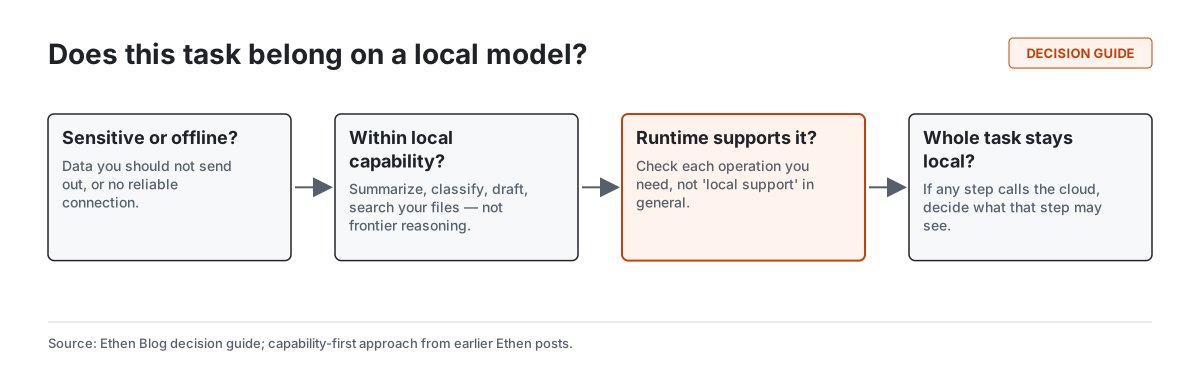
Is the task sensitive, or do you need to work offline? If neither, a cloud model is often simpler. Is the task within what a local model can do well? Summarizing, classifying, drafting and searching usually are; multi-step reasoning over large inputs often is not. Does your runtime support the operations you need? Local runtimes differ: listing models, downloading them, streaming chat and generating embeddings are separate capabilities, and not every runtime supports all of them. Does the whole task stay local? If one step calls a cloud tool or model, decide deliberately what that step is allowed to see.
What local AI does not protect
It is easy to overstate what local processing guarantees, so Figure 3 sets out its limits.
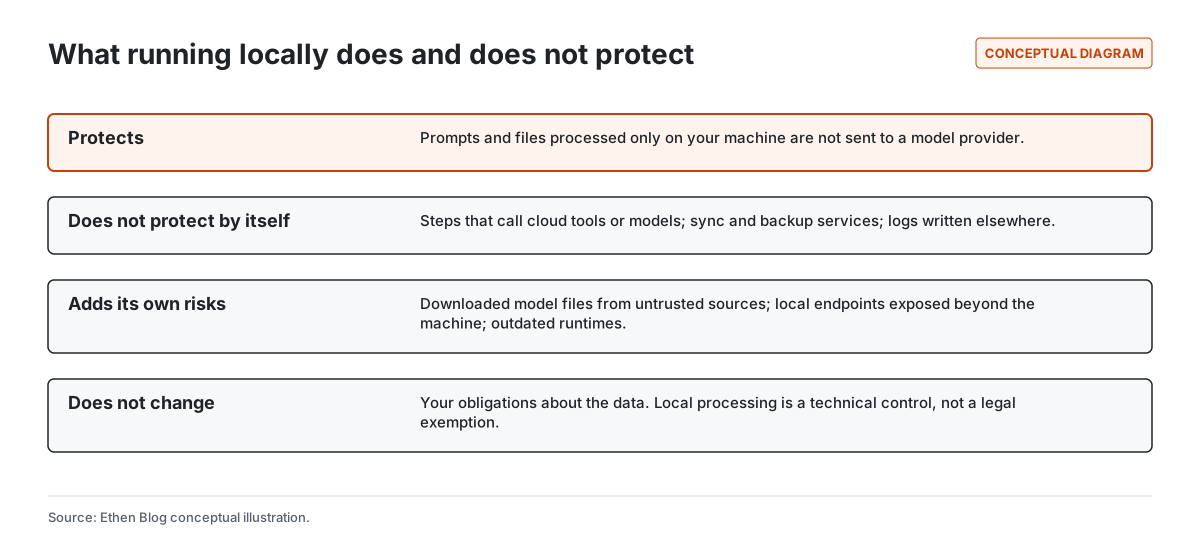
Local processing protects prompts and files that are processed only on your machine. It does not, by itself, protect steps that call cloud tools, files that sync to cloud storage, or logs written to services elsewhere. It also adds risks of its own. Model files downloaded from untrusted sources can be tampered with. A local model server configured to listen beyond your own machine can be reached by others on the network. Outdated runtimes carry unpatched vulnerabilities. And local processing does not change your obligations about the data: it is a technical control, not a legal exemption.
How Ethen approaches local AI
In Ethen's product structure, local models belong to the desktop app, because running a model on your own machine is a local activity. The published engineering is described in How Ethen Desktop Talks to Local Models. Local runtimes are reached only on your own machine. Privileged operations, such as reaching the runtime, downloading or deleting a model, are separated from the interface, which can request only a fixed set of named operations. Runtimes are not treated as interchangeable: the desktop app supports a full set of operations for Ollama and a narrower set for runtimes that expose an OpenAI-compatible interface, such as LM Studio or a llama.cpp server. Unknown runtimes get no operations by default rather than being trusted.
The broader design, in which local models sit alongside the web, the desktop app and cloud workspaces, is described in Building Ethen Across Desktop, Web and Local AI. Ethen Research Lab is also exploring how AI systems can improve without moving raw data off the systems where it lives, in Private AI Improvement Without Raw Data Export, a research proposal that has not been tested.
Local and cloud together
The most useful way to think about local AI is not as an alternative to the cloud, but as a place where some steps of a task belong. A private document can be summarized locally before a non-sensitive question about it goes to a larger model. A local model can screen files before deciding which ones a cloud workspace needs to see. An offline draft can be refined later with a hosted model once you reconnect. Each step goes where its requirements are best met, and the boundary between local and cloud becomes a deliberate decision rather than an accident.
That also changes how we think about the capability gap. A local model does not need to match the best hosted model on every task to be valuable. It needs to be good enough for the steps where privacy, availability or stability matter most. As small open-weight models improve, the set of steps that can stay local grows. But the decision should still be made task by task, with the limits in Figure 3 in mind.
Tradeoffs and limitations
- Capability. Local models are generally less capable than the largest hosted models, and quality varies by task.
- Hardware. Larger local models need substantial memory. Running them on underpowered machines is slow.
- Maintenance. You install, update and store models, and keep runtimes patched.
- Partial privacy. Any step that leaves the machine is outside the local privacy boundary.
- Licenses vary. Open-weight model licenses differ in what they permit; check them before relying on a model for commercial use.
Frequently asked questions
Is local AI more private than cloud AI? For work that is processed entirely on your machine, yes: it is not sent to a model provider. Any step that calls a cloud service is outside that protection.
Do local models work offline? Yes, once the model and runtime are installed.
Are local models as good as cloud models? Generally not for the hardest tasks. For many everyday tasks, such as summarizing, classifying and drafting, smaller models are often adequate.
Which local runtimes does Ethen support? Ethen's published desktop design treats Ollama as the fully supported runtime and supports a narrower set of operations for OpenAI-compatible runtimes such as LM Studio and llama.cpp servers.
Related reading
- Local AI or GPU Hosting: What to Check First
- How Ethen Desktop Talks to Local Models
- Why User-Controlled AI Memory Matters
- Ethen Local Models
References
- Chen, L., Zaharia, M., Zou, J. (2023). How is ChatGPT's behavior changing over time? arXiv:2307.09009. https://arxiv.org/abs/2307.09009
- Lermen, S. et al. (2026). Large-scale online deanonymization with LLMs. arXiv:2602.16800. https://arxiv.org/abs/2602.16800
- Ollama. API reference. https://github.com/ollama/ollama/blob/main/docs/api.md
- llama.cpp. Project repository and HTTP server documentation. https://github.com/ggml-org/llama.cpp
- Ethen Research Lab (2026). The Capability Transfer Ledger: Measuring Whether AI Skills Survive Model Upgrades. Methods paper; no measurements. https://upcube.ai/resources/research/capability-transfer-ledger
- Ethen Research Lab (2026). Private AI Improvement Without Raw Data Export. Research proposal; untested. https://upcube.ai/resources/research/private-ai-improvement