What We’re Learning From Designing iBOT
iBOT is Ethen's digital robot design project: an exploration of how a digital AI agent should look, move and present itself. It is not a physical robot and not a launched product. The central lesson so far is that a digital robot's appearance makes promises — about what it understands, what it feels and what it can do — and that good design promises less than the agent can actually do, never more. That led to a series of deliberate choices: no human face, a calm and approachable form rather than an armored or hyper-realistic one, motion that signals what the agent is doing rather than performing emotion, a design light enough to run in a web browser, and a firm rule that nobody should ever need the visual character to use Ethen. This article shares those lessons, the reasoning behind them, and what we have not yet tested.
iBOT is Ethen's digital robot design project: an exploration of how a digital AI agent should look, move and present itself. It is not a physical robot and not a launched product. The central lesson so far is that a digital robot's appearance makes promises — about what it understands, what it feels and what it can do — and that good design promises less than the agent can actually do, never more. That led to a series of deliberate choices: no human face, a calm and approachable form rather than an armored or hyper-realistic one, motion that signals what the agent is doing rather than performing emotion, a design light enough to run in a web browser, and a firm rule that nobody should ever need the visual character to use Ethen. This article shares those lessons, the reasoning behind them, and what we have not yet tested.
Key takeaways
- Appearance is a promise. Faces, eyes and bodies imply understanding, feeling and capability.
- No human face. A neutral visor avoids false emotional cues and the uncanny valley.
- Approachable, not imposing. Soft, light materials and a relaxed posture.
- Clearly not a person. Human proportions, unmistakably a machine.
- Motion should mean something. Calm by default; movement signals state.
- Never required. The character is optional; accessibility and a clear non-visual interface come first.
What is iBOT?
iBOT is a design project for a digital robot: a visual and behavioral identity that a digital AI agent could use when a visual presence helps — for example, when introducing an assistant, demonstrating what an agent is doing, or giving people a consistent figure to recognize across Ethen surfaces. It is a three-dimensional character designed to be shown in a web browser, with a small set of movements and several levels of detail so it can run on modest devices.
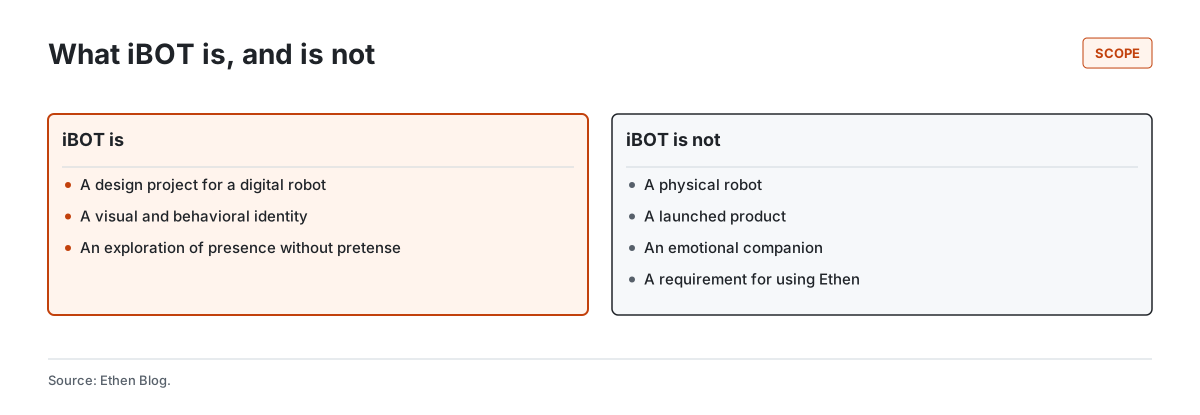
Figure 3, near the end of this article, sets out its scope plainly. iBOT is not a physical robot; Ethen does not build physical robots, as we explain in Why Ethen Is Researching Digital Robots Before Physical Robots. It is not a product announcement. It is not an emotional companion. And it is not something anyone needs in order to use Ethen.
Lesson 1: appearance is a promise
People respond to computers and characters socially, often without realizing it. Research in the "computers are social actors" tradition, beginning with work by Clifford Nass and colleagues in the 1990s, found that people apply social rules and expectations to computers that display even minimal human-like cues. A face, a voice or a name is enough to trigger assumptions about understanding and intention.
For a digital robot, that means every visual choice says something. A realistic human face implies human understanding. Expressive eyes imply feelings. A muscular or armored body implies physical capability or threat. Constant motion implies attention and eagerness. Figure 1 lays out the choices we considered.
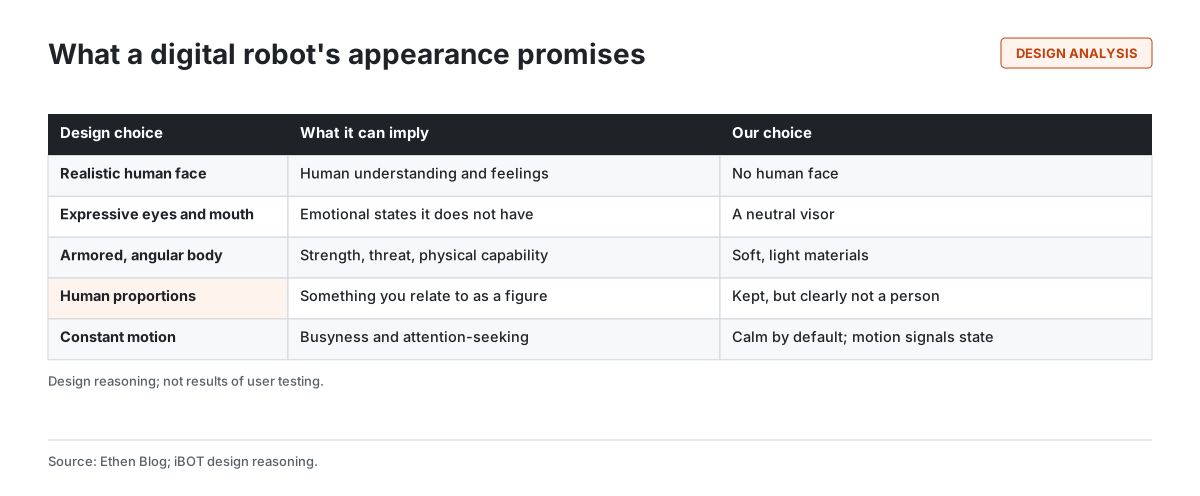
The rule we settled on is that the character should never promise more than the agent behind it can deliver. If an AI agent cannot feel, its face should not perform feelings. If it cannot act in the physical world, its body should not suggest strength. Under-promising is a design choice in favor of trust.
Lesson 2: no human face
The most consequential decision was to give iBOT no human face. Its head has a smooth, dark visor instead of eyes, nose and mouth.
There are two reasons. The first is the uncanny valley, the observation first described by the roboticist Masahiro Mori in 1970: as a figure becomes more human-like, people's comfort with it rises — until it becomes almost, but not quite, human, at which point comfort can drop sharply. A realistic AI face is very hard to get right, and getting it slightly wrong is worse than not trying.
The second reason matters more. Faces communicate emotion, and an AI agent's face would be communicating emotions it does not have. That is a small deception repeated constantly. A neutral visor communicates presence — something is here and paying attention — without claiming an inner life.
Lesson 3: approachable, not imposing
The body went through the most iteration. Early directions drew on familiar robot imagery: hard shells, metallic finishes, angular plates. They looked capable and slightly threatening, and they suggested a machine built for physical work.
The direction we chose is softer: light, matte, fabric-like materials over a human-proportioned form, with darker, more structured materials at the joints, hands and feet. The overall effect is closer to a calm, neutral figure in plain clothing than to an industrial machine. It reads as approachable, it does not suggest strength or speed, and it carries no military connotations.
This connects to a principle we hold for all of Ethen's interfaces: calm presence rather than performance, which we describe for voice in What We Want Ethen Voice to Feel Like.
Lesson 4: clearly not a person
Keeping human proportions was a deliberate trade-off. Proportions make a figure easy to relate to: people read posture and gesture instinctively. But they also invite people to treat the figure as a person.
The answer was to keep proportions and remove everything that would complete the illusion: no face, no skin, no hair, no clothing that signals a particular culture, gender or role. iBOT is meant to be immediately readable as a figure and immediately recognizable as not human. That matches a commitment we make across Ethen: you should always know you are dealing with an AI.
Lesson 5: motion should mean something
A character that moves constantly — fidgeting, gesturing, reacting to every input — feels busy and attention-seeking. A character that never moves feels dead.
Our direction is calm by default, with motion that signals state: whether the agent is idle, listening, working or finished. Motion should help a person understand what the agent is doing at a glance, not entertain them. This is the design question we have explored least so far, and the one where testing will matter most.
Lesson 6: light, optional and accessible
A three-dimensional character can easily become the heaviest thing on a page. iBOT is designed to run in a web browser with several levels of detail, so that a simpler version loads on modest devices, and with still images as a fallback when animation is not appropriate.
Accessibility shaped the design from the start. People who are sensitive to motion should be able to turn animation off; accessibility guidelines for the web recommend that motion triggered by interaction can be disabled. People who use screen readers gain nothing from a 3D figure, so nothing important should depend on it. And people who simply prefer a plain interface should never have to see it.
That is why "avatar optional" is a firm rule in our wider direction for a personal Ethen experience, described in What We Want My Ethen to Feel Like. A clear, accessible, non-3D interface comes first. A character is an option on top.
Lesson 7: review in stages
The design process taught us something too. Changing a character's shape after its materials and motion are done tends to break both. So we reviewed the design in stages, shown in Figure 2.
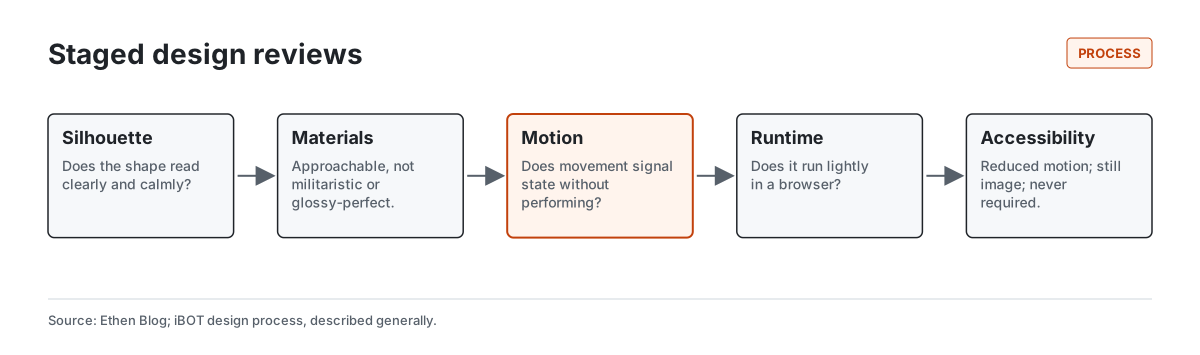
Silhouette. Does the shape read clearly and calmly from every angle?
Materials. Do the surfaces look approachable rather than militaristic or plastic-perfect?
Motion. Does movement signal state without performing?
Runtime. Does the character run lightly in a browser at each level of detail?
Accessibility. Does everything work with reduced motion, as a still image, and without the character at all?
Each stage was reviewed against reference images and approved before the next began, and approved work was locked so later changes could not quietly undo it. It is the same discipline we apply to software: decide, record, then build on what was decided.
Lesson 8: identity is not permission
A recognizable character raises a less visible design question. If the same figure appears across Ethen surfaces — a browser, a phone, a desktop app — does it represent the same agent with the same access everywhere?
Our answer is no. A consistent identity across devices is useful for recognition and continuity, but it must not become a license to share every device's permissions. An agent that appears on your phone should have only the access granted there. The character is a face for the agent's identity, not a key to everything it can reach.
Alternatives we considered
A humanoid figure was not the only option, and the alternatives clarified what we wanted.
No character at all. Many AI products have no visual presence beyond text and icons, and that works well. We kept this as the default: Ethen must be fully usable with no character. The question was whether an optional character could add something.
An abstract shape. A glowing orb, a waveform or a geometric form is simple, light and avoids anthropomorphism entirely. Abstract shapes are good at signaling state — listening, thinking, speaking — and we expect to use them in places where a figure would be too much. Their limitation is that they are hard to recognize as a consistent identity across contexts and hard to use when demonstrating an agent acting in an interface.
A cartoon mascot. A friendly, stylized creature is approachable and memorable. It also sets a playful tone that sits awkwardly with serious work — reviewing contracts, handling customer data, approving payments — and invites people to treat the agent as a pet.
A realistic human. A photorealistic person is the most relatable option and the most misleading. It promises human understanding and feeling, risks the uncanny valley, and blurs the line between AI and person that we are committed to keeping clear.
The humanoid-but-faceless direction sits between these: recognizable and relatable as a figure, clearly a machine, serious enough for work, and restrained enough not to perform. It is a compromise, and we expect to keep testing it against the abstract alternative.
Where a character helps, and where it does not
A visual character is not useful everywhere. It can help when introducing what an agent is and does, when showing an agent's state during long-running work, when demonstrating an action in a tutorial, and when giving people a consistent figure across devices. It does not help in dense working interfaces, in text-heavy review, in accessibility-critical flows, or anywhere it would compete with the work itself for attention. In those places, the right amount of character is none.
What we have not tested
We want to be clear about the limits of what we have learned. The lessons above are design reasoning, informed by research and by our own reviews. We have not published user research on iBOT. We have not measured how people perceive it, whether its motion communicates state clearly, or whether it builds or undermines trust.
Researchers have developed standard instruments for exactly these questions. The Godspeed questionnaire series, published by Christoph Bartneck and colleagues in 2009, measures how people perceive robots on dimensions such as anthropomorphism, animacy, likeability, perceived intelligence and perceived safety. Instruments like it are how we would expect to test iBOT before relying on it.
What iBOT is, and is not
Figure 3 summarizes the scope.
We discuss why a digital robot needs much more than a visual character — identity, authority, memory, approvals and evidence — in Why a Digital Robot Needs More Than an Avatar, and the broader robotics research direction in From Screen to Physical World: How We Think About Ethen Robotics.
Tradeoffs and limitations
Neutral can feel cold. A faceless, calm figure may feel distant to some people. We prefer that to false warmth, but it is a real trade-off.
Human proportions still invite projection. Even without a face, people will read personality into posture and motion.
3D has costs. Any 3D character adds weight, complexity and potential accessibility barriers, which is why it must always be optional.
Untested. These are design lessons, not user research results.
FAQ
What is Ethen's iBOT? A design project for a digital robot: a visual and behavioral identity for a digital AI agent. It is not a physical robot or a launched product.
Should an AI assistant have a human-like face? We decided not. A realistic face risks the uncanny valley and communicates emotions the AI does not have. A neutral visor signals presence without pretending to feel.
How do you design a digital robot that people trust? Promise less than it can do: avoid false emotional cues, avoid imposing or threatening forms, make it clearly not a person, use motion to signal state, and keep it optional and accessible.
Do I need iBOT to use Ethen? No. A character is always optional; a clear, accessible interface without it comes first.
Is iBOT a physical robot? No. Ethen does not build physical robots.
Related reading
- Why a Digital Robot Needs More Than an Avatar
- Why Ethen Is Researching Digital Robots Before Physical Robots
- What We Want My Ethen to Feel Like
- What We Want Ethen Voice to Feel Like
- From Screen to Physical World: How We Think About Ethen Robotics
References
- Mori, M. (2012). The Uncanny Valley (K. F. MacDorman & N. Kageki, Trans.). IEEE Robotics & Automation Magazine, 19(2), 98–100. (Original work published 1970.) https://doi.org/10.1109/MRA.2012.2192811
- Nass, C., Steuer, J., & Tauber, E. R. (1994). Computers are social actors. Proceedings of CHI 1994. https://doi.org/10.1145/191666.191703
- Bartneck, C., Kulić, D., Croft, E., & Zoghbi, S. (2009). Measurement instruments for the anthropomorphism, animacy, likeability, perceived intelligence, and perceived safety of robots. International Journal of Social Robotics, 1(1), 71–81. https://doi.org/10.1007/s12369-008-0001-3
- W3C. Web Content Accessibility Guidelines (WCAG) 2.2, Success Criterion 2.3.3 Animation from Interactions. https://www.w3.org/TR/WCAG22/