What We Want Ethen to Feel Like in 2027
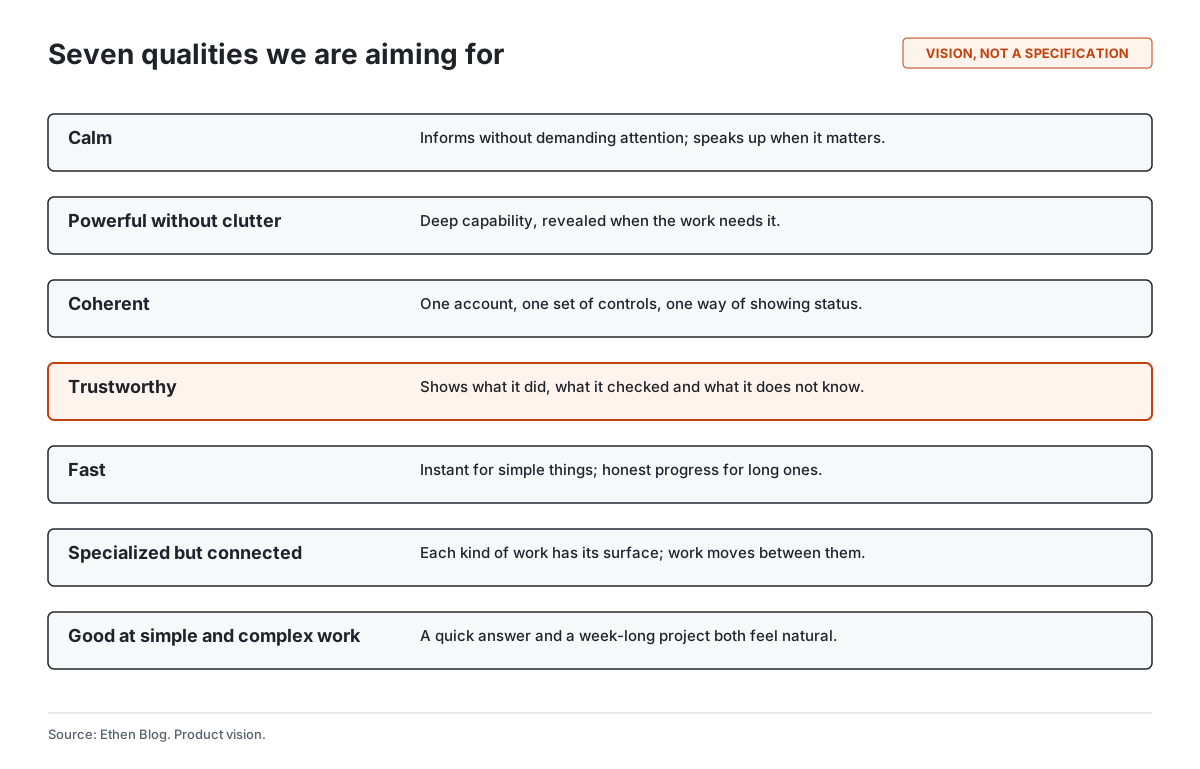
Most predictions about the future of AI assistants in 2027 are lists of capabilities. Ours is a description of an experience. By 2027 we want Ethen to feel calm — it informs without demanding attention and speaks up when something matters. Powerful without clutter — deep capability that appears when the work needs it. Coherent — one account, one set of controls and one way of showing status across every surface. Trustworthy — it shows what it did, what it checked and what it does not know. Fast — instant for simple things, with honest progress for long ones. Specialized but connected — each kind of work has a surface built for it, and work moves between them without starting over. And good at both simple and complex work — a quick question and a week-long project should both feel natural. We want that to hold for everyday users, creators, developers and organizations alike. This is a vision, not a product specification: it names no features and no dates.
Most predictions about the future of AI assistants in 2027 are lists of capabilities. Ours is a description of an experience. By 2027 we want Ethen to feel calm — it informs without demanding attention and speaks up when something matters. Powerful without clutter — deep capability that appears when the work needs it. Coherent — one account, one set of controls and one way of showing status across every surface. Trustworthy — it shows what it did, what it checked and what it does not know. Fast — instant for simple things, with honest progress for long ones. Specialized but connected — each kind of work has a surface built for it, and work moves between them without starting over. And good at both simple and complex work — a quick question and a week-long project should both feel natural. We want that to hold for everyday users, creators, developers and organizations alike. This is a vision, not a product specification: it names no features and no dates.
Key takeaways
- We are describing a feeling, not features. Feelings are what people judge; features are how we try to earn them.
- Seven qualities. Calm, powerful, coherent, trustworthy, fast, specialized but connected, and good at simple and complex work.
- Trust is the quality the others depend on. Speed and power are worth little if people cannot tell whether the work is right.
- One vision, four contexts. The same qualities mean different things to consumers, creators, developers and organizations.
- The hard part is the tensions. Calm versus informed, powerful versus simple, fast versus checked, autonomous versus controlled.
- 2027 is a horizon, not a commitment. We will judge progress by questions, not launch dates.
Why describe a feeling instead of a feature list?
We describe a feeling because a feature list cannot be wrong in the ways that matter. A product can have every listed feature and still feel noisy, confusing, slow or untrustworthy. A description of how a product should feel can be checked against people's actual experience, and it constrains decisions that a feature list leaves open: whether to add another option, whether to interrupt, whether to show a result before it has been checked.
It also keeps us honest about the future. Capabilities will change faster than we can predict; the models available in 2027 will differ from today's. The qualities that make a product good to use change much more slowly. Research on human-AI interaction has been stating many of them for years: make clear what the system can do and how well; show why it did what it did; make it easy to correct, dismiss and recover; and match interruptions to the person's context (Amershi et al., 2019).
For the personal side of this vision — a version of Ethen that is yours across your devices — see What We Want "My Ethen" to Feel Like. This article covers the whole of Ethen, across every kind of person it serves.
Seven qualities
Figure 1 lists the qualities we are aiming for.
Calm
Calm means Ethen informs without demanding attention. Mark Weiser and John Seely Brown described calm technology in 1995 as technology that moves easily between the center of attention and the periphery: present when needed, out of the way otherwise. For AI that does work in the background, that is the right model. A long job should not ask for attention every few minutes; it should reach you when a decision is genuinely yours, and otherwise let you see its progress when you choose to look.
Calm rules out engagement-driven design: notifications that exist to bring you back, and conversational padding that keeps you talking when the work is done.
Powerful without clutter
Power means Ethen finishes real tasks end to end, not just the demonstration version. Without clutter means that power appears when the work calls for it rather than as a wall of options on the first screen. A beginner should see a clear first step; an expert should find depth without hunting for it. We explain why we prefer complete workflows to long feature lists in Why We're Choosing Depth Over Feature Count.
Coherent
Coherent means every Ethen surface shares the same account, the same controls over memory and permissions, the same status words and the same way of showing evidence. Someone who learns how approvals work in one app should already understand them in another.
Trustworthy
Trustworthy means Ethen shows its work: what it did, what it checked, and what it does not know. It means a result that is uncertain looks uncertain, and an outcome that could not be confirmed is labeled as such rather than reported as success. Research on trust in automation describes the goal as calibrated reliance: people trusting a system as much as its demonstrated reliability justifies, no more and no less (Lee and See, 2004). We cannot produce calibrated trust by asking for it; we can only make reliability visible. We describe the principle in Why Ethen Shows What It Doesn't Know and how safety becomes part of the experience in Why Ethen Is Treating AI Safety as a Product Experience.
This is the quality the others depend on. A calm, fast, powerful product that cannot be trusted is a fast way to make mistakes.
Fast
Fast means simple things feel instant and long things feel honest. Jakob Nielsen's widely used response-time limits distinguish delays that feel instantaneous, delays people notice but tolerate without losing their train of thought, and waits long enough that attention wanders and progress information becomes necessary (Nielsen, 1993). Quick questions should stay in the first category. Work that genuinely takes minutes or hours should show progress in meaningful phases, not a spinner; see Why Long-Running AI Work Needs a Different UX Than Chat.
Specialized but connected
Specialized means each kind of work has a surface built for it: conversation, code, creative work, research, design, delegated jobs, operations and local AI. Connected means work moves between those surfaces without being re-explained. A question that becomes a project should carry its context into the place that holds projects. We explain the design reasoning in Why Ethen Uses Specialized Interfaces Instead of One Universal UI.
Good at simple and complex work
Most AI products are designed for one end of the range. Chat products are good at quick questions and awkward at long projects; professional tools are powerful and heavy for small tasks. We want both ends to feel natural, which is one reason Ethen hands work from lighter surfaces to deeper ones rather than forcing every task into the same shape.
One vision, four contexts
Ethen serves people in very different situations. Figure 2 shows how the same qualities translate.
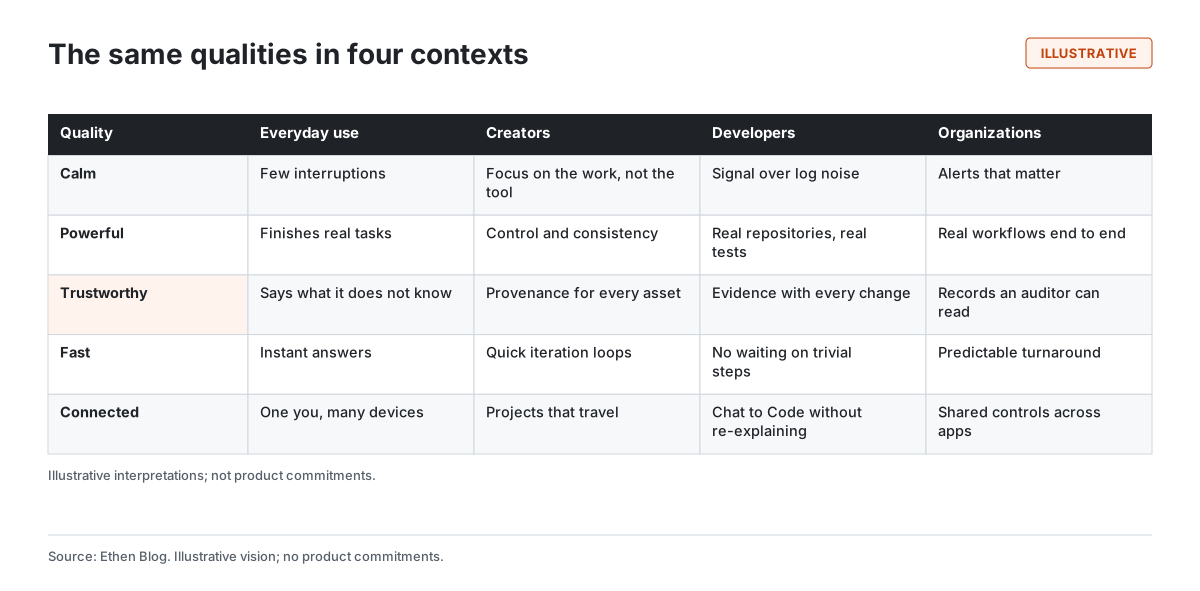
Everyday use. Ethen should help people finish things — an organized decision, a maintained personal project, a bounded action they approved — and then get out of the way. It should never be designed to maximize time spent with it.
Creators. Creative work needs control and consistency: the same character across a series, the same style across formats, and a record of how each asset was made. Ethen Studio's direction toward workflows reflects this; see Why Ethen Studio Is Becoming More Workflow-Oriented.
Developers. Developers need real repositories, real tests and evidence with every change, in the environment they prefer: in a conversation, in the cloud or on their own machine. See Ethen Code: What's Next.
Organizations. Organizations need AI work they can govern: clear ownership, controls that apply across apps, and records someone accountable can read. We discuss the difference between consumer and organizational needs in What We're Learning From Building Ethen for Both Consumers and Enterprises.
The tensions we have to hold
The qualities are easy to list and hard to achieve together, because several pull against each other. Figure 3 names four tensions.
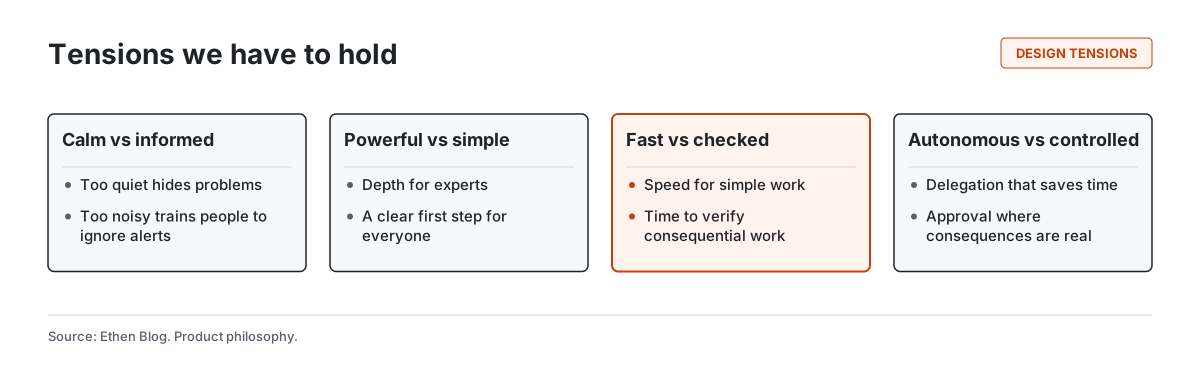
Calm versus informed. A product that is too quiet hides problems; one that is too noisy trains people to ignore it. The answer is not a setting but judgment about what deserves attention.
Powerful versus simple. Depth for experts must not bury the first step for everyone else.
Fast versus checked. Simple work should be instant. Consequential work needs time to verify, and that time should be visible rather than hidden. This is the tension we expect to matter most as AI work grows longer.
Autonomous versus controlled. Delegation should save time, and approval should appear where consequences are real. Too many approvals make delegation pointless; too few make it unsafe. We describe our position in What We Mean by Responsible Autonomy.
What has to be true underneath
An experience is the visible result of things people never see. Each quality depends on foundations that have to exist first.
Calm depends on durable work. A product can only stay quiet about a long job if the job survives interruptions on its own. If work silently fails when a connection drops, the product has to keep asking for attention to be safe. Durable jobs that resume or reconcile after failure are what make it reasonable to let work run in the background.
Trustworthy depends on evidence that is recorded, not reconstructed. Showing what was done and what was checked requires the system to record those things as it works, not to summarize them afterwards in fluent prose. Completion should depend on an independent check, and an unclear outcome should be stored as unclear.
Coherent depends on shared foundations. One account, one set of memory and permission controls, and one vocabulary for status only feel consistent if every app draws on the same underlying records rather than keeping its own.
Fast depends on putting long work in the right place. Conversation stays instant partly because slow work is moved into surfaces built to show progress, rather than making a chat wait.
Specialized but connected depends on hand-offs that carry context. When Chat sends a question to Research or a brief to Studio, the context has to travel with it. Otherwise specialization means repeating yourself.
These foundations are why so much of our current work is unglamorous. We describe the state of that work, area by area, in Ethen V5: What We're Rebuilding and Why.
What it should not feel like
A vision is sharper with its opposites named. Ethen should not feel like a slot machine that rewards checking back, a companion designed to create attachment, a control panel with every option visible at once, an agent that acts more because acting looks impressive, or a system so confident that its mistakes are indistinguishable from its successes.
How we will judge it
We will not judge this vision by whether features ship. We will judge it by questions we can ask of real use, within the permissions people have given:
- Do people finish what they started, with fewer corrections?
- Do people come back because the work was useful, not because they were prompted to?
- When Ethen says something is done, is it?
- When Ethen is unsure, do people see that before they rely on the result?
- Can someone move from a quick question to a long project without starting over?
- Do people in organizations understand what the AI did on their behalf?
We have not set public targets for these questions, and we will not claim progress on them without evidence.
An illustrative moment
The following example is illustrative.
A product designer asks Ethen a quick question about color contrast and gets an instant, sourced answer. Later, they start a set of marketing visuals in Studio, which keeps the brief and references together across sessions. Overnight, a delegated job compiles feedback from several documents; in the morning it reports what it read, what it could not access, and one decision it is waiting on. Their engineering colleague reviews a related code change with evidence attached. None of it demanded attention it did not need, and each piece showed its work.
Tradeoffs and limitations
Visions are easy to agree with. Few people object to "calm" or "trustworthy." The value is in the tensions and the questions, which are where decisions get hard.
2027 is a horizon. We chose a near horizon to keep the vision concrete. Parts of it will take longer, and some may change.
Different people want different things. Some people want maximum control and every option visible. A calm default must still leave room for them.
No measurements yet. This article states intentions. It makes no claim that Ethen already feels this way.
FAQ
What will AI assistants be like in 2027? We expect them to do longer, more consequential work. Our goal is that Ethen feels calm, powerful without clutter, coherent, trustworthy, fast, specialized but connected, and good at both simple and complex work.
What should a good AI product feel like? It should finish real work, show what it did and what it does not know, stay out of the way until a decision is yours, and let you control what it touches.
What is Ethen's vision? Specialized AI apps that feel like one Ethen and help people finish things, with evidence, across everyday, creative, developer and organizational work.
Is this a roadmap? No. It describes an experience. It names no features and no dates.
How is this different from My Ethen? My Ethen describes a personal experience. This article describes the whole of Ethen across everyone it serves.
Related reading
- What We Want "My Ethen" to Feel Like
- The Road to Ethen V5
- The Principles Behind Ethen's Product Design
- What We're Learning From Building Ethen for Both Consumers and Enterprises
References
- Weiser, M., & Brown, J. S. (1995). Designing Calm Technology. Xerox PARC. Published in PowerGrid Journal 1.01 (1996).
- Amershi, S., et al. (2019). Guidelines for Human-AI Interaction. Proceedings of CHI 2019. https://doi.org/10.1145/3290605.3300233
- Lee, J. D., & See, K. A. (2004). Trust in automation: Designing for appropriate reliance. Human Factors, 46(1), 50–80. https://doi.org/10.1518/hfes.46.1.50_30392
- Nielsen, J. (1993). Response Times: The 3 Important Limits. Nielsen Norman Group. https://www.nngroup.com/articles/response-times-3-important-limits/