Ethen V5: What We’re Rebuilding and Why
Ethen V5 rebuilds seven areas of Ethen: the boundaries between products, the durability of long-running workflows, the model experience, how research connects to products, reliability and evidence, support for long-form work, and the design language that ties every surface together. Each area is being rebuilt for the same underlying reason: AI work is getting longer and more consequential, and a structure designed for quick answers does not fit it. Because direction is easy to mistake for a launch, every item in this article carries one of four labels — shipped (public today), being rebuilt, research direction, or future exploration — and the labels reflect what our published posts document as of October 2026. Most of V5 is being rebuilt. Some parts are public today. Some ideas are research and may never become product. This article says which is which.
Ethen V5 rebuilds seven areas of Ethen: the boundaries between products, the durability of long-running workflows, the model experience, how research connects to products, reliability and evidence, support for long-form work, and the design language that ties every surface together. Each area is being rebuilt for the same underlying reason: AI work is getting longer and more consequential, and a structure designed for quick answers does not fit it. Because direction is easy to mistake for a launch, every item in this article carries one of four labels — shipped (public today), being rebuilt, research direction, or future exploration — and the labels reflect what our published posts document as of October 2026. Most of V5 is being rebuilt. Some parts are public today. Some ideas are research and may never become product. This article says which is which.
Key takeaways
- Seven areas are being rebuilt. Boundaries, durable workflows, models, research integration, reliability, long-form work and design language.
- Four labels keep claims honest. Shipped, being rebuilt, research direction, future exploration.
- Most of V5 is in progress. "Being rebuilt" is not a launch or availability claim.
- Some parts are public now. The labeled Research Lab and public model pages are examples.
- Research is not a roadmap. Research proposals inform products only after testing.
- Statuses will change. We will add dated updates rather than silently rewriting.
Four labels, defined
We use four labels throughout. Figure 1 defines them.
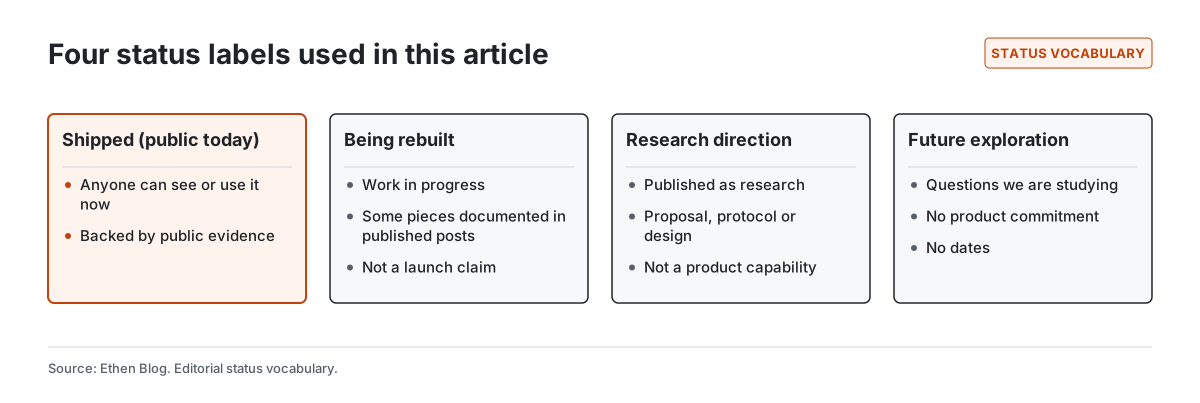
Shipped (public today). Anyone can see or use it now, and public evidence supports it.
Being rebuilt. Work in progress. Some pieces may be documented in our published engineering posts, often as early-stage systems with stated limits. This label never means "available."
Research direction. Published by Ethen Research Lab as a proposal, protocol, benchmark design or synthesis. It is not a product capability.
Future exploration. A question we are studying, with no product commitment and no date.
The broader direction behind these areas is in The Road to Ethen V5. The changes already made are recorded in What We've Changed Since Ethen V4.
The seven areas at a glance
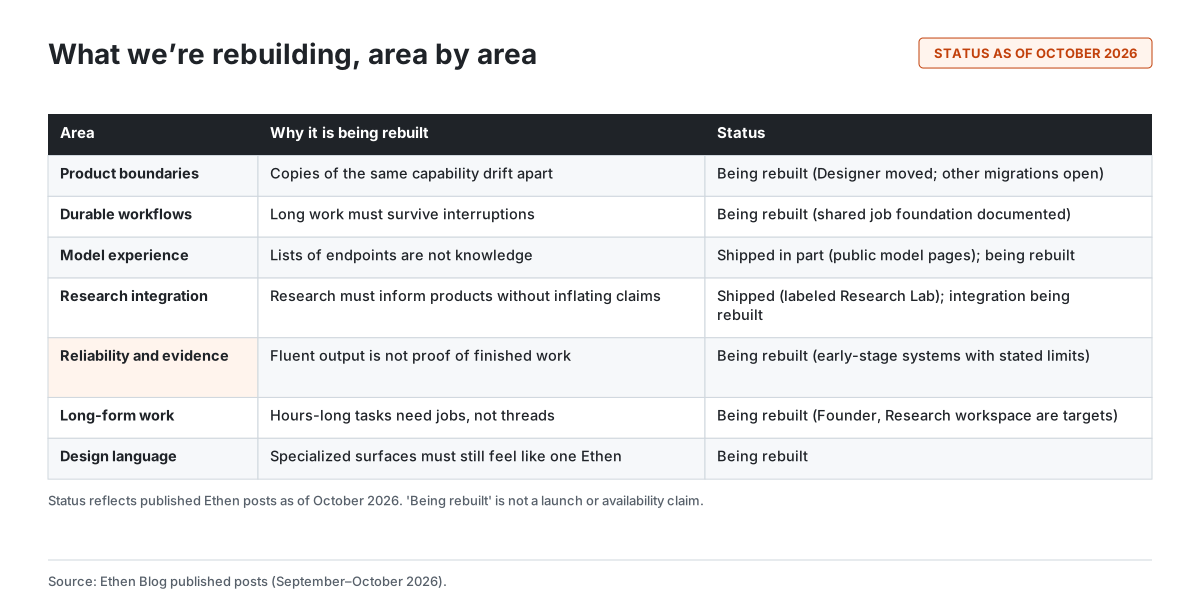
Figure 2 summarizes each area, why it is being rebuilt and its current status.
1. Product boundaries
What is being rebuilt: where each capability lives. Every capability gets one canonical owner, and lighter surfaces hand off to deeper ones instead of keeping their own copy.
Why: copies of the same capability drift apart. One gets the fix; the other keeps the bug. Users stop knowing which version to trust. We explain the company reasoning in Why Ethen Is a Family of Specialized AI Apps, Not One App.
Status: being rebuilt. Ethen Designer has moved into its own application and was verified locally; that was not a public launch. Ethen Chat's boundaries are defined, and our post Keeping Ethen Chat Focused notes that the current model picker still lists more than the curated design calls for. Our published ownership map lists the migrations still open, including Research as a standalone app and Computer management consolidated in Platform.
2. Durable workflows
What is being rebuilt: how work that takes minutes or hours survives crashes, restarts and interruptions without being run twice.
Why: long AI work fails in the middle. A worker crashes after calling a provider; did the call land? A product that cannot answer that question either repeats the action or loses the work. The problem is growing: research from METR published in 2025 found that the length of tasks frontier AI agents can complete with 50% reliability has been doubling roughly every seven months since 2019.
Status: being rebuilt. A shared durable-job foundation is documented in Inside Ethen's Durable Job Service, and Ethen Studio's published media pipeline runs four qualified workflows on verified routes. Making every product use that foundation, and turning Studio's individual steps into reusable creative chains, is ongoing; see Why Ethen Studio Is Becoming More Workflow-Oriented.
3. The model experience
What is being rebuilt: how people learn about, compare and choose models.
Why: a long list of endpoints tells people what exists, not what to choose. Model knowledge needs sources, dates and honest gaps.
Status: shipped in part; being rebuilt. Public model pages exist; a snapshot of our media catalog grouped 1,499 provider endpoints into 491 families, with 128 qualifying for indexable pages. Ethen Model Intelligence shows "Unknown" when a benchmark value lacks provenance. Connecting that knowledge to how models are chosen inside each product is being rebuilt. We explain the concept in Why Model Families Matter More Than Huge Model Counts and the investment in Why Ethen Invests in Model Intelligence.
4. Research integration
What is being rebuilt: how research findings, once tested, reach products — and how products avoid borrowing research credibility they have not earned.
Why: research and product claims answer different questions. Mixing them inflates both.
Status: shipped (Research Lab); integration being rebuilt. Ethen Research Lab publishes in public, with each publication labeled by type and evidence status. The rule that research proposals are not product features is described in Why Ethen Separates Research From Product Claims. The process by which tested research would inform products is being rebuilt, and many research items will never become product; see Why Not Everything Ethen Researches Needs to Become a Product.
5. Reliability and evidence
What is being rebuilt: how Ethen decides that work is done, records what happened, handles unclear outcomes, and asks for approval.
Why: fluent output is not proof of finished work. As models improve, their output looks finished more often, including when it is wrong.
Status: being rebuilt. Our published engineering posts document early-stage systems with stated limits: completion that depends on an independent check backed by evidence, unknown outcomes recorded and reconciled rather than retried, verification capacity reserved before execution spend, and computer-use approvals bound to one specific action. Release certificates record scoped, dated checks; see What a Release Certificate Actually Proves at Ethen. Extending these properties across every product is the core of V5.
Related research direction includes per-task records of authority, actions and verification, described in Work Receipts, and a precise definition of false completion in Commitment Graphs. Both are proposals. Neither is an Ethen product capability.
6. Long-form work
What is being rebuilt: support for work that is too long, too multi-step or too consequential for a conversation: investigations, delegated jobs and projects that span days.
Why: chat assumes the work takes seconds, that you are watching and that one reply is the result. Long work breaks every one of those assumptions; see Why Long-Running AI Work Needs a Different UX Than Chat.
Status: being rebuilt. Ethen Founder is designed around jobs with plans, approvals and checked outcomes, and its end-to-end operation is not yet proven. A standalone Research workspace with sources, branches and history is a target home. We describe the design challenge in Designing Ethen for Work That Takes Hours.
7. Design language
What is being rebuilt: the visual and interaction language shared across surfaces.
Why: specialized surfaces must still feel like one Ethen. Different interfaces for different work only help if people recognize the same account, controls, status words and evidence everywhere.
Status: being rebuilt. We describe the principles in The Principles Behind Ethen's Product Design and why surfaces differ in Why Ethen Uses Specialized Interfaces Instead of One Universal UI.
What is research direction or future exploration
Some topics that people associate with Ethen's direction are not being rebuilt as products at all. Labeling them clearly matters as much as describing what is.
Research direction. Ethen Research Lab has published proposals and protocols on work receipts, commitment graphs, recovery after partial failures, testing model upgrades before they reach real work, and compressing context without losing obligations. They are research. Some may inform products after testing; many will not.
Future exploration. Digital robots, and a personal Ethen experience we call My Ethen by working name, are directions we are studying; see Why Ethen Is Researching Digital Robots Before Physical Robots and What We Want "My Ethen" to Feel Like. Physical robotics hardware is gated behind specific conditions. Private and enterprise deployment options are being explored with principles rather than commitments; see How We're Preparing Ethen for Private and Enterprise Deployments.
How an item changes status
Items move between statuses only with evidence. Figure 3 shows the rule.
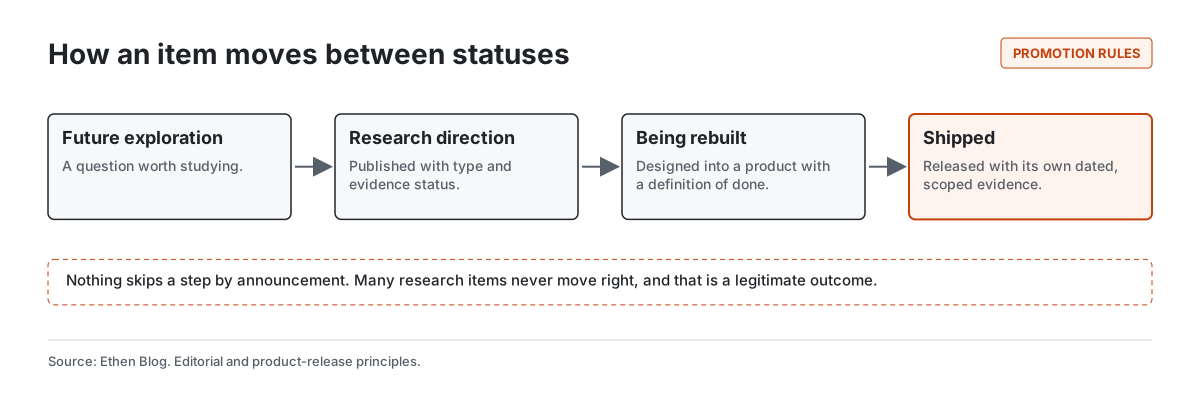
A future question becomes research direction when it is published with its type and evidence status. Research direction becomes something being rebuilt when it is designed into a product with a definition of "done" — usually only after it has been tested. Something being rebuilt becomes shipped when it is released with its own dated, scoped evidence. Nothing skips a step by announcement. Items can also move left: if evidence shows an approach does not work, we will say so and relabel it.
One idea in two places: unknown outcomes
The statuses are easiest to understand through an example where the same idea appears in both research and product.
Ethen Research Lab's research note Unknown Effects in Autonomous AI Systems argues that when an AI system cannot tell whether an action took effect — a request timed out after it was sent, for instance — the right state is "unknown," and the right response is to reconcile before retrying. The note is a research synthesis. It makes no measured claim about any Ethen system.
Separately, our engineering post When an Agent Action's Outcome Is Unknown documents how one early-stage Ethen system records unknown outcomes and reconciles them, with its limits stated.
The two share an idea, but they carry different labels. The research note is research direction: an argument and a set of open questions. The engineering post documents something being rebuilt: an early implementation inside one part of Ethen. Neither makes the idea "shipped" across Ethen. That would require the behavior to be in place across products and released with its own evidence. Keeping those three things apart — the argument, the early implementation, and the released capability — is what the labels are for.
What we are deliberately not rebuilding
Some parts of Ethen are staying the way they are, and saying so is as useful as listing what is changing.
Working with many models. Ethen continues to use multiple model providers and to choose among them by task. V5 changes how that choice is informed, not the commitment itself.
People approving consequential actions. Bounded delegation, with approval for actions that have real consequences, is a principle rather than a feature to redesign.
Publishing research in public with labels. The Research Lab's format — type and evidence status on every publication — stays as it is.
Why rebuild instead of patch
A fair question is why Ethen is rebuilding these areas rather than improving them in place. The answer is that we are doing both, in a specific way. Where something works, we move it intact into the place it belongs and rewrite only what must change. Martin Fowler's "strangler fig" pattern describes the idea: grow the new structure around the old one and retire the old parts gradually. What we avoid is a single large rewrite justified by a diagram. Large rewrites discard working behavior and the knowledge embedded in it, and they make it hard to tell what changed.
The word "rebuilding" therefore describes the result — boundaries, foundations and experiences that are different in kind — more than the method, which is mostly incremental.
What this means for people using Ethen
Expect changes one product at a time. There is no single V5 switch-over. Changes arrive per product, with release evidence.
Expect hand-offs. As boundaries take hold, lighter surfaces such as Chat will send deeper work to the app that owns it rather than stretching to fit it.
Expect honest status. Product posts will say what was checked and what was not. Research will say what kind of evidence it is.
Expect this page to change. As items change status, we will add dated update notes below.
Tradeoffs and limitations
Rebuilding takes time. Incremental rebuilding is slower than announcing a new version. We think it is safer for people who rely on what already works.
Status labels simplify. An area can be partly shipped and partly being rebuilt; we have said so where it applies, but a single label always loses detail.
Published posts lag work. Statuses here reflect what is documented publicly, which may trail internal progress. We prefer understating to overstating.
This is not an availability statement. Nothing labeled "being rebuilt" should be read as available.
FAQ
What is being rebuilt in Ethen V5? Product boundaries, durable workflows, the model experience, research integration, reliability and evidence, long-form work, and the shared design language.
Which parts of Ethen V5 are available now? Public surfaces such as the labeled Research Lab and public model pages are available today. Most product areas are being rebuilt, and that label is not an availability claim.
Why is Ethen rebuilding its products? Because AI work is getting longer and more consequential, and a structure built for quick answers does not fit it: work needs a home, a durable foundation, evidence and clear boundaries.
Are Ethen Research Lab proposals part of V5? No. They are research direction. Some may inform products after testing; many will not.
How will I know when something changes status? Through product posts with release evidence and dated update notes on this page.
Update notes
- October 2026: Original status list.
Related reading
- The Road to Ethen V5
- What We've Changed Since Ethen V4
- Ethen Code: What's Next
- Work Receipts: A Verifiable Record for Autonomous AI Work — Ethen Research Lab technical report (proposal; not implemented)
- Commitment Graphs — Ethen Research Lab research proposal (untested)
References
- Fowler, M. (2004). StranglerFigApplication. martinfowler.com. https://martinfowler.com/bliki/StranglerFigApplication.html
- Kwa, T., West, B., Becker, J., Deng, A., Garcia, K., et al. (2025). Measuring AI Ability to Complete Long Tasks. arXiv:2503.14499. https://arxiv.org/abs/2503.14499