The Road to Ethen V5
Ethen V5 is the next generation of Ethen, and it is a rethinking of how Ethen is organized and what it promises rather than a visual redesign. The direction has seven threads that move together: specialized products for different kinds of work; a shared foundation for trustworthy, reliable AI work; model intelligence that helps people choose models with sources; research that informs products through labeled evidence; creative work organized as workflows; autonomous work delegated as jobs with approvals and checked outcomes; and long-term coherence across every surface. This is not a dated Ethen V5 roadmap. We do not publish milestone schedules, because each step is gated by its own evidence rather than a calendar, and each product is announced only when its release evidence exists. This article explains the direction, the principles behind it, and how to follow it.
Ethen V5 is the next generation of Ethen, and it is a rethinking of how Ethen is organized and what it promises rather than a visual redesign. The direction has seven threads that move together: specialized products for different kinds of work; a shared foundation for trustworthy, reliable AI work; model intelligence that helps people choose models with sources; research that informs products through labeled evidence; creative work organized as workflows; autonomous work delegated as jobs with approvals and checked outcomes; and long-term coherence across every surface. This is not a dated Ethen V5 roadmap. We do not publish milestone schedules, because each step is gated by its own evidence rather than a calendar, and each product is announced only when its release evidence exists. This article explains the direction, the principles behind it, and how to follow it.
Key takeaways
- V5 is structural, not cosmetic. It changes where work lives and what Ethen promises about it.
- Seven threads move together. Products, trust, models, research, creative work, delegated work and coherence.
- One idea sits at the center. Ethen should help people finish real work, and show what it did.
- The road is gated by evidence. No dates; each step waits for its own checks.
- V5 has explicit non-goals. It is not one universal app, not autonomy for its own sake, and not every research idea as a product.
- This is a series. Companion articles cover what changed, what is being rebuilt, how it should feel and how it is designed.
Why is V5 more than a visual redesign?
V5 is more than a redesign because the problem it addresses is structural. AI work is getting longer and more consequential. Research from METR published in 2025 found that the length of tasks frontier AI agents can complete with 50% reliability had been doubling roughly every seven months since 2019, mostly measured on software tasks. Whatever the exact rate, the direction is clear: people are handing AI systems work that takes minutes or hours, touches real tools and produces things someone must check.
A product organized around quick answers in one window does not fit that work. A new visual design would not change that. What changes it is where work lives, what persists, what can be checked, who approves what, and how surfaces hand work to one another. Those are the things V5 rethinks.
Interaction is changing too. Jakob Nielsen argued in 2023 that generative AI introduces a new interface paradigm, "intent-based outcome specification," in which people describe the result they want rather than the steps to get there. When people specify outcomes, they need ways to see what was done on their behalf and to judge whether the outcome was achieved. That is a product problem, not a model problem; we make the broader argument in Why Better AI Models Don't Eliminate the Need for Better Products.
The idea at the center
The center of V5 is a simple promise: Ethen should help you finish things, and show you what it did. For individuals, that means help that completes tasks rather than prolonging conversations. For creators, control and consistency across creative work. For developers, dependable execution and evaluation. For organizations, AI work with control, evidence and outcomes they can measure.
The research version of this idea is what Ethen Research Lab calls verified adaptive intelligence: systems that do consequential work, establish what actually happened, and improve only from evidence they have the right to use. The position paper Verified Adaptive Intelligence sets out that program. It is a position paper; its hypotheses are untested, and V5 does not depend on them being true. The products have to be useful on their own.
Seven threads
Figure 1 shows the seven threads. They are listed separately, but they are designed to reinforce one another.
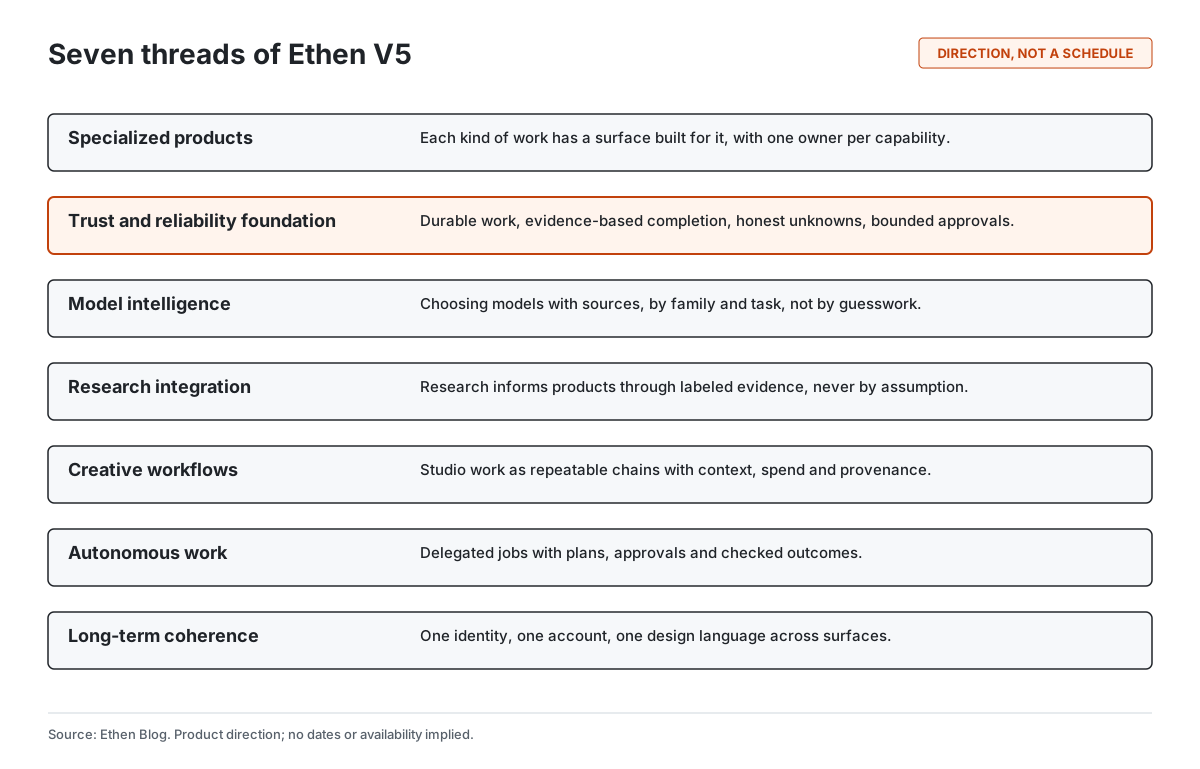
1. Specialized products. Each kind of work — conversation, code, creative work, research, design, delegated jobs, operations, local AI — gets a surface built for it, with one canonical owner per capability. Lighter surfaces hand off to deeper ones. We explain the reasoning in Why Ethen Is a Family of Specialized AI Apps, Not One App.
2. A trust and reliability foundation. Every product draws on the same foundation: work that survives interruptions, completion that depends on evidence, unknown outcomes treated honestly, and approvals bound to specific actions. This is the thread we consider most important, because the other six depend on it. Our current view of reliability is in Improving Reliability Across Ethen.
3. Model intelligence. Ethen works with many models. Choosing among them should rest on sourced facts organized by model family and task, with missing information shown as unknown rather than guessed. Faros, the research program studying how intelligence should choose intelligence, explores how those choices could improve; its position paper is explicit that strong rules come first and that learned approaches must earn their place. See also Why Ethen Invests in Model Intelligence.
4. Research integration. Research should inform products through labeled evidence. A proposal stays a proposal until it is tested; a protocol stays a protocol until it is run. We describe the separation in Why Ethen Separates Research From Product Claims.
5. Creative workflows. Creative work is a chain of steps — brief, options, choice, edits, adaptation, delivery — not a single prompt. Ethen Studio is moving toward workflows that carry context, spend and provenance from step to step; see Why Ethen Studio Is Becoming More Workflow-Oriented.
6. Autonomous work. Some work should be delegated, not asked. Delegated work needs a job with a plan, approvals at the right moments, and an outcome that is checked rather than claimed. Ethen Founder is built around that unit of work; see Why Ethen Founder Is About Outcomes, Not More Chat.
7. Long-term coherence. Specialized products must still feel like one Ethen: one account, one identity, shared permissions and memory you control, and a consistent design language. Coherence is what keeps specialization from becoming fragmentation.
How the threads depend on each other
The threads are not independent projects. Most of them only work if the others do.
Specialization depends on coherence. Separate surfaces are useful only if moving between them is easy: the same account, the same permissions, memory you control, and work that travels with you when Chat hands off to Research or Studio. Without coherence, specialization feels like a bundle of unrelated apps.
Autonomous work depends on the trust foundation. A delegated job that cannot survive an interruption, cannot tell an unknown outcome from a failure, or cannot show evidence of what it did is not something a careful person should delegate to. Delegation is the thread most exposed to weak foundations, which is why the foundation comes first.
Creative workflows depend on model intelligence. A workflow that chains image, video and audio steps has to choose models for each step. Those choices are only as good as the facts behind them, which is why model knowledge is organized by family and missing facts are shown honestly.
Research integration depends on restraint. Research can improve products only if the boundary between "proposed" and "tested" holds. If research proposals leaked into product claims, the research would lose its value as evidence and the products would lose credibility.
The road from a user's side
The following example is illustrative and describes direction, not availability.
A small-team lead uses Ethen Chat to ask how a competitor's pricing has changed. The answer is quick and sourced. A week later the question has become a project: the lead wants a running comparison they can share with colleagues. Chat hands the work to Research, where sources, notes and branches persist. When the lead needs a one-page visual for a board update, the relevant figures go to Studio as a short creative workflow, with the brief and references carried along. When the lead decides the comparison should be refreshed monthly and flagged when something important changes, it becomes a delegated job with a plan, a budget, an approval step before anything is sent outside the team, and a result that arrives with evidence of what was checked.
Each step uses a different surface. The person experiences one Ethen.
How the road is travelled
The road to V5 is travelled one evidenced step at a time, not by a calendar. Figure 2 shows the sequence we apply to each step.
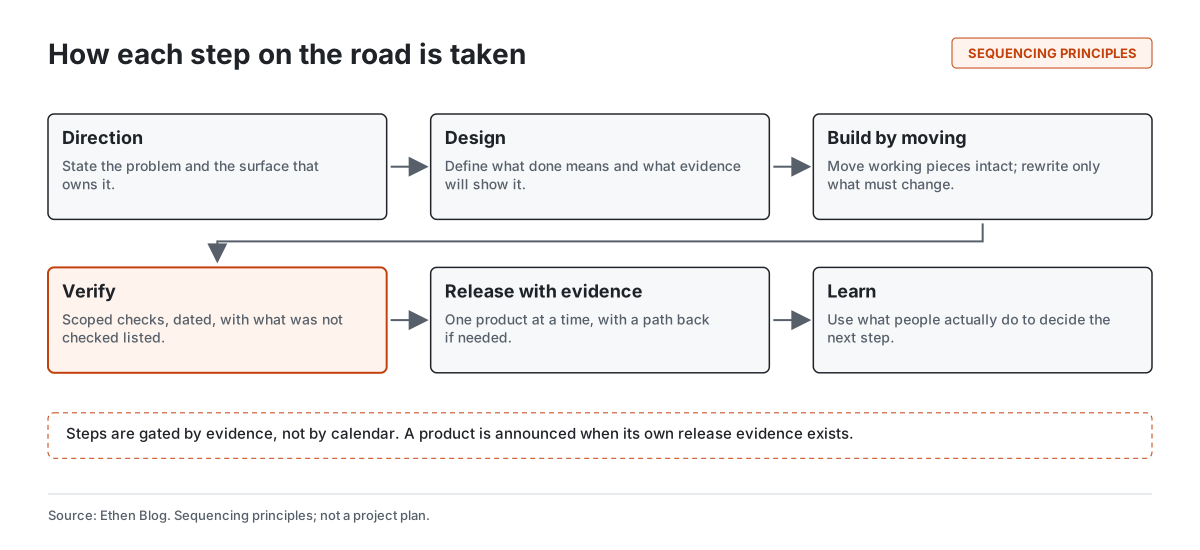
Direction. State the problem and the surface that owns it.
Design. Decide what "done" means for the step and what evidence will show it.
Build by moving, not rewriting. Where something already works, move it intact and rewrite only what must change. This keeps it possible to tell "this moved" from "this changed." The move of Ethen Designer into its own app followed this pattern; see What We've Changed Since Ethen V4.
Verify. Run scoped checks, record the date and scope, and list what was not checked. Our release certificates are built this way; see What a Release Certificate Actually Proves at Ethen.
Release with evidence. Release one product at a time, with a way back if something goes wrong. Architecture diagrams are not release evidence.
Learn. Use what people actually do with a product, within the permissions they have given, to decide the next step.
This is why we do not publish a V5 schedule. A date would have to be set before the evidence exists. When the evidence and the date disagree, we would rather move the date than weaken the evidence, and we would rather not make promises we expect to move.
What V5 is not
Naming what V5 is not is part of keeping it honest. Figure 3 lists both sides.
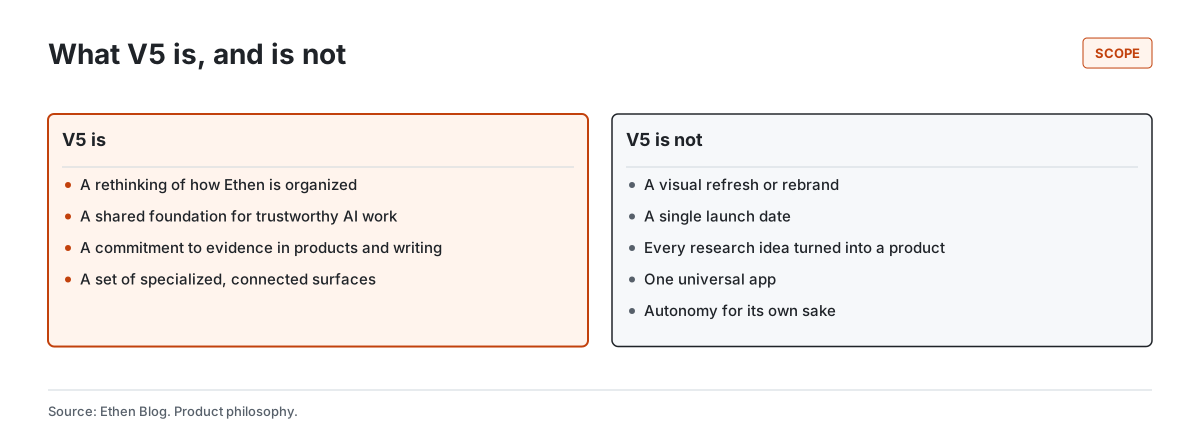
Not a visual refresh. The visual language will evolve, but a new look without new structure would change nothing that matters.
Not a single launch. Products reach people one at a time, each with its own evidence.
Not every research idea as a product. Ethen Research Lab publishes many proposals and protocols. Most will remain research; some will be published rather than built; a few may inform products after testing. See Why Not Everything Ethen Researches Needs to Become a Product.
Not one universal app. Specialized surfaces are the point; we explain the design reasoning in Why Ethen Uses Specialized Interfaces Instead of One Universal UI.
Not autonomy for its own sake. Delegation is valuable when it finishes work within limits a person sets. A system that acts more often is not better because it acts more often.
What V5 should feel like
Direction is easier to describe than experience, but experience is what people will judge. We want Ethen to feel calm rather than noisy, powerful without being cluttered, coherent across surfaces, trustworthy because it shows its work, and fast for simple things while staying capable for complex ones. We describe that in What We Want Ethen to Feel Like in 2027, and the design principles that should produce it in The Principles Behind Ethen's Product Design.
How to follow along
The V5 series has six parts:
- Where we came from: What We've Changed Since Ethen V4
- Where we are going: this article
- What is being rebuilt, and its status: Ethen V5: What We're Rebuilding and Why
- How it should feel: What We Want Ethen to Feel Like in 2027
- How it is designed: The Principles Behind Ethen's Product Design
- Why the surfaces differ: Why Ethen Uses Specialized Interfaces Instead of One Universal UI
Beyond the series, product changes appear on the Ethen Blog with their evidence, and research appears in Ethen Research Lab with its evidence status.
Tradeoffs and limitations
No dates is frustrating. People planning around Ethen would like a schedule. We think a schedule we cannot keep is worse than none, but we recognize the cost.
Seven threads is a lot. Moving many threads together risks moving all of them slowly. The trust and reliability thread comes first because the others depend on it.
Direction can change. This article describes our current direction. If evidence shows a thread is wrong, we will change it and say so.
This is philosophy, not proof. Nothing here establishes that any product is available or that any approach works. Those claims belong to release evidence and research results.
FAQ
What is Ethen V5? The next generation of Ethen: specialized products on a shared foundation for trustworthy AI work, with model intelligence, research integration, creative workflows, delegated jobs and consistent design across surfaces.
Is Ethen V5 just a redesign? No. It changes how Ethen is organized, where work lives and what Ethen promises about it. Visual design is one part of the coherence thread.
When will Ethen V5 launch? V5 is not a single launch. Products are released individually when their own release evidence exists, and we do not publish milestone dates.
Where is Ethen going? Toward AI that helps people finish real work and shows what it did, across consumer, creator, developer and organizational use.
Will Ethen Research Lab papers become V5 features? Not automatically. Research informs products only after testing, and many publications will remain research.
Related reading
- What We've Changed Since Ethen V4
- Ethen V5: What We're Rebuilding and Why
- Why Ethen Is a Family of Specialized AI Apps, Not One App
- Verified Adaptive Intelligence — Ethen Research Lab position paper (research synthesis; hypotheses untested)
- Faros: Researching How Intelligence Should Choose Intelligence — Ethen Research Lab position paper (proposal; no routing results)
References
- Kwa, T., West, B., Becker, J., Deng, A., Garcia, K., et al. (2025). Measuring AI Ability to Complete Long Tasks. arXiv:2503.14499. https://arxiv.org/abs/2503.14499
- Nielsen, J. (2023). AI: First New UI Paradigm in 60 Years. Nielsen Norman Group. https://www.nngroup.com/articles/ai-paradigm/